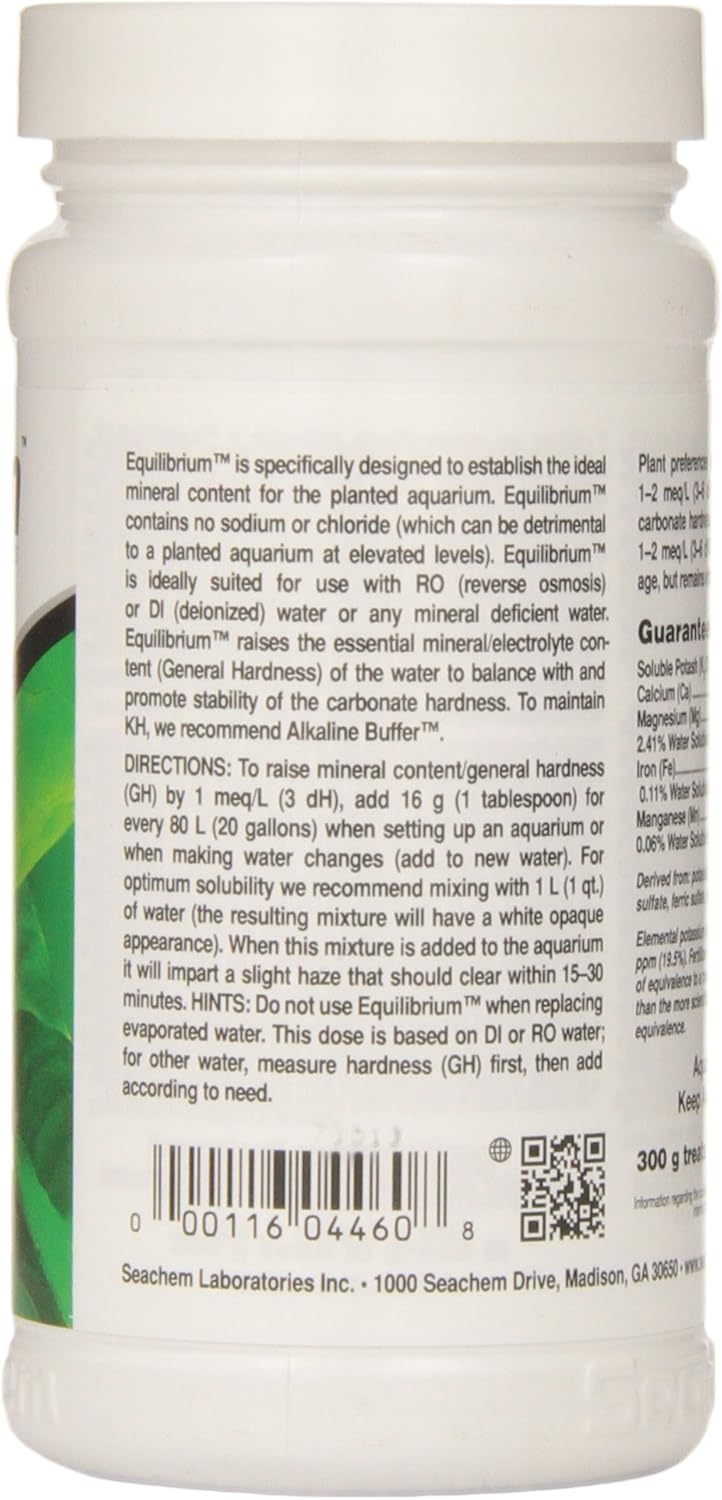
If you’ve ever run your tap water through a reverse osmosis (RO) filter — a system that strips out virtually everything, including contaminants — you end up with water that is almost chemically pure. That sounds ideal, but for a planted aquarium or a shrimp tank, it creates an immediate problem: the minerals your plants and animals actually need are gone too. Plants rely on dissolved calcium and magnesium (together measured as GH, or “general hardness”) to build cell walls and drive metabolic processes. Shrimp need those same minerals to grow and harden a new exoskeleton every time they molt. Without them, plants stall and shrimp can die mid-molt. Remineralizing — deliberately adding those minerals back to blank RO water — is the fix, and Seachem Equilibrium is one of the most widely used products for exactly this job. This guide explains what Equilibrium does, what it doesn’t do, how to dose it, and when it makes sense over cheaper DIY options.
GH and KH Are Not the Same Thing — and Equilibrium Only Touches One
This is the single most common point of confusion around Seachem Equilibrium, and it’s worth being blunt: Equilibrium raises GH only. It does not raise KH. It does not affect pH.
Here’s the distinction in plain terms:
- GH (general hardness) measures dissolved calcium and magnesium ions. These are the minerals plants uptake as nutrients and shrimp use to calcify their shells.
- KH (carbonate hardness, also called alkalinity) measures the buffering capacity of your water — its ability to resist pH swings. In a planted tank with CO2 injection, KH is what keeps the pH from crashing overnight.
Equilibrium’s formula is built around calcium sulfate, magnesium sulfate, and potassium chloride. None of those compounds contribute meaningfully to carbonate hardness. If you add Equilibrium to RO water and then test KH, you will read near zero — exactly where you started.
That matters because a complete RO remineralization strategy for planted tanks usually involves two separate products working in parallel: something to raise GH (Equilibrium) and something to raise KH (typically sodium bicarbonate — plain baking soda — or a dedicated KH buffer like Seachem Alkaline Buffer). Treating them as interchangeable is a setup for pH instability, especially in injected CO2 tanks where the carbonate system is under active pressure.
Per the Seachem Laboratories Equilibrium technical data sheet, the recommended dose is 1 teaspoon (roughly 6 grams) per 40 US gallons to raise GH by approximately 1 degree (1 dGH or ~17.8 mg/L as CaCO₃). That gives you a predictable, calculable starting point.
Target Numbers: What GH to Actually Aim For
The “right” GH depends almost entirely on what you’re keeping.
By the Numbers
| Inhabitant | Target GH (dGH) | Target KH (dKH) |
|---|---|---|
| Neocaridina shrimp (Cherry, Bloody Mary) | 6–8 | 2–5 |
| Caridina shrimp (Crystal Red, Taiwan Bee) | 4–6 | 0–2 |
| General planted community tank | 4–8 | 3–6 |
| Discus / soft-water biotope | 1–4 | 1–2 |
Neocaridina species — the hardy, colorful shrimp most beginners start with — come from moderately hard water in Taiwan and southern China. They’re tolerant of a wider GH range, but owners on Aquatic Plant Central’s shrimp water chemistry threads consistently report better molting success and more vivid color when GH is held at a stable 6–8 dGH rather than allowed to drift. The keyword is stable: a slow drift from 6 to 8 over a week is far less stressful than bouncing between 4 and 9.
Caridina species — Crystal Reds, Taiwan Bees, Shadow Pandas — are the precision instruments of the shrimp world. They’re bred for very soft, slightly acidic water. Per Practical Fishkeeping’s shrimp water chemistry feature, Caridina keepers using Equilibrium typically target 4–6 dGH and rely on active substrate (like ADA Amazonia) to manage KH and pH independently. Overdosing Equilibrium in a Caridina tank is a real risk — start low, test before you add more.
For planted tanks without shrimp, TFH Magazine’s planted tank water chemistry guide notes that most stem plants, carpeting plants, and mosses thrive anywhere in the 4–8 dGH window as long as macronutrients (nitrogen, phosphorus, potassium) are supplemented separately. Equilibrium happens to contain potassium as a bonus, which is a mild but real benefit for planted systems.
How to Actually Dose Equilibrium Without Clouding Your Tank
Here’s the practical workflow that aggregated owner reports consistently recommend:
Don’t dump it directly into your display tank. The product can be slow to dissolve — reviewers of the larger 600g container note this specifically — and adding powder directly to an established tank creates a temporary cloudiness as undissolved particles swirl through the water column. This isn’t chemically harmful, but it’s alarming if you’re not expecting it, and it can briefly stress shrimp.
The pre-dissolve method:
- Fill a clean cup or small pitcher with RO water from your mixing container.
- Measure your Equilibrium dose based on the volume you’re remineralizing (not your full tank volume — just the new water you’re about to add).
- Add the powder to the cup, stir vigorously, let it sit for 2–3 minutes, stir again. Some fine particles may remain suspended — that’s fine.
- Pour the solution into your mixing container (typically a 5-gallon bucket or dedicated mixing reservoir), add any KH buffer, then aerate and let it equilibrate for 30–60 minutes before use.
This approach gives you consistent dosing, no cloud event in the display tank, and a chance to test GH before the water goes in.
For water change workflow specifically: calculate the GH of your replacement water to match the tank’s current GH. You’re not trying to raise the tank’s GH with every water change — you’re maintaining it. If your tank is sitting at 6 dGH and you add replacement water at 2 dGH, you’ll drag the parameter down over successive changes. Build the habit of mixing replacement water to target before it touches the tank.
Plant Response: What to Expect and When
Owners consistently report visible improvement in plant condition within 1–2 days of correcting a GH deficiency — and this speed is one of the most-cited reasons hobbyists keep paying for Equilibrium rather than switching to DIY mineral mixes. Plants described as “melting,” showing pinholes in leaves, or simply sitting static without new growth will often show new lateral shoots or leaf unfurling within 48 hours of a corrective dose.
This fast feedback loop is also useful diagnostically. If your plants don’t respond within 3–4 days of a GH correction, the limiting factor is probably something else — likely a nitrogen or iron deficiency, lighting shortfall, or insufficient CO2. Equilibrium solves a specific problem; if the response isn’t there, keep looking.
The potassium component in Equilibrium is genuinely useful for high-tech planted setups running pressurized CO2 and strong lighting, where potassium is often the first macronutrient to deplete. It’s not a complete fertilizer — you still need a dedicated macro/micro dosing regimen — but it’s a meaningful bonus.
Is There a Cheaper Way? The DIY Mineral Option
Yes — and it’s worth being honest about the tradeoff.
The most common DIY approach is to combine:
- Calcium chloride (raises GH, calcium-dominant)
- Magnesium sulfate (Epsom salt) (raises GH, magnesium-dominant)
- Optionally potassium sulfate for planted setups
This combination can achieve a similar mineral profile to Equilibrium at a fraction of the per-dose cost. Aquatic Plant Central’s reference threads include several community-built calculators for dialing in the calcium-to-magnesium ratio using these raw inputs.
So why do experienced hobbyists keep coming back to Equilibrium? Across aggregated reviews and forum discussions, the answers cluster around three things: convenience, reliability, and the known ratio. You know exactly what you’re getting with each dose. There’s no risk of accidentally over-skewing calcium vs. magnesium (a real concern with DIY mixes, which can affect plant uptake differently). And for shrimp keepers especially — where molting failures are catastrophic and hard to reverse — the peace of mind of using a consistent, formulated product is worth the premium.
For someone managing a single 20-gallon shrimp tank, the DIY savings are modest. For someone running a rack of breeding tanks or a large display, the economics tip more meaningfully toward DIY. This is a genuine “size of your operation” decision, not a quality judgment.
Frequently Asked Questions
Does Seachem Equilibrium raise KH or pH, or only GH? Only GH. Equilibrium’s mineral formula (calcium sulfate, magnesium sulfate, potassium chloride) does not contribute to carbonate hardness or buffering capacity. Your KH and pH will be unchanged after dosing. To raise KH in RO water, you need a separate carbonate-based buffer such as sodium bicarbonate or a dedicated alkalinity supplement.
How quickly will I see a difference in my plants after dosing Equilibrium? Most owners report visible improvement within 1–2 days — new growth tips, unfurling leaves, or recovery from a melt. If you’re correcting a genuine GH deficiency, the response is often fast enough to be visible by the next morning. If you see no change within 3–4 days, GH is probably not the limiting factor.
Why does my tank get cloudy after I add Equilibrium, and is it harmful? The powder is slow to fully dissolve, and adding it directly to the tank creates a temporary suspension of fine particles. It’s not chemically harmful and will typically clear within a few hours as your filter turns the water over. To avoid it entirely, pre-dissolve the measured dose in a small cup of water before adding it to your mixing bucket or tank.
What GH level should I be targeting for Neocaridina shrimp vs. Caridina shrimp? Neocaridina (Cherry shrimp, Bloody Mary, Snowball) thrive at 6–8 dGH. Caridina (Crystal Red, Taiwan Bee, Shadow Panda) prefer softer water at 4–6 dGH. Both groups prioritize stability over hitting a precise number — consistent parameters matter more than perfection.
Can I use Equilibrium in a tank that already has hard tap water? This is an unusual use case and generally unnecessary. Equilibrium is designed to add minerals to mineral-depleted water (RO or very soft well water). If your tap water already reads 8–12 dGH, adding Equilibrium will push you above range for almost any freshwater application. Test your source water first; if it’s already hard, your remineralization tool is dilution or RO blending, not additional mineral dosing.
Is there a meaningfully cheaper way to raise GH that works just as well? Yes — a DIY blend of calcium chloride and magnesium sulfate (Epsom salt) can achieve a comparable GH increase at lower cost per dose. The tradeoff is precision and convenience: you need to calculate and weigh your own ratios, and getting the calcium-to-magnesium balance wrong over time can affect plant and shrimp health. For a single tank, the cost difference is small. For multi-tank operations, the savings become more compelling. Seachem Equilibrium’s premium is essentially a premium on simplicity and a known, tested mineral ratio.