If you’ve ever bought a reef light based on wattage alone and then watched your SPS (small polyp stony) corals bleach in the center of the tank while the edges stayed dim, you already know the problem this article solves. Lighting a reef tank isn’t just about raw brightness — it’s about coverage, meaning how evenly that brightness lands across every square inch of your specific tank shape. The key measurement reefkeepers use is PAR, which stands for Photosynthetically Active Radiation. Think of PAR as the fuel gauge for your corals’ zooxanthellae (the tiny algae living inside coral tissue that convert light into food). Most SPS corals want PAR values between 200 and 400 micromoles per square meter per second (µmol/m²/s) at the rock surface. LPS (large polyp stony) and soft corals are happy with less — often 50 to 200. The problem: a single fixture’s PAR output isn’t uniform. It peaks directly below the light and falls off toward the edges. That drop-off pattern is everything when you’re deciding how many fixtures to buy and where to hang them.
This guide maps the most common reef tank footprints — from compact 24-inch nanos to sprawling 60-inch peninsula builds — against the fixtures the community actually uses, with honest coverage math and clear decision rules at the end.
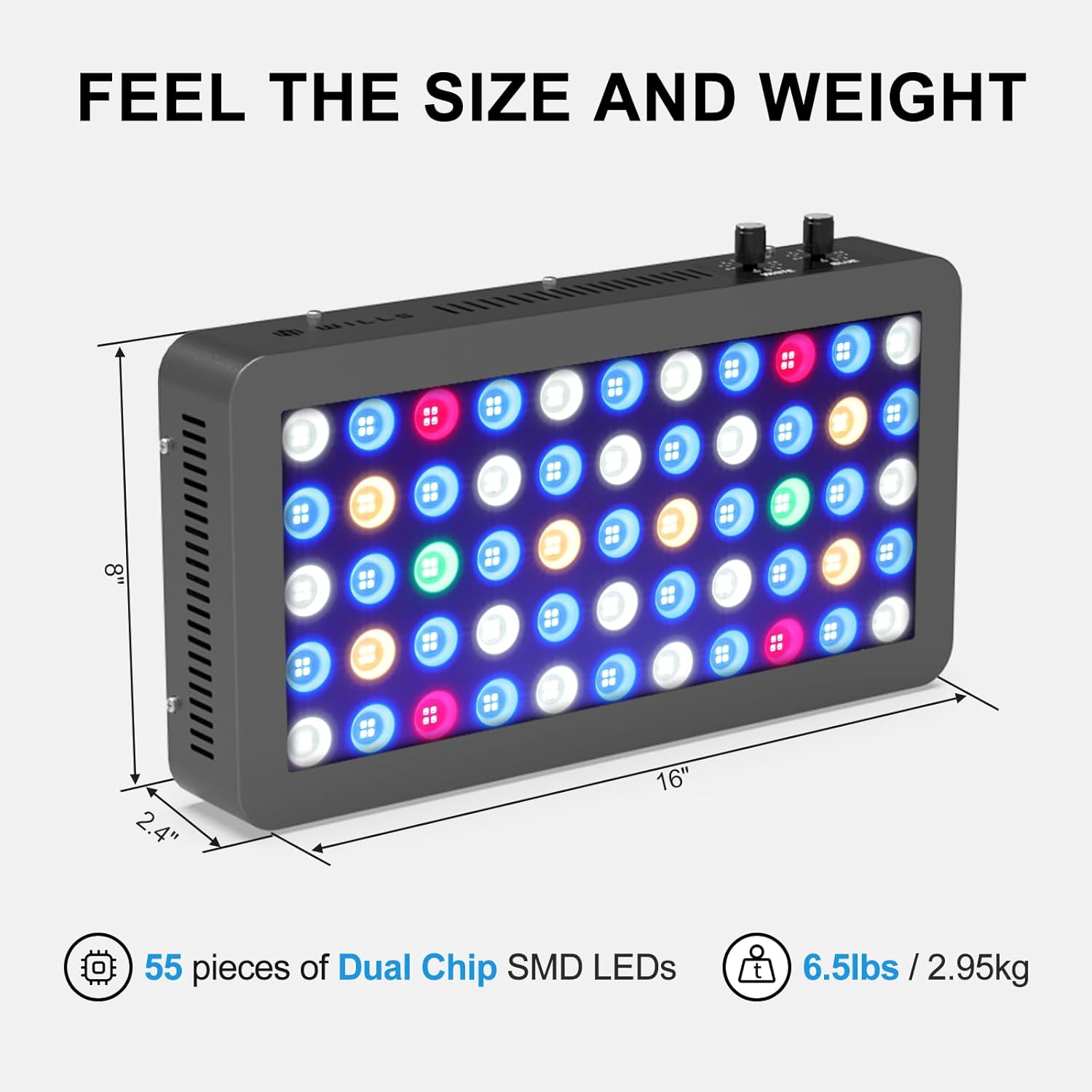
| EDITOR'S PICKAquaIllumination Hydra 32 LED A… | Mid-tierWills Aquarium Light | Budget pickFluval SEA Marine Nano LED Aqua… | |
|---|---|---|---|
| Wattage | — | 100W | 20W |
| Control | Wireless | Dual dimmable | Bluetooth |
| LEDs | — | 55 SMD | — |
| Mounting | — | Hanging kit | — |
| Daisy chain | — | ✓ | — |
| Spectrum | Full spectrum | Full spectrum | — |
| Price | $479.99 | $89.99 | $85.15 |
| See on Amazon → | See on Amazon → | See on Amazon → |
Why Footprint Beats Wattage Every Time
Wattage tells you how much electricity a fixture consumes. It says almost nothing about where the light lands. A 200-watt fixture with a tight, focused optic cluster might deliver excellent PAR directly beneath it but leave the front and rear thirds of a 48-inch tank starved. A lower-wattage fixture with a wide-angle lens array and good PAR uniformity might actually outperform it for mixed-reef coverage.
The term to know is PAR map — a grid of measurements taken at multiple points across a tank at a set depth, typically with an Apogee or Seneye quantum meter. Reef Builders’ fixture reviews have consistently published these maps since at least 2022, and they reveal something wattage spec sheets hide: most single-unit fixtures show a 30–60% PAR drop from center to corner on tanks wider than 24 inches.
Why this matters for your purchasing decision: if you’re planning a 48×24-inch mixed reef and you’re pricing a single high-output fixture, you may be underbuying. Two overlapping fixtures at a lower price point can produce more even coral growth than one flagship unit — and even growth is what separates a showpiece tank from a patchy one.
There are three variables that control coverage:
- Beam angle — the spread of light from the fixture’s optics, usually 60° to 120°. Wider angles spread PAR further but reduce peak intensity.
- Mounting height — the distance from the water surface to the fixture. Every additional inch of height increases spread but decreases peak PAR at depth.
- Fixture count and spacing — the number of units and how their coverage zones overlap.
Advanced Aquarist’s overview of LED reef lighting notes that the relationship between mounting height and spread follows a roughly predictable cone: a fixture with 90° beam optics mounted 12 inches above water will illuminate roughly a 24-inch-diameter circle at the surface, meaning a 24×24 footprint is nearly saturated, but a 36×24 footprint still has meaningful shadows in the corners.
Footprint-by-Footprint Breakdown
Nano and Cube Tanks (up to 24 inches / ~60 cm)
Common formats: Waterbox Cube 20, Nuvo Fusion 20, ADA 60-F, Red Sea Max Nano.
At this footprint, one mid-range fixture is almost always sufficient, and the main decision is whether you want a dedicated nano unit or a scaled-down flagship. The AquaIllumination (AI) Hydra 26 HD is the fixture that most frequently appears in Reef2Reef’s aggregated nano threads as the go-to recommendation here — owners report full PAR coverage across a 24×18 footprint when mounted 6–8 inches above water, with center PAR hitting 300+ µmol/m²/s at 12 inches depth on a 70% intensity setting.
The Kessil A360X is the other dominant option. Its narrow, focused beam works beautifully in the 20-gallon cube format — but owners consistently flag that it needs a gooseneck arm positioned slightly off-center on tanks over 18 inches wide, or the rear corners will underperform.
Decision rule for nanos: if the tank is 24 inches or under in its longest dimension, one AI Hydra 26 HD or Kessil A360X covers it cleanly. Don’t oversize into a Radion XR30 — you’ll run it at 20–30% power anyway, and you lose the fine-tuned programming advantages of the fixture.
Standard Display Tanks (36–48 inches / ~90–120 cm)
Common formats: Red Sea Reefer 250 (36×22), Waterbox 220.6 (48×24), ADA 90-P, standard 75-gallon (48×18).
This is the most competitive footprint category — and the one where fixture selection mistakes are most expensive. At 48 inches wide, a single fixture will almost always leave the front-to-back midline zones undersupplied unless it’s a dual-cluster unit or you mount it unusually high.
The EcoTech Marine Radion XR30 Blue is the flagship choice here. Coral Magazine’s 2024 buyer’s guide notes that its published PAR maps, when mounted at 10 inches above water, show ~90% of a 36×24 footprint landing between 150–400 µmol/m²/s — a range that supports everything from soft corals to demanding Acropora. For a 48×24 footprint, most experienced reefers run two XR30s spaced roughly 12 inches from each end, with a 50% intensity overlap in the center.
The AI Hydra 64 HD is a compelling alternative at a lower price point. Spec sheets put its 90° coverage at approximately 24×24 inches at a 10-inch mount height. For a 48-inch tank, two units spaced evenly will outperform a single XR30 on edge-to-edge uniformity, though owners note the XR30’s shimmer effect and spectral tuning are noticeably superior for SPS color development.
The Maxspect Recurve 100W deserves a mention in this tier: it’s a dual-head pendant that spans a 36-inch bar, and owners running 36-inch reef tanks report excellent edge coverage without the two-fixture mounting complexity. Reef Builders’ review noted its PAR uniformity across a 36×24 footprint was among the better single-unit results they’d mapped.
Decision rule for 36–48 inch tanks: for a 36-inch footprint, one XR30 or one Maxspect Recurve handles it. For a 48-inch footprint, two AI Hydra 64 HDs is the value path; two Radion XR30s is the performance path. Don’t be tempted by a single oversized unit — uniformity beats peak output every time.
Large and Peninsula Displays (60+ inches / 150+ cm)
Common formats: Red Sea Reefer XL 425 (60×24), custom SPS builds on 72×30 footprints, Waterbox 7225 peninsula, UNS 150L.
At 60 inches and above, you’re in multi-fixture territory without exception. The math is simple: even the widest-coverage LED arrays max out meaningful PAR coverage at roughly 30 inches per unit. A 60-inch tank needs a minimum of two units; a 72-inch tank realistically needs three.
The Mitras LX 7206 HV (by GHL) is the fixture that shows up in premium large-format builds, particularly where automated control via the GHL Profilux system is already in use. Advanced Aquarist’s coverage notes that the 7206 HV’s dual-rail construction allows precise positioning across wide footprints, and its spectral output — particularly its deep violet and UV channels — is cited by SPS hobbyists as a meaningful differentiator for Acropora coloration versus the Radion lineup.
The Radion XR15 is worth flagging here as a supplemental fixture: many builders running three XR30s on a 72-inch tank will add a fourth XR15 at the back rail to fill in the rear 8 inches, particularly in peninsula tanks viewed from three sides.
By the Numbers: Single-Fixture PAR Coverage at 10-Inch Mount Height
| Fixture | Approx. Coverage Zone (W×D) | Peak PAR (center, 12” depth) | Footprint Sweet Spot |
|---|---|---|---|
| AI Hydra 26 HD | ~22×18 in | ~280–320 µmol/m²/s | Nano up to 24-inch tanks |
| Kessil A360X | ~20×16 in | ~300–350 µmol/m²/s | Cubes and shallow nanos |
| AI Hydra 64 HD | ~24×24 in | ~350–420 µmol/m²/s | 36-inch tanks or paired on 48 |
| EcoTech Radion XR30 | ~30×26 in | ~400–500 µmol/m²/s | 36-inch solo or paired on 48–60 |
| Mitras LX 7206 HV | ~36×28 in (dual-rail) | ~420–550 µmol/m²/s | 48–72 inch premium builds |
Coverage zones and PAR values derived from manufacturer spec sheets and published reviews by Reef Builders and Coral Magazine. Real-world results vary with water clarity, mounting height, and intensity settings.
The Mounting Height Variable You Might Be Ignoring
Most hobbyists lock in fixture count and placement and then forget that mount height is a genuine tuning dial — not just an aesthetic choice. The practical rule, supported by published PAR maps from Reef Builders’ fixture test archive, is this: every additional inch of mount height above 8 inches costs you approximately 10–15% of peak center PAR but gains you roughly 2 inches of additional spread radius per side.
That tradeoff is valuable in a few scenarios:
- You have a wide tank (30+ inches front-to-back) and need to push light to the rear glass.
- You’re running a mixed reef where the front 8 inches are designated for low-PAR LPS and the back for high-PAR Acropora — in that case, dropping mount height concentrates PAR toward center-rear, naturally gradient-lighting the tank.
- You’ve overspecced on fixtures and need to dial down peak PAR without reducing the color channels (useful when running the Radion’s UV output at full for pigmentation while controlling light stress).
The inverse also applies: if you’re getting corner bleaching on a tank where the fixture seems centered, try dropping mount height by 2–3 inches and see if the spread tightens beneficially.
Decision Rules: If X, Then Y
These are the clean takeaways for a reader with a purchasing decision pending:
If your tank is 24 inches or under: One AI Hydra 26 HD or Kessil A360X. Don’t oversize. Use the savings on a quality PAR meter (Apogee MQ-510 or Seneye Reef are the two most widely cited tools in Reef2Reef’s measurement threads) so you can map your actual coverage after setup.
If your tank is 36 inches: One Radion XR30 Blue or one Maxspect Recurve 100W. Either covers the footprint cleanly. The Radion wins on spectral control and EcoTech’s Mobius app integration. The Recurve wins on price.
If your tank is 48 inches: Two AI Hydra 64 HDs is the value answer. Two Radion XR30s is the performance answer. Do not attempt a single-fixture solution at this footprint if you’re keeping SPS.
If your tank is 60 inches or larger: Budget for three XR30s or two Mitras LX 7206 HVs minimum. At this tier, control ecosystem matters — consider whether GHL, Neptune Apex, or EcoTech’s own Mobius system aligns with the rest of your automation stack before choosing your fixture brand.
If you’re unsure: buy a PAR meter before you buy more fixtures. Reef2Reef’s long-running PAR measurement threads show repeatedly that most bleaching and poor-growth problems are lighting placement and intensity issues, not fixture quality failures. Map first, upgrade second.
The fixture is only as good as its fit to the footprint. Get that match right, and the corals will tell you.