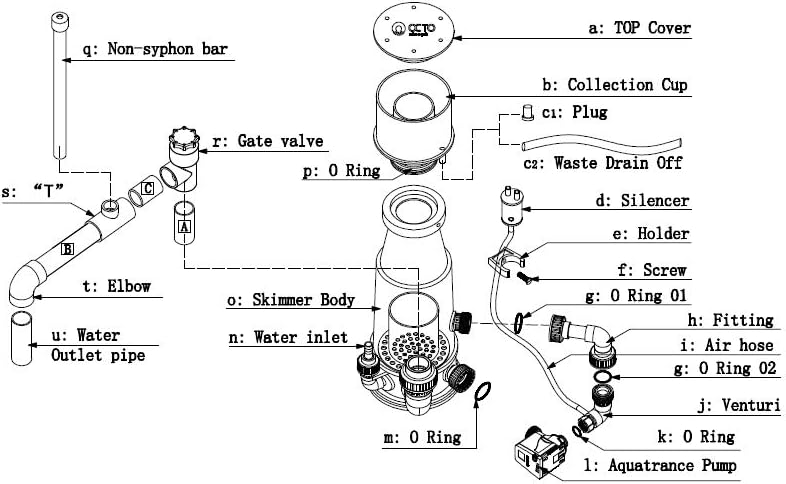
If you just brought home your first saltwater aquarium, here’s the quick version: a protein skimmer is a device that pulls dissolved organic waste — fish waste, uneaten food, decomposing matter — out of your water before it has a chance to break down into ammonia and nitrate. Think of it as a pre-filter that intercepts pollution at the source. In a freshwater tank you can often manage without one, but in a reef tank housing corals and delicate marine fish, water quality tolerances are much tighter, and a skimmer is genuinely your first line of chemical defense. The problem most hobbyists run into is simple: they buy a skimmer rated for their tank’s water volume, but they forget to account for how heavily that tank is actually stocked — the bioload, meaning the total biological demand placed on the system by everything living in it. This guide breaks down how to size correctly, name the math, and help you decide whether your current setup is actually protected.
Why the “Rated For X Gallons” Label Lies to You
Every protein skimmer box has a gallon rating. A skimmer listed as “rated for up to 150 gallons” sounds reassuring — until you realize that rating almost always assumes a lightly stocked fish-only system with moderate feeding. Manufacturers have every incentive to print the highest plausible number.
The actual variable that determines skimmer demand isn’t water volume. It’s bioload — the combined organic input from fish waste, coral mucus, uneaten food, and bacterial activity. A 100-gallon display tank with two clownfish and a handful of soft corals has a radically different bioload than a 100-gallon system running six tangs, a large angel, and weekly heavy feeding. Same tank footprint. Completely different skimmer requirements.
Advanced Aquarist’s foundational overview of protein skimmer theory, authored by Sanjay Joshi, makes this distinction explicit: skimmer performance scales with the concentration of dissolved organics in the water column, not simply with total system volume. The takeaway is that sizing from the box label alone is a structural error, not just a conservative choice.
The rule of thumb that actually works: size your skimmer for 1.5× to 2× your effective system volume when you account for bioload multipliers. We’ll build the math below.
Calculating Your Real Bioload Number
Bioload isn’t a single number you read off a chart — it’s a composite of several factors. Here’s the framework most experienced reefers use, drawn from operator reports across the Reef2Reef community and methodology described in Coral Magazine’s skimmer shootout features.
Step 1: Start with net water volume. Your display tank may be listed at 120 gallons, but subtract rock displacement (roughly 10–15% in a well-aquascaped reef), sand bed volume, and sump equipment. A “120-gallon” system realistically holds 90–100 gallons of actual water.
Step 2: Apply a stocking multiplier.
| Stocking scenario | Multiplier |
|---|---|
| Lightly stocked (1–2 small fish, primarily coral) | 1.0× |
| Moderately stocked (3–5 fish, mixed reef) | 1.5× |
| Heavily stocked (6+ fish, active feeding, SPS dominant) | 2.0× |
| Very heavily stocked (tangs, angels, large predators) | 2.5×+ |
A moderately stocked 100-gallon system (net water volume) has an effective bioload equivalent of 150 gallons. Size your skimmer for at least that.
Step 3: Add a future margin. Most reefers underestimate how much they’ll add over 12–18 months. If you’re at 1.5× now, buy for 2.0×. Skimming capacity costs almost nothing to over-spec relative to the livestock and coral value at stake.
The Undersizing Trap: What Actually Goes Wrong
This isn’t abstract. When a skimmer is undersized, it can’t pull dissolved organics out fast enough, and the overflow goes somewhere: it feeds bacteria, spikes nitrate and phosphate, and — in a reef context — suppresses coral growth and colors, bleaches sensitive SPS frags, and opens the door to nuisance algae like dinoflagellates and cyano.
Practical Fishkeeping’s guide to protein skimmer maintenance notes that hobbyists most often discover undersizing not when they buy the skimmer, but six months later when they can’t explain why nutrient levels keep climbing despite regular water changes. By that point, they’ve often spent more on remediation (phosphate reactors, additional water changes, replacement frags) than a correctly sized skimmer would have cost at the outset.
The other failure mode: buying a correctly sized skimmer and then running it poorly. A skimmer neck caked in dried skim, a collection cup that hasn’t been cleaned in three weeks, or a water level in the sump that’s 2 inches higher than spec — any of these can cut effective performance by 30–50%. ReefBuilders’ skimmer review series consistently flags poor water-level management as the leading cause of underperformance complaints across nearly every brand they’ve evaluated.
Skimmer Size vs. Tank Type: A Quick Decision Frame
Not all reefs are the same, and the right sizing approach shifts depending on what you’re running.
Nano and mixed-reef systems (under 75 gallons): These tanks swing chemically fast. A skimmer rated conservatively for your size class will be overwhelmed the moment you add a fish or two above plan. For nano builds, the Reef2Reef community broadly recommends sizing as if the tank were 1.5× larger from day one — the cost delta is small and the protection is significant.
SPS-dominant systems: High-light, low-nutrient SPS systems are paradoxically easier to over-skimm than under-skimm. Many SPS keepers run skimmers rated for 2–3× system volume deliberately to drive nitrate toward the low single digits (1–3 ppm), then supplement with amino acids to compensate. If you’re running Acropora, err heavily toward oversizing.
Mixed reef with high fish load (FOWLR-adjacent): This is where undersizing causes the most visible damage. Fish waste is the dominant organic source here. Size at 2.0–2.5× minimum, and consider pairing the skimmer with a refugium or algae scrubber as a backup nutrient export pathway.
Commercial and display installations: Hospitality and medical-office reef systems typically run higher fish density for visual impact, with maintenance windows sometimes stretching to biweekly or monthly. ReefBuilders and operator reports in Coral Magazine both suggest commercial reef builds size skimmers at a minimum 3× effective system volume and specify redundant units wherever the display justifies the cost. Downtime risk — and the reputational consequence of a crash in a hotel lobby — changes the calculus entirely.
By the Numbers: Quick Sizing Reference
100-gal system, light stock (1.0×) → size for 100 gal 100-gal system, moderate stock (1.5×) → size for 150 gal 100-gal system, heavy stock (2.0×) → size for 200 gal 100-gal system, SPS + high fish (2.5×) → size for 250 gal
These aren’t maximums — they’re starting floors. The cost of oversizing a skimmer by one tier is typically $50–$150 at retail. The cost of undersizing, measured in crashed coral and emergency interventions, routinely exceeds that within the first year.
Matching Skimmer Class to Budget Tier
Once you have your target effective volume, the market segments fairly cleanly.
Entry to mid-range (effective volume under 150 gallons, $80–$250): This tier covers the Reef Octopus Classic series and Bubble Magus Curve line. Owners across aggregated reviews consistently report reliable performance when correctly sized, with the Bubble Magus Curve A8 drawing particular praise for quiet operation in systems up to a true 150-gallon equivalent bioload. The tradeoff is build quality and adjustability — neck-height adjustment and neck cleaning are more finicky than upper-tier units.
Mid to performance range (150–300 gallon equivalent, $250–$600): The Reef Octopus Regal series and Nyos Quantum line live here. Reef2Reef operator threads consistently place the Reef Octopus Regal 200 as a benchmark unit in this class — stable skim, low micro-bubble output, and enough body volume to handle genuine fluctuations in bioload without flooding the collection cup.
Performance to professional range (300–600+ gallon equivalent, $600–$1,500+): This is Deltec AP-series, Skimz Monzter, and Royal Exclusive territory. Coral Magazine’s skimmer shootout features note that at this price tier, the differentiation is less about raw skimming capacity and more about consistency under load variance, ease of dialing in, and build longevity. For the Triton-method and ICP-monitored builds where stability is everything, the premium is defensible. For a 180-gallon mixed reef with moderate stock, it probably isn’t.
The If-Then Decision Rules
If you’re standing at the decision point right now, here’s the distilled framework:
If your stocking is light and stable (two to three small fish, primarily corals, no plans to expand): size to 1.5× net system volume and revisit if stock changes.
If you’re running a mixed reef with five or more fish: size to 2.0× minimum. Don’t talk yourself into the smaller unit because it fits the sump more neatly.
If you’re running an SPS-dominant system: size to 2.0–2.5× and accept that you may need to dial back skimmer aggressiveness to maintain the low-but-nonzero nutrient range SPS actually needs.
If you’re speccing a commercial or feature display: start at 3.0× effective volume, plan for a redundant unit or backup nutrient export, and write the skimmer maintenance interval into the service contract explicitly — weekly at minimum.
If you already own a skimmer and suspect it’s undersized: run ICP or standard nutrient testing to baseline your nitrate and phosphate. If nitrate is climbing above 10 ppm on a reef despite regular water changes and a clean skimmer, undersizing is the first hypothesis to test. The replacement skimmer will cost less than the coral losses if you wait.
Skimmer sizing is one of those decisions that feels low-stakes when you’re setting up and becomes very high-stakes six months later. The math isn’t complicated — the hard part is ignoring the box rating and doing the bioload calculation honestly. Do that once, size up by one tier when in doubt, and your skimmer will genuinely be the first line of defense it’s supposed to be.