A nano reef is simply a small saltwater aquarium — typically 10 to 30 gallons — that houses living coral alongside fish and invertebrates. That might not sound like much water, but inside those gallons lives a slice of a tropical coral reef: colorful stony or soft corals anchored to rock, small fish weaving between them, and an invisible chemistry engine keeping everything alive. The appeal is real: nano reefs fit on a desk, a credenza, or a spare bedroom shelf, and they cost a fraction of a full-size system to set up. The challenge is equally real. Small water volume means chemistry swings faster, mistakes compound quicker, and gear choices matter more per gallon than they ever would in a 125-gallon display. This guide exists to help you spend your first $500–$1,200 wisely — identifying the five categories of gear you genuinely need, showing you where budget cuts hurt and where they don’t, and giving you clear decision rules before you click Buy.
The Five Gear Categories That Actually Matter
Nano reef builds fail or succeed in five areas: the tank and its filtration chamber, lighting, flow, chemistry management, and salt/water preparation. Everything else — fancy dosing pumps, calcium reactors, aquascaping tools — comes later. Let’s work through each honestly.
1. The Tank (All-in-One vs. Open Sump Build)
For a first build under 30 gallons, an all-in-one (AIO) tank is almost always the right call. An AIO is a tank with a rear or side filter compartment already built in — no separate sump (an external filtration chamber plumbed beneath the tank), no drilling, no overflow boxes. You fill the back compartment with filter media, a small return pump, and optionally a protein skimmer (a device that pulls dissolved organics out of the water using a column of fine bubbles before they break down).
The main alternatives — the Fluval Evo 13.5, Innovative Marine Nuvo 20, and Red Sea MAX Nano 20 — collectively dominate the beginner-to-intermediate conversation on Reef2Reef build threads. ReefBuilders’ AIO buyer’s guide consistently flags the Red Sea MAX Nano as the premium end of this segment, noting its included skimmer, higher-wattage LED fixture, and tighter chamber tolerances. The Innovative Marine Nuvo 20 lands in the middle: a cleaner rimless aesthetic, a deep rear chamber, and wide aftermarket support. The Fluval Evo 13.5 sits at the accessible entry point — compact, affordable, and well-documented by Practical Fishkeeping’s beginner saltwater setup guides as a valid first tank.
Decision rule: If your budget is under $250 for the tank itself, start with the Fluval Evo 13.5 or the Innovative Marine Nuvo 20. If you’re prepared to spend $400–$600 on the tank and want lighting and a skimmer bundled in, the Red Sea MAX Nano earns its price premium.
2. Lighting — The Most Consequential Decision You’ll Make
Coral is photosynthetic. The zooxanthellae (symbiotic algae living inside coral tissue) need light to feed the coral. Get lighting wrong and corals bleach, die, or simply never color up. Get it right and the same tank looks like a magazine cover.
The metric that matters is PAR — photosynthetically active radiation, measured in µmol/m²/s. Soft corals and LPS (large-polyp stony corals, like hammers and torches) want roughly 50–150 PAR at the sandbed. SPS (small-polyp stony corals, the demanding branching species like Acropora) want 200–400+. For a first nano reef, you’re targeting soft and LPS corals — so aim for a fixture that delivers 100–200 PAR at six to ten inches depth.
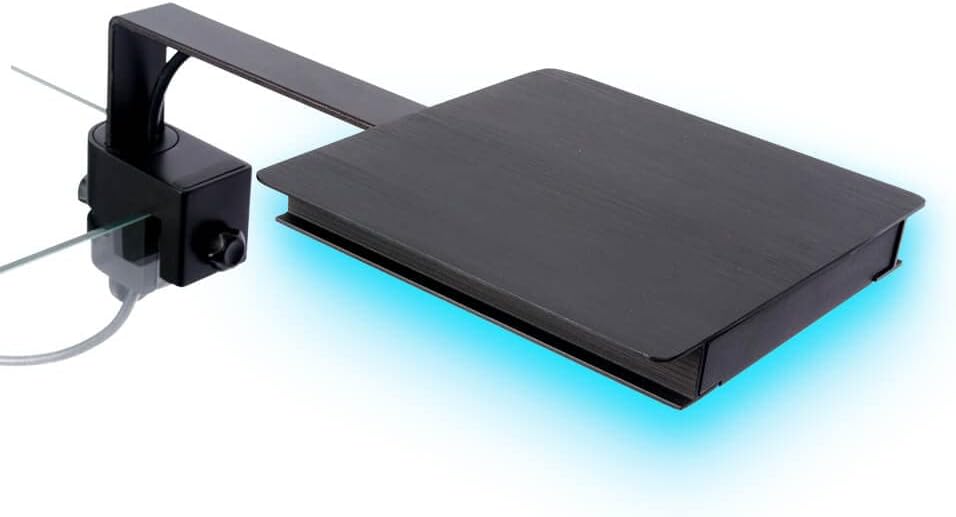
Coral Magazine’s nano lighting coverage notes three fixtures that consistently appear in sub-30-gallon builds:
- AI Prime 16 HD — the benchmark in the 10–20 gallon range. Published specs put it at a 60° beam angle with a meaningful PAR footprint for tanks up to roughly 24” wide. Owners on Reef2Reef routinely report strong color rendering and reliable Bluetooth app control.
- Kessil A80 — a compact, single-lens pendant that punches above its price in PAR density. Better suited to tanks 12–16 gallons or smaller due to its narrower coverage footprint.
- Radion XR15 Blue — the premium option, with EcoSmart Live scheduling and PAR depth that exceeds what most nano corals require. Worth the price if you intend to upgrade your tank within two years; otherwise, the AI Prime 16 HD delivers comparable biology at lower cost.
By the numbers:
| Fixture | Approx. Price (2026) | Best-fit tank size | PAR at 10” (published / reported) |
|---|---|---|---|
| Kessil A80 | ~$150 | 5–15 gal | ~100–180 µmol/m²/s |
| AI Prime 16 HD | ~$250 | 10–25 gal | ~150–300 µmol/m²/s |
| Radion XR15 Blue | ~$380 | 15–30 gal | ~200–400 µmol/m²/s |
Decision rule: For tanks 20 gallons and under stocking soft corals and LPS, the AI Prime 16 HD is the pick. For 25–30 gallons or any plan that includes SPS down the road, step to the Radion XR15 Blue.
3. Flow — More Important Than Most Beginners Expect
Coral doesn’t just need light — it needs water moving across its tissue to deliver nutrients and carry away waste. Dead spots in a nano tank lead to algae blooms, coral tissue recession, and elevated nitrate. Circulation pumps (also called powerheads) provide this flow.
The standard guidance, cited in Advanced Aquarist’s piece on small-system design, is to achieve 20–40x total water volume turnover per hour in a reef tank. For a 20-gallon system, that means 400–800 GPH (gallons per hour) of total flow from all sources combined.
Two pumps dominate nano builds:
- Hydor Koralia Nano 425 — inexpensive, proven, and widely available. Owners consistently report trouble-free operation over multi-year periods. The wavemaker function is basic, but for soft coral and LPS tanks it’s sufficient.
- Maxspect Turbine Duo XF130 — a dual-head wavemaker with programmable pulse modes. Better flow pattern distribution, meaningfully quieter per long-run owner reports on Reef2Reef, and worth the price premium for tanks 20 gallons and up.
For most tanks under 20 gallons, one well-positioned Hydor Koralia Nano is adequate. For 20–30 gallon builds, budget for two smaller heads or one programmable wavemaker.
4. Chemistry Management — Where Nano Reefs Live or Die
Small water volume is the defining challenge of nano reefing. In a 125-gallon system, a coral drawing calcium and alkalinity from the water column makes a negligible dent in parameters. In a 20-gallon system, a single large hammer coral can drop alkalinity (the measure of carbonate compounds that buffer pH and build coral skeletons) by 0.5–1 dKH per day. Stability — not perfect numbers — is what keeps coral healthy.
Advanced Aquarist’s analysis of alkalinity stability in small-volume systems makes the case clearly: daily swings above 1.0 dKH correlate with tissue necrosis in SPS and color loss in LPS. The target is 8.0–9.5 dKH, held within ±0.5 dKH day-to-day.
Your chemistry toolkit, in priority order:
- A reliable test kit or refractometer for salinity — the Milwaukee MA871 digital refractometer is the entry-level standard. For alkalinity, the Salifert Alk test kit is the hobbyist benchmark; the Hanna HI755 checker is a step up in resolution and worth the $50 if you plan to keep SPS.
- Two-part dosing — for tanks under 30 gallons, manually dosing a balanced calcium/alkalinity two-part solution (brands like BRS 2-Part are well-regarded across Reef2Reef community threads) is more practical than a calcium reactor. You can dial it in without additional CO2 equipment.
- A quality salt mix — Red Sea Coral Pro and Tropic Marin Pro Reef are the consistent recommendations in Practical Fishkeeping’s saltwater setup guides for their stable Mg/Ca/Alk ratios batch-to-batch. Avoid bargain-shelf salts; inconsistent batch chemistry is a documented root cause of unexplained parameter crashes.
5. Water Preparation — The Unsexy Priority You Shouldn’t Skip
Tap water contains chloramine, phosphate, and silicate — all of which fuel nuisance algae and stress livestock. An RODI unit (reverse osmosis/deionization filter) strips tap water down to near-pure H₂O before you add salt. This is non-negotiable for reef tanks.
For a nano system, a 4-stage RODI unit rated at 50–75 GPD (gallons per day) is sufficient. The BRS 4-Stage Value RODI and the Coralife Pure-Flo II are both widely used entry-level options with strong owner satisfaction records. Buy TDS (total dissolved solids) meters to verify your output — you want 0 TDS off the DI stage before mixing salt.
The Honest Budget Breakdown
Here’s what a complete, no-compromise nano reef build realistically costs in mid-2026 across two tiers:
Entry tier (~$550–$700 all-in): Fluval Evo 13.5 or IM Nuvo 20 + AI Prime 16 HD + single Hydor Koralia powerhead + Salifert test kits + BRS 2-Part + 4-stage RODI unit + quality salt mix (one bucket). This setup will keep soft corals and hardy LPS alive and coloring up.
Mid-range tier (~$900–$1,200 all-in): Red Sea MAX Nano 20 (with included lighting and skimmer) + Maxspect Turbine wavemaker + Hanna checkers + BRS 2-Part + upgraded RODI unit + two buckets of premium salt. This setup is genuinely capable of SPS in the long run.
What’s not in either budget: automated dosing pumps, a refugium (a secondary lit chamber growing nutrient-exporting macroalgae), an aquarium controller, or a quarantine tank. Add those over your first year as you understand where your system needs help — not on day one.
Three Mistakes Worth Avoiding
1. Over-stocking too early. A nano reef’s bioload tolerance (the amount of organic waste the system can process before water quality degrades) is low. One or two small fish — a clownfish pair is the classic choice, and for good reason — plus a cleanup crew of snails and hermit crabs, is the right starting point. Reef2Reef’s community documentation on nano bioload crashes is extensive; nearly every story starts with “I added three fish in month two.”
2. Buying a protein skimmer before understanding your system. Skimmers are valuable — they pull dissolved organics out before they fuel algae and nitrate. But in a lightly-stocked 10–20 gallon nano, the rear-chamber filtration and regular water changes (10–15% weekly) may outperform a cheap skimmer that requires constant fiddling. If the tank is under 20 gallons and you’re running light bioload, test without one first, then add if nitrate climbs above 10 ppm.
3. Chasing perfect numbers before chasing stability. New reefkeepers obsess over hitting textbook alkalinity (8.3 dKH) and pH (8.2–8.3) from week one. Advanced Aquarist’s research is clear: stability of parameters over time matters more than precision. A tank running consistently at 7.8 dKH outperforms a tank swinging between 7.0 and 9.5 dKH daily. Test twice a week. Dose conservatively. Adjust slowly.
The Decision Rule
If you’re under 30 gallons, buying your first reef, and want corals within six months: choose an AIO tank, buy your lighting one step above what feels necessary, and treat water chemistry as a daily discipline rather than a monthly checkbox. Gear is only half the equation. The other half is consistency — same water change schedule, same test routine, same slow additions. Nano reefs reward patience with something genuinely extraordinary in a small space. The hardware above gets you to the starting line. The discipline keeps you there.