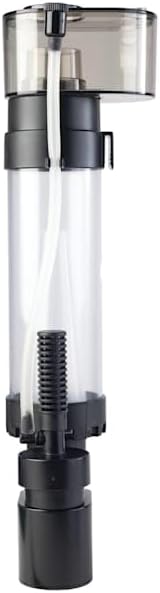
If you’ve just set up a small reef tank — a 16-gallon all-in-one, say, or a 32-gallon peninsula display — you’ve probably heard the word “skimmer” thrown around a lot. A protein skimmer is a device that pulls dissolved organic waste out of your water before it breaks down into ammonia and nitrates. Think of it as a pre-filter that physically removes the bad stuff by trapping it in foam. In a full-size reef system, skimmers usually live in a separate compartment called a sump — a hidden tank below the display. But in a nano reef (generally any display under 40 gallons), there often is no sump, or the built-in filter compartment is barely wide enough for your hand. That’s where most beginners get stuck. This guide walks you through the real constraint — space — and maps each major skimmer option to the situation it actually fits.
Why Space Changes Everything in Nano Skimmer Selection
In a standard reef build, skimmer selection is mostly a question of rated tank volume and neck diameter. You oversize by 1.5–2× your display volume, set it in the sump, and you’re done. Nano builds don’t get that luxury.
When your entire filtration compartment is a back-chamber roughly the size of a shoebox — common in Biocube, Fluval Sea EVO, and IM Nuvo formats — you’re not just choosing a skimmer. You’re solving a geometry problem. The key dimensions to nail down before you read a single review:
- Footprint (length × width in cm or inches): Does it physically fit your chamber?
- Water level sensitivity: Many nano skimmers are extremely sensitive to water height. A 1-inch swing can mean the difference between skimmate production and a foam overflow.
- Mounting method: Hang-on-back (HOB) skimmers clamp to the tank wall; in-sump skimmers sit submerged. Most nano builds without a sump need the HOB format.
Per Advanced Aquarist’s overview of protein skimming fundamentals, the physics of foam fractionation — the process that actually separates waste — works the same regardless of skimmer size. What changes is how much margin for error you have in a smaller water volume. In a 16-gallon system, a skimmer that’s slightly miscalibrated can crash water chemistry in hours. Getting the fit right isn’t optional.
The No-Sump Scenario: HOB Skimmers That Actually Work
The majority of nano reef owners on Reef2Reef aren’t running sumps. They bought an all-in-one tank because it was clean, compact, and required minimal plumbing knowledge — and they want a skimmer that fits that philosophy.
Coralife Biocube Skimmer is the name that comes up most often in this context, and the reason is specifically situational: it’s one of the few skimmers purpose-built to fit inside the back chamber of a Biocube without drilling, external plumbing, or modification. For owners who have zero interest in a sump — either by choice or by their living situation — that constraint-matching is genuinely meaningful. One owner account aggregated on Reef2Reef is unusually specific: after losing five tanks in a house fire, they were restarting with a Biocube and the Coralife skimmer was the only unit that fit the restart situation cleanly, both physically and in terms of not adding new complexity during an already stressful rebuild.
The consistent owner caveat: expect a 4–6 hour break-in period during which the skimmer overflows with bubbles before it settles into normal operation. This is normal across most HOB nano skimmers (more on this in the FAQ below), but it generates real anxiety for first-timers who assume something is broken. Set it up on a day when you can watch it. Put a towel under the collection cup. It settles.
Tunze 9001 sits in a different category — it’s a small HOB unit that works outside a formal sump but is loved most by owners who’ve already tried something cheaper and regretted it. The pattern across aggregated reviews is emphatic in a way that’s unusual: owners describe it as the product they wish they’d bought first, specifically because cheaper alternatives often failed to produce meaningful skimmate at all. The language in these reviews implies that many sub-$60 nano skimmers are essentially decorative — they run, they bubble, and the collection cup stays empty.
What owners praise most about the Tunze 9001 isn’t its design or build finish — it’s that it actually pulls waste. Brown, oily skimmate in the cup within reasonable time. That sounds like the baseline expectation for any skimmer, but per Coral Magazine’s nano skimmer roundup, consistent skimmate production in the under-30-gallon range is harder to achieve than it looks. Rated for tanks up to roughly 65 gallons, the 9001 is intentionally oversized for most nano builds, which gives you production headroom as your bioload grows.
When You Add a Sump: The In-Sump Tier
If you’re at the stage where you’re adding a sump to your nano build — even a small 10-gallon refugium under a 20-gallon display — your skimmer options improve significantly.
Reef Octopus 110-INT is the product that consistently surfaces in sump-ready nano conversations, and its calling card is silence. Owners across multiple review aggregations describe it as dead-quiet out of the box — a meaningful claim for a device sitting inside a cabinet under your display tank. In a bedroom or living room setup, audible skimmer noise is a legitimate quality-of-life issue that often goes underweighted in spec comparisons.
The break-in timeline for the 110-INT is longer than most: owners report roughly 1–2 weeks before the skimmer produces consistent brown skimmate. During that window, it may look like it’s not working. It is. The protein-saturated neck takes time to develop the surface chemistry needed for stable foam. Per ReefBuilders’ product overview of the Reef Octopus nano line, this break-in behavior is characteristic of higher-quality needle-wheel impeller designs — the same engineering that produces reliable long-term performance also means a slower start.
One important constraint to flag clearly: the 110-INT is an in-sump skimmer. It requires submersion in a sump or large refugium chamber. If you’re running a true all-in-one without a sump, this unit is not the right fit — not because of quality, but because of format.
The Aesthetic Variable Nobody Talks About
Here’s a consideration that almost never appears in spec sheets but shows up consistently in owner reviews: what does a dirty skimmer look like in your tank?
For nano builds where the skimmer is visible through the glass or sitting on the back of an open-top display, aesthetics matter more than most people admit before they buy. The IOAOI nano skimmer is a useful case study: one owner gave it a one-star deduction from an otherwise positive review purely because the white housing looks, in their words, “disgusting” once it’s coated in skimmate. This complaint appears across multiple independent reviews. Skimmate — the oily, dark organic waste the skimmer pulls from your water — will stain any light-colored housing quickly and visibly.
If your skimmer lives inside a back chamber or a cabinet sump, this is irrelevant. If it’s visible, factor finish color and material into your decision.
Quick Decision Table: Matching Skimmer to Situation
| Your situation | Recommended format | Unit to investigate |
|---|---|---|
| AIO tank, no sump, Biocube chassis | In-chamber HOB, purpose-fit | Coralife Biocube Skimmer |
| AIO tank, no sump, want proven skimmate production | Small HOB, oversize-rated | Tunze 9001 |
| Nano build with sump, silence is a priority | In-sump needle-wheel | Reef Octopus 110-INT |
| Any nano, skimmer will be visible | Any format — dark housing preferred | Avoid white-chassis units |
The Decision Rule
If you have no sump and no plans to add one: your decision tree is short. The Coralife Biocube Skimmer is the right answer if you’re on a Biocube chassis and want a purpose-fit solution. The Tunze 9001 is the right answer if you’re on any AIO format and want a unit that demonstrably produces skimmate — and you’re willing to pay more to avoid the frustration of an underpowered budget option.
If you’re adding or already have a sump: the Reef Octopus 110-INT earns serious consideration. Budget two weeks of patience before judging its output. The silence payoff is real.
If you’re still on the fence about needing a skimmer at all in a nano: per Practical Fishkeeping’s all-in-one tank guide, lightly stocked nano builds with aggressive water change schedules can run without skimmers, but the margin for error is thin. A skimmer adds stability, not just cleanliness. In a reef context — where coral tissue reacts to dissolved organic spikes — that stability is usually worth the space trade-off.
Frequently Asked Questions
Why is my new protein skimmer overflowing with bubbles and not producing skimmate?
This is normal break-in behavior and almost universal in new skimmers. During the first few hours — sometimes up to 24 hours — the neck and collection cup haven’t yet developed the protein film needed for stable foam. Bubbles overflow, skimmate collection is near zero, and it looks like something is wrong. It isn’t. Set your water level, verify the skimmer is at the correct depth for its rating, and give it time. The Coralife Biocube Skimmer’s 4–6 hour overflow window is well-documented by owners; the Reef Octopus 110-INT’s longer 1–2 week break-in is equally characteristic of its design.
Will the Coralife Biocube Skimmer fit my 16-gallon Biocube?
The Coralife Biocube Skimmer is specifically designed for the Biocube chassis. That said, confirm which generation of Biocube you have — the 16-gallon and 32-gallon share a similar back-chamber architecture, but chamber dimensions have varied slightly across production runs. Measure your middle chamber width and cross-reference with the manufacturer spec sheet before ordering.
Do I need a sump to run the Reef Octopus 110-INT?
Yes. The 110-INT is an in-sump skimmer — it operates submerged and requires a stable water level to function. It is not a hang-on-back unit. If your build has no sump, this skimmer is the wrong format regardless of its performance merits. Consider the Tunze 9001 instead.
How long does the Tunze 9001 take to break in and start pulling real skimmate?
Most owners report meaningful skimmate production within 48–72 hours. The Tunze 9001 tends to break in faster than many in-sump designs because of its HOB format and simpler water level interface. If you’re past the 72-hour mark with nothing in the cup, check water level against the manufacturer’s spec — this skimmer is sensitive to operating depth.
Can I run a nano skimmer without a sump in an AIO tank?
Yes, with the right unit. HOB skimmers like the Tunze 9001 and purpose-fit designs like the Coralife Biocube Skimmer are built for exactly this scenario. The limitation is that AIO back chambers are often narrow, so you need to verify footprint dimensions before buying. What you cannot do is run an in-sump skimmer — like the Reef Octopus 110-INT — without a sump. Format matters more than brand in this decision.