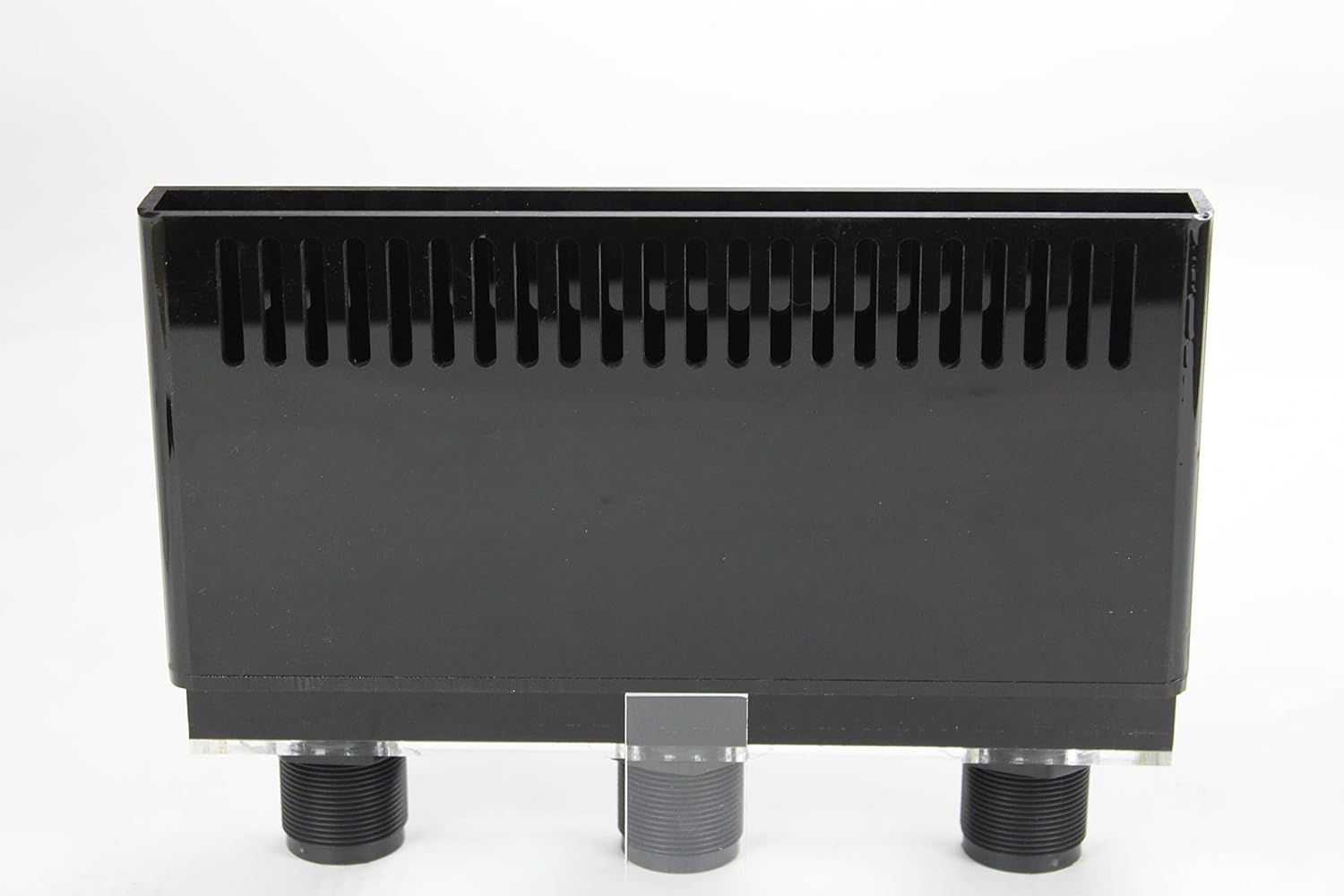
If you run a reef tank with a separate filter chamber — called a sump — hidden in your cabinet, you need a way to move water from the display tank down to that sump and back up again. Tanks drilled at the factory have the cleanest solution, but most small tanks (under 40 gallons) ship without holes. That’s where a hang-on-back (HOB) overflow box comes in: it’s a two-chamber device that straddles the back wall of your tank, uses a U-tube siphon to pull water over the rim, and feeds it down to your sump. The return pump then pushes filtered water back up. Simple in theory — but in practice, siphon breaks, gurgling pipes, and mismatched flow rates are the top reasons nano reef owners lose sleep at two in the morning. This guide gives you the math, the modification worth considering, and the product-specific details to make the right call before you buy.
| EDITOR'S PICKESHOPPS Eclipse Slim Overflow B… | Mid-tierAqueon AAG29251 Overflow Access… | Budget pickMultipurpose U Return Pipe Dire… | |
|---|---|---|---|
| Slim profile | ✓ | — | — |
| Configuration | Overflow box | Overflow kit | Return pipe |
| Main component | Overflow box | — | U return pipe |
| Hose size | — | — | 3/4"–1" |
| Included hose | — | — | ✓ |
| Price | $179.99 | $69.99 | $11.98 |
| See on Amazon → | See on Amazon → | See on Amazon → |
How to Size an Overflow Box Without Flooding Your Tank
This is the single most important calculation you’ll run, and it’s genuinely simple.
The rule: your overflow box must be rated to handle at least as many gallons per hour (GPH) as your return pump delivers — ideally with 20–30% headroom on the overflow side.
The math in three steps
- Find your return pump’s GPH at the actual head height (the vertical distance from sump water surface to tank return nozzle). Pump manufacturers publish head-loss curves; a pump rated at 800 GPH open-flow might deliver 500 GPH against 4 feet of head.
- Add any additional flow you’re running through the overflow from powerheads that recirculate through the sump. (Most nano builds don’t do this, but note it if you do.)
- Compare that number to your overflow box’s rated throughput. If the overflow is rated at 600 GPH and your pump delivers 550 GPH to the tank, you have 50 GPH of margin — thin, but workable. If the numbers are equal or the pump wins, water climbs and eventually spills over the back wall.
By the numbers — quick sizing reference:
| Tank size | Typical return pump GPH (at head) | Minimum overflow rating | Recommended overflow rating |
|---|---|---|---|
| 10–20 gal nano | 150–250 GPH | 300 GPH | 400–500 GPH |
| 29–32.5 gal | 300–450 GPH | 500 GPH | 600–750 GPH |
| 40 breeder | 400–600 GPH | 700 GPH | 900+ GPH |
Reef2Reef’s community documentation on overflow and drain sizing consistently reinforces this 20–30% oversizing buffer as a minimum, not a maximum — the extra capacity is your insurance against partial siphon breaks that reduce effective throughput mid-session.
One smart commissioning technique worth highlighting: owners of the Seapora Nano overflow on 32.5-gallon builds describe adding a gate valve on the return pump outlet line and dialing it down until the tank water level stabilizes exactly where they want it before ever running the system at full speed. This approach — throttle the return, not the overflow — lets you find the stable operating point with zero risk of overfilling. It’s low-tech and takes ten minutes but saves hours of re-plumbing later.
The Herbie Method: Is It Worth Modifying a Budget Overflow Box?
A standard HOB overflow box routes all drain flow through a single standpipe, which creates noise (gurgling, rushing sounds) as air and water compete in the pipe. The Herbie method — documented extensively in reef2reef.com’s Herbie Overflow community thread — solves this by running two standpipes:
- Main drain: set just below full siphon, controlled by a gate valve to run at exactly the flow rate your return pump delivers. Water fills the pipe completely, eliminating the air-water turbulence that causes noise.
- Emergency drain: taller than the main drain, open to air at the top, sized to handle full flow if the main drain fails. It only flows when something goes wrong.
Modifying an Eshopps PF-1200 for Herbie operation
Documented reviewers who have run this modification on the Eshopps PF-1200 describe the process in enough detail to be instructive. The modification involves:
- Replacing one of the existing standpipes with a longer emergency pipe that terminates above the main drain inlet — so it only activates if the main drain clogs or the gate valve is over-closed.
- Adding a gate valve (typically a 3/4-inch PVC ball valve with fine-threaded adjustment) inline on the main drain tubing between the overflow box and the sump.
- Commissioning by opening the gate valve slowly until the main drain runs full siphon — a visual confirmed by the pipe running completely water-filled with no air entrainment and the display tank holding a stable water level.
Advanced Aquarist’s coverage of drain sizing for reef systems notes that a full-siphon Herbie drain is significantly quieter than a Durso or open standpipe at equivalent flow rates, which is particularly valuable in nano builds where the sump sits in a small cabinet with little acoustic separation from the living space.
Is it worth it on a budget box? If you’re running an Eshopps PF-1200 and noise is your primary frustration, yes — the gate valve costs a few dollars in fittings, and the modification is reversible. If you’re buying new, pay attention to whether the box has room for a second standpipe before committing. The Eshopps PF-1200’s internal chamber geometry allows the modification; not all budget boxes do.
Siphon Reliability: Why Your Overflow Keeps Breaking and How to Stop It
A siphon break is when air enters the U-tube that pulls water over the tank rim, stopping flow. If your return pump keeps running while the overflow isn’t flowing, your sump will drain into the tank until it overflows — a very bad night.
Common causes and fixes
Micro-bubbles accumulating in the U-tube. This is the most frequent culprit. Water carries dissolved gas; as it moves through the curved U-tube, tiny bubbles collect and eventually block the siphon. The fix is a small, continuous air-purge system — most modern overflow boxes include a venturi valve or a small air-line fitting at the top of the U-tube that allows a slow, deliberate bleed of accumulating gas before it blocks flow. Owners of the ESHOPPS Eclipse Slim consistently rate it positively for quietness once the venturi is tuned correctly, but reviewers explicitly flag that the tuning isn’t obvious from the product description and takes iteration to dial in. Budget additional commissioning time.
Dirty or degraded gaskets. Multiple four-star reviewers of the ESHOPPS Eclipse Slim specifically call out gaskets that required replacement shortly after installation. The symptom is a slow air leak at the U-tube joint that gradually degrades siphon strength before breaking it entirely. Physically inspect every gasket joint at installation and keep a spare O-ring kit on hand — it’s a $3 fix that prevents a $300 problem.
Power outage restart. When the pump loses power, the siphon may break entirely. When power returns, a U-tube that’s full of air won’t self-prime. The solution is either a reliable self-starting design (check manufacturer claims carefully) or a dedicated siphon-start line — a small air pump that evacuates the U-tube on startup. Some builders use an Aqualifter pump plumbed to the U-tube top for continuous low-volume air removal.
Practical Fishkeeping’s guide to sump setup for marine aquariums recommends treating siphon reliability as a primary selection criterion for HOB overflows — not an afterthought — because the failure mode (sump overflow into the display, or display overflow onto the floor) is severe enough that inconvenient commissioning is preferable to a failed siphon at 3 a.m.
Backflow, Duckbill Valves, and Return Line Siphoning
Here’s a failure mode that surprises many first-time sump builders: when your return pump shuts off (power cut, scheduled pause, controller command), the water column in the return line can siphon backwards — draining back into the sump until the return nozzle is exposed to air. If your sump is too small for this extra volume, it overflows onto the cabinet floor.
Two solutions:
-
Drill a siphon-break hole in the return line just above the tank’s waterline — a 1/16-inch hole that lets in air and breaks the back-siphon. Simple, reliable, permanent. The tradeoff is a small stream of bubbles when the pump is running.
-
Duckbill check valve on the return outlet inside the tank. A duckbill valve is a one-way flexible valve that allows forward flow but collapses shut when flow reverses, preventing back-drainage. Owners of the U-return duckbill pipe note one specific installation issue worth flagging: a misaligned hose barb seam on some units can cause a slow drip at the connection point. Inspect the barb seam alignment before tightening and before the tank is filled — catching a poor seam fit at installation is straightforward; catching it after the tank is live means draining down to access the fitting.
The Aqueon overflow kit earns consistent praise specifically from owners who had been struggling with DIY water-level management that they couldn’t crack on their own. Reviewers describe it as solving water-level stability problems that custom PVC configurations failed to address — worth noting for builders who’ve already gone through one iteration of DIY plumbing without success.
Stopping the Gurgling: Noise Control for Nano Sump Setups
Reef Builders’ overview of overflow and sump plumbing basics identifies drain pipe noise as the most commonly cited complaint from HOB overflow users — ahead of flow rate, ahead of aesthetics, ahead of price. Here’s the short version of what actually works:
- Standpipe design matters more than box brand. A Durso standpipe (air-intake pipe inside the drain tube) reduces noise versus an open pipe by letting a controlled amount of air mix above the water column. A Herbie full-siphon drain eliminates most noise entirely but requires a gate valve and two standpipes.
- Pipe diameter relative to flow rate. An undersized drain pipe in full siphon is louder than a larger pipe at the same flow. If you’re running 400 GPH through a 3/4-inch drain, consider upsizing to 1-inch even if it means replumbing the sump connection.
- Sump entry turbulence. The drain line dropping into the sump creates splash noise. Route it into a submerged section or add a Loc-Line flex nozzle pointed toward the sump wall to dissipate energy without splashing.
- Gate valve micro-adjustment. If you’ve run a Herbie modification, the gate valve position is the final tuning control. Open slowly until the drain pipe runs completely water-filled with no air noise, then stop. A change of a quarter-turn can shift the system from noisy to silent.
Frequently Asked Questions
How do I calculate whether my overflow box can handle my return pump’s GPH without flooding the display tank? Measure (or calculate from the manufacturer’s head-loss curve) your actual pump delivery GPH at your specific head height. Your overflow box’s rated throughput should exceed that number by at least 20–30%. If the numbers are close, throttle the return pump with a gate valve or ball valve on the outlet line rather than running at full speed.
What is a Herbie overflow and is it worth modifying a budget overflow box to run one? A Herbie overflow uses two standpipes — a main drain running at full siphon (controlled by a gate valve) and a taller emergency drain — to eliminate the air-water noise of a standard single-pipe drain. It’s worth the modification on boxes like the Eshopps PF-1200 if the internal chamber fits a second standpipe and noise is your primary frustration. The hardware cost is minimal; the commissioning time is real but finite.
Why does my HOB overflow keep losing its siphon and how do I stop it? The most common causes are micro-bubble accumulation in the U-tube, a degraded or misseated gasket creating an air leak, and failure to self-prime after a power outage. Solutions: add or tune a venturi air-bleed fitting at the U-tube top, replace gaskets and inspect seals at installation, and consider a small Aqualifter pump for continuous air removal and startup priming.
Do I need a gate valve on my return pump, and where does it go? Yes, for commissioning and long-term level control. Place it on the outlet side of the pump (never the inlet — restriction on the inlet side can damage pump impellers). Use it to throttle flow until your display tank holds a stable water level that matches your overflow’s comfortable operating range.
How do I stop my overflow box from making gurgling or rushing noise? The root cause is air competing with water in the drain pipe. Solutions in order of effectiveness: tune or add a Durso standpipe for partial improvement; run a Herbie full-siphon modification for the quietest possible operation; ensure your drain pipe diameter is not undersized for your flow rate; and route the sump entry point into a submerged baffle section to eliminate splash noise.
What causes a return pipe to siphon backwards when the pump turns off, and how does a duckbill valve fix it? When the pump stops, the water column in the return line is under gravity and will drain back into the sump unless air can enter the pipe. A duckbill check valve at the return outlet collapses shut when flow reverses, stopping back-drainage. Alternatively, drill a small siphon-break hole in the return line just above the tank waterline. Inspect duckbill barb seam alignment at installation — a misaligned seam is a documented leak point that’s much easier to address before the tank is filled.
The decision rule: If you’re on a 29–40 gallon tank, noise-sensitive, and willing to spend 90 minutes on commissioning, run an Eshopps PF-1200 with a Herbie modification and a gate valve. If you want quieter out-of-the-box with less tuning overhead, the ESHOPPS Eclipse Slim delivers — but budget time for gasket inspection and venturi tuning. For builders who’ve already failed once at DIY water-level control, the Aqueon overflow kit’s documented success in exactly that scenario makes it the lower-risk restart. And whichever box you choose, add a gate valve to your return line on day one. It costs almost nothing and gives you the control that makes everything else solvable.