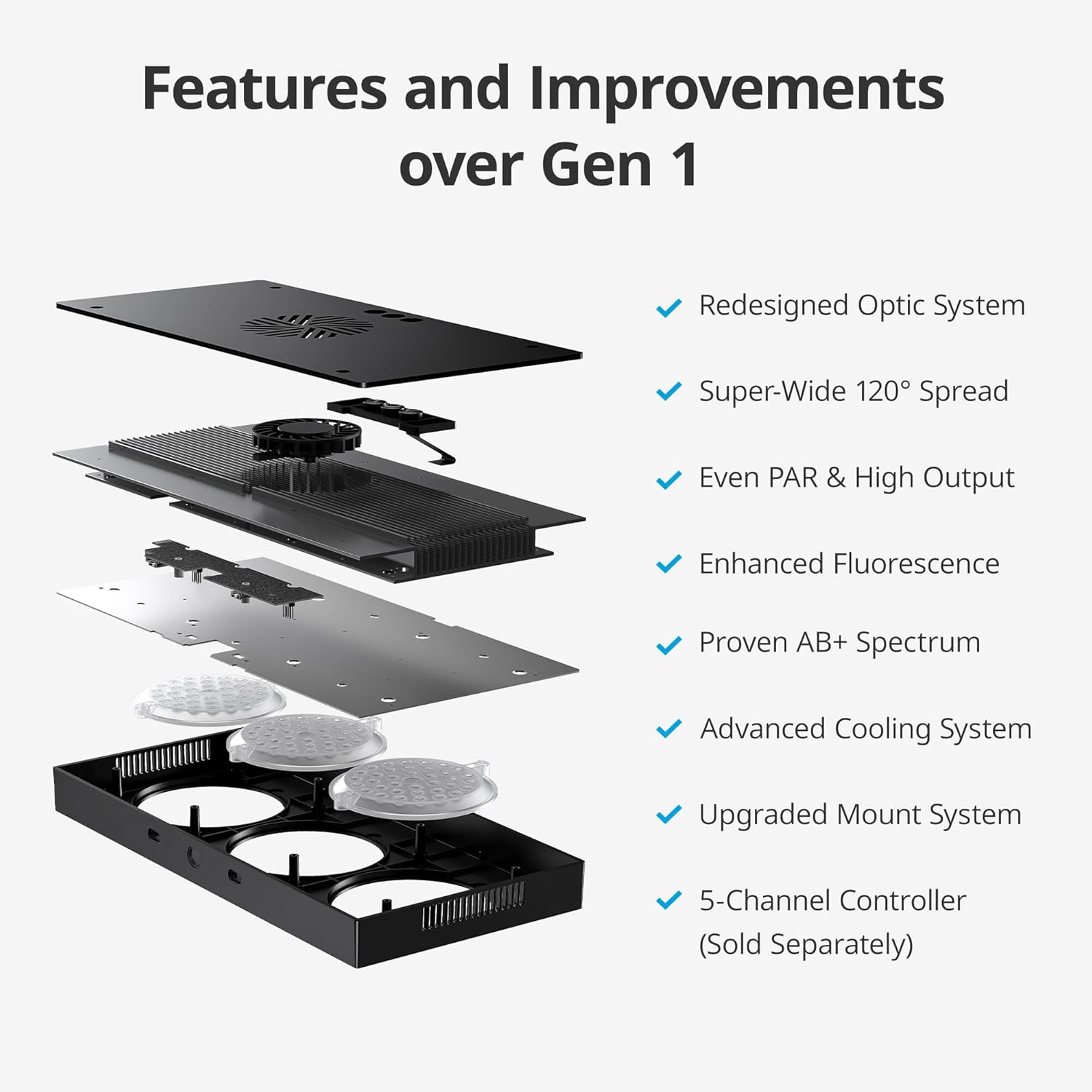
Choosing a LED light for a reef tank can feel overwhelming fast. A reef LED — short for reef light-emitting diode fixture — is the primary tool that drives photosynthesis in corals and coralline algae. Unlike a simple planted freshwater tank, a reef system depends on very specific wavelengths of light (especially blue and violet, in the 400–450 nm range) to keep the symbiotic algae inside coral tissue, called zooxanthellae, alive and productive. Get the spectrum wrong, or push intensity too hard without a gradual ramp-up, and corals bleach. Get it right, and they grow, color up, and reward the effort.
This article focuses on three fixtures that show up repeatedly in mid-range reef discussions in 2025–2026: the NICREW HyperReef 200 Gen 2, the AI (AquaIllumination) Hydra 32, and the VIPARSPECTRA 165W. We also touch on a budget 95W multi-channel option where relevant. If you’re sitting on a purchasing decision right now — first SPS (small polyp stony coral) build, upgrade from a black box, or coverage plan for a long tank — this is the decision frame you need.
| EDITOR'S PICKAquaIllumination Hydra 32 LED A… | Mid-tierNICREW HyperReef 150 Gen 2 Reef… | Budget pickVIPARSPECTRA 165W LED Aquarium… | |
|---|---|---|---|
| Wattage | — | 150W | 165W |
| Control | Wireless | — | Remote/Timer |
| Corals | Coral | SPS, LPS | Coral |
| Channels | — | 5 Channels | Dual Channel |
| Price | $479.99 | $249.99 | $139.99 |
| See on Amazon → | See on Amazon → | See on Amazon → |
What Separates These Three Fixtures
At a high level, these lights occupy three distinct positions on the price-to-programmability spectrum:
| Fixture | Approx. Street Price (2026) | Control Channels | App/Connectivity |
|---|---|---|---|
| NICREW HyperReef 200 Gen 2 | ~$120–$160 | Multi-channel (blue, violet, white, UV) | Limited app or manual knobs |
| NICREW HyperReef 150 | ~$90–$120 | Multi-channel | Same platform |
| AI Hydra 32 | ~$380–$420 | 10 independent channels | myAI app, Apex integration |
| VIPARSPECTRA 165W | ~$100–$130 | 2–3 channels (blue/white split) | Basic timer controller |
The gap between the NICREW tier and the Hydra 32 isn’t just price — it’s the difference between a fixture you tune manually (or via a basic app) and one that integrates into an automated reef controller ecosystem like Neptune Apex. That distinction matters more as your tank complexity grows.
The Three Fixtures, Head to Head
NICREW HyperReef 200 Gen 2: Budget SPS Credibility
The HyperReef line has earned something it didn’t have two or three years ago: real-world SPS credibility. Owners running the HyperReef 200 Gen 2 across large systems report concrete results. Community review threads on Reef2Reef document a multi-unit owner running three to four of these fixtures over a 180-gallon system at 70% blue/violet and only 3% white — and reporting solid PAR (photosynthetically active radiation, the measurement of usable light energy for photosynthesis) at the sandbed. That’s not a beginner claim; sandbed PAR on a 180-gallon requires meaningful intensity and spread.
What stands out in that documentation: the owner specifically credits the Gen 2 spectrum as a meaningful improvement over earlier HyperReef drivers, even though the newer version uses lower-wattage diodes overall. Advanced Aquarist’s coverage of LED spectrum and coral photobiology has consistently noted that diode efficiency and binning quality often matter more than raw wattage — a better-binned 200W driver can outperform a poorly binned 250W one for coral response.
The HyperReef 150, the smaller sibling, has an equally compelling data point: Reef2Reef owner reports document acropora growth in a 125-gallon tank under this fixture. Acropora is the canary-in-the-coalmine coral species for lighting quality — it’s among the first to stall or bleach under poor spectrum or insufficient PAR. Getting acropora growth out of a sub-$130 fixture is a signal worth taking seriously.
The honest tradeoff: connectivity is limited. You’re not getting 10-channel granular control or Apex integration at this price. Scheduling and ramping require either manual knob adjustment or a basic controller, depending on the exact unit. If you need sunrise-to-sunset PAR curves programmed through an app, this isn’t that fixture.

VIPARSPECTRA
$139.99
In stock on Amazon
Check price on AmazonAI Hydra 32: The Connectivity Argument
The AquaIllumination Hydra 32 is the fixture that serious hobbyists cite when they want programmability without stepping up to commercial-tier pricing. Reef Builders’ coverage of the AI Hydra series documents 10 independent LED channels — including separate control of cool white, warm white, deep red, green, blue, royal blue, violet, and UV — each adjustable on individual intensity curves throughout the day.
Aggregated owner reports across the reef-keeping community back this up. Owners who run multiple units across diverse systems describe strong coral growth across mixed marine and freshwater planted setups — a breadth that speaks to the fixture’s spectrum flexibility. It isn’t optimized for one type of system; it adapts.
The myAI app is the key differentiator at this price point. You can build full-day schedules, acclimation ramp-downs for new coral additions, cloud-sync backups of your programming, and — critically — connect to a Neptune Apex controller via the AquaBus protocol for full automation integration. For anyone running dosing pumps, ATO (auto top-off) units, or flow management through an Apex, having your lights on the same controller network is a genuine quality-of-life upgrade, not a luxury.
Coral Magazine’s coverage of PAR, PUR, and spectrum considerations for SPS reefs makes a point worth repeating here: spectrum quality and stability matter as much as brand-name credibility when evaluating whether a fixture can support demanding coral. The Hydra 32’s multi-channel granularity allows you to dial in precisely the spectrum profile your coral population needs as it matures — something fixed-channel fixtures simply cannot match.
Is it worth three times the NICREW? If you’re building a mixed reef or SPS-dominant system where you’ll want to fine-tune your spectrum as your coral population matures — yes, the math favors it over two or three years. If you’re running a softies-and-LPS system and just need reliable blue-heavy output, the cost delta is harder to justify.
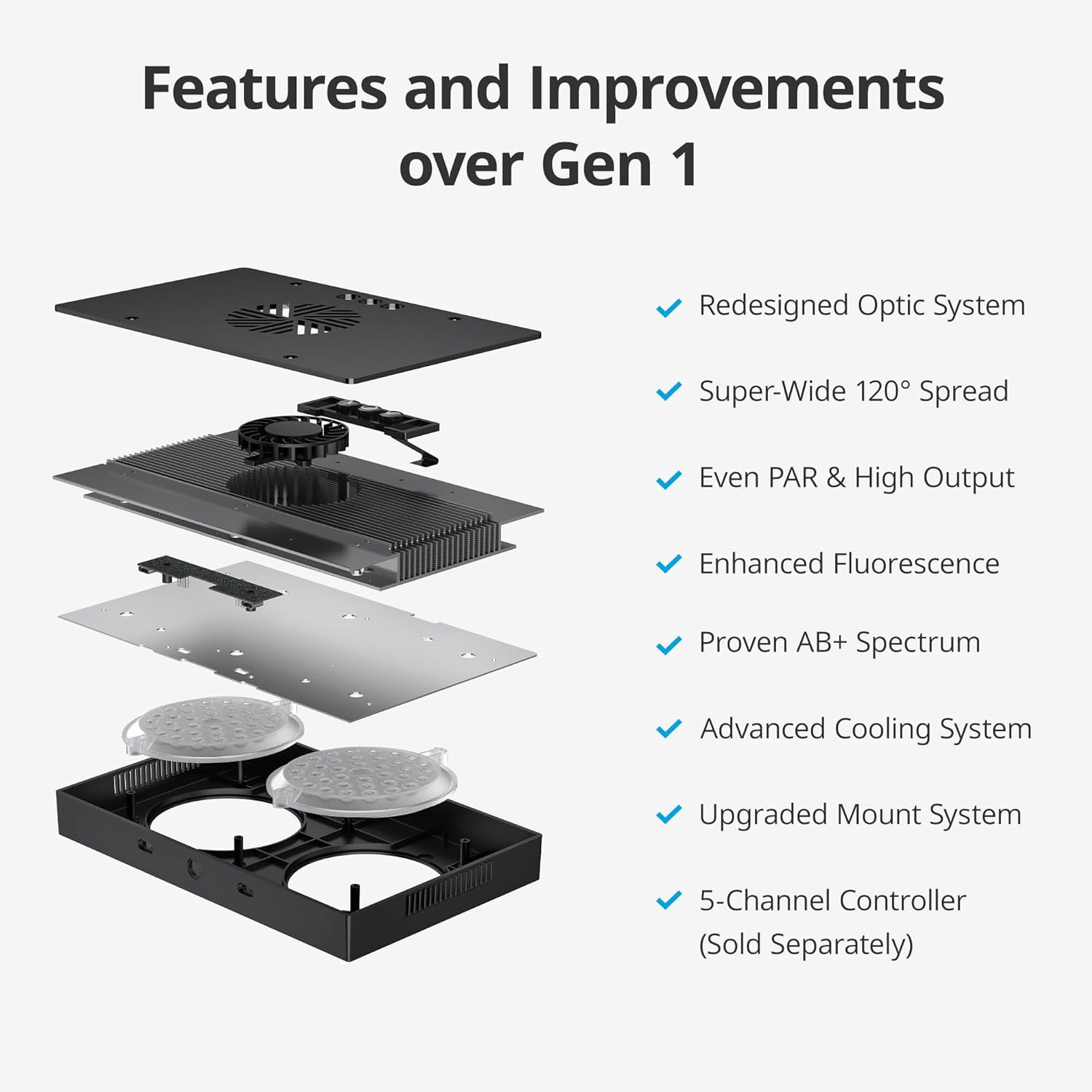
NICREW
$249.99
In stock on Amazon
Check price on AmazonVIPARSPECTRA 165W: Power With a Spread Problem
The VIPARSPECTRA 165W is a capable fixture that generates a frustrating pattern in owner reviews: strong raw output, weak diffusion. The most telling data point comes from a modification documented by owners who physically removed the inner lenses from paired units — specifically to improve light spread across the tank footprint. That’s a meaningful real-world signal. The light is powerful enough to drive coral growth, but the factory lens configuration concentrates intensity into a narrower beam than most reef footprints require.
The modification improved spread measurably for those owners. But it’s worth being clear: opening a fixture and removing components voids the warranty, introduces moisture-ingress risk if the housing seal is disrupted, and requires comfort with electronics disassembly to avoid damaging drivers or diode boards. We don’t recommend this as a standard approach — but we note it because it reveals something true about the product: the hardware underneath the lenses is capable; the optics are the constraint.
If you’re evaluating the VIPARSPECTRA 165W stock, plan your tank footprint coverage assuming narrower beam angles than the marketing suggests. Either purchase additional units or accept that you’ll have brighter center zones and dimmer edges. Reef Builders’ fixture coverage has repeatedly flagged optic quality as an underappreciated variable in comparing fixtures at similar wattage claims — this is a textbook case of that principle in action.
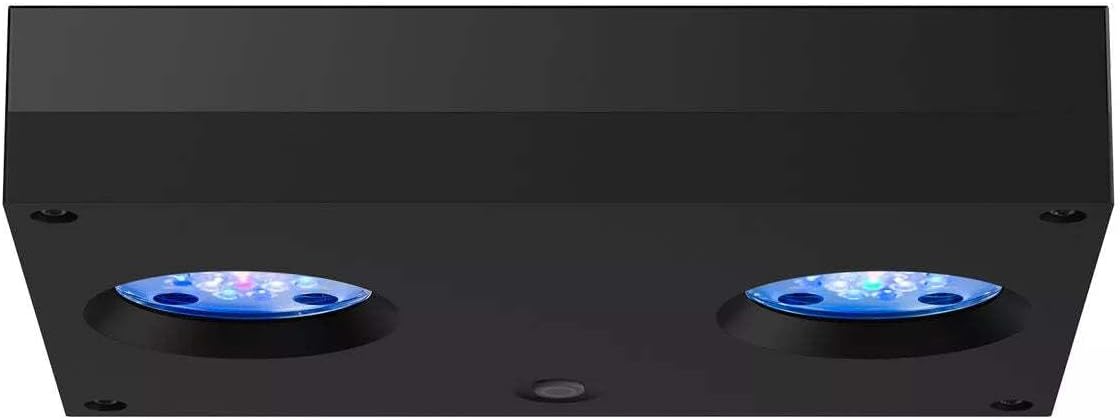
AquaIllumination
$479.99
In stock on Amazon
Check price on AmazonA Note on the Budget 95W Multi-Channel Option
For completeness: a 95W multi-channel fixture that appears in this price tier has two documented frustrations worth flagging. Owners report fan noise that’s noticeable at close range — not dealbreaking for a sump room, but relevant for a display tank in a living space. More consequential is a save-function issue: programmed schedules reportedly require multiple sequential save attempts before the unit actually retains the settings. This isn’t a fatal flaw, but it’s the kind of friction that erodes confidence in gear you’re trusting with a several-hundred-dollar coral collection.
Frequently Asked Questions
How many NICREW HyperReef units do I need to cover a 120- or 180-gallon tank?
Coverage scales with tank footprint, not volume. A standard 120-gallon (typically 48” × 24”) needs at minimum two HyperReef 200 units placed across the length — three gives you better edge coverage and lets you run lower intensity with headroom to spare, which is gentler on corals and extends diode life. The 180-gallon (typically 72” × 24”) owner documented in Reef2Reef community review threads runs three to four units and reports adequate sandbed PAR. Three is workable; four gives you comfort margin. Hang height matters: lower placement increases intensity and reduces spread, so dial that in before committing to unit count.
Is the AI Hydra 32 worth three times the price of a NICREW HyperReef for SPS growth?
For pure coral growth, the gap matters less than you’d expect at equivalent PAR levels — Coral Magazine’s coverage of SPS photobiology consistently notes that spectrum quality and stability matter as much as brand. The real Hydra 32 premium is in programmability and ecosystem integration. If you’re running Apex automation, want granular daily curves, or need cloud-backup of your schedules, the Hydra 32 earns its price. If you’re a set-it-and-leave-it keeper with a stable mixed reef, two HyperReef 200s deliver credible SPS results at a fraction of the cost.
What starting settings work with the AI Hydra 32 for a mixed reef?
A widely used starting point in the hobby community — documented in Bulk Reef Supply’s published programming guides for the Hydra platform — runs blue and royal blue channels at 60–75% peak, whites at 20–35%, and UV/violet at 40–55%, with a gradual 2-hour ramp at each end of the photoperiod. Treat those as a starting point, not a final answer — your tank’s depth, water clarity, and coral placement will require tuning from there.
Do I need to acclimate my corals when switching to a more powerful LED from a budget black box?
Yes — this is non-negotiable. Practical Fishkeeping’s guidance on acclimating corals to new lighting conditions is explicit: corals that have adapted to lower-PAR or different-spectrum conditions over weeks or months can bleach within days when exposed to abruptly higher intensity, even if the new light is technically “better.” Standard protocol is to start the new fixture at 30–40% of your target intensity and ramp up 5–10% per week, watching coral polyp extension and color response as your guide. The ramp typically takes four to eight weeks for a fully stocked SPS system.
Can I modify a VIPARSPECTRA black box to improve light spread, and is it safe?
The modification has been done — the lens-removal approach documented by owners does appear to improve spread. But “done by owners” is different from “safe or advisable.” Opening the unit risks voiding the warranty and potentially compromising the housing seal. If you’re comfortable with basic electronics disassembly and accept those tradeoffs, the mod is documented to work. If you’re not, the better path is to adjust hang height, add a second unit, or move to a fixture with better factory optics for your footprint.
Why does my multi-channel reef light not save my programmed schedule?
The save-function issue documented in the 95W multi-channel fixture tier appears to require multiple sequential save attempts before settings stick. Attempt to save, power-cycle the unit, re-enter the schedule, and save again. If settings still don’t persist after a firmware update — check the manufacturer’s support documentation for your specific unit — the unit may have a defective EEPROM (the memory chip that stores settings). At that point, a warranty replacement is the right call.
The Decision Rule
Here’s the honest “if X, then Y” frame:
- If you’re building a softies or mixed LPS reef on a budget and your priority is value-per-PAR: NICREW HyperReef 200 Gen 2, sized to your footprint, is the call. It’s SPS-credible at the right price point.
- If you want SPS growth with the option to eventually integrate a reef controller ecosystem: AI Hydra 32. The connectivity gap is real, and you’ll use it as your system matures.
- If you’re considering VIPARSPECTRA: Know going in that spread is the weak point. Plan coverage accordingly, and don’t expect factory optics to behave like a wider-beam fixture.
- If a budget 95W multi-channel is on your shortlist: Budget for the save-function frustration and assess whether fan noise will affect your specific install location before committing.
Lighting is the single variable that reef keepers most commonly under-specify and then upgrade twice. Spending a few extra hours on this decision now is almost always cheaper than replacing a fixture six months in.