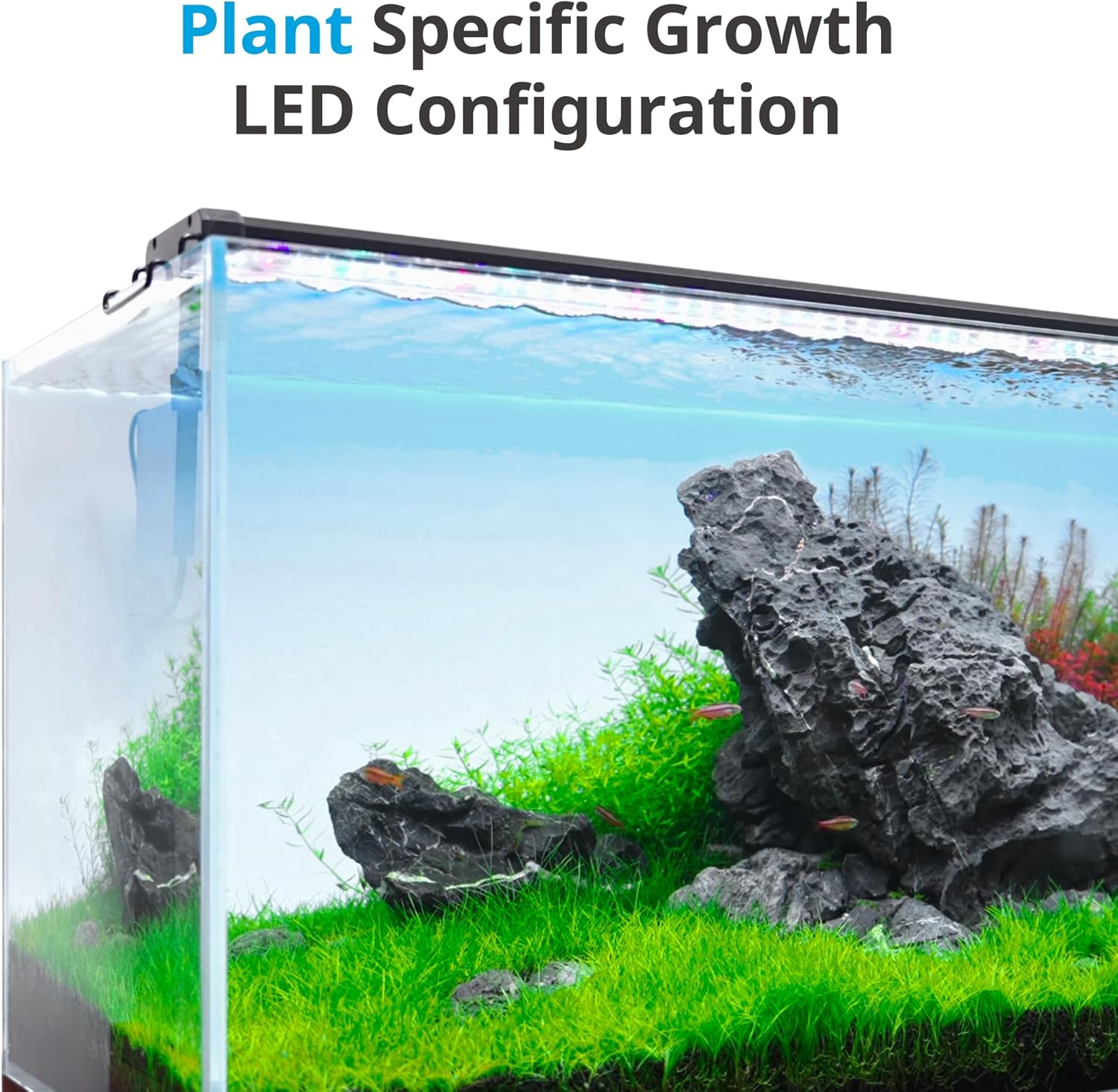
If you’ve ever set up a freshwater aquarium and tried to grow live plants — real plants, not plastic ones — you’ve already learned the single most frustrating lesson in the hobby: the light that came bundled with your tank almost certainly isn’t enough. Plants use light the same way they do outdoors, converting it into energy through photosynthesis. The measure that matters is PAR (Photosynthetically Active Radiation), which quantifies how much usable light energy actually reaches your plants. Too little PAR and easy plants like java fern survive but carpet plants like dwarf hairgrass just slowly die. Too much PAR without CO₂ supplementation (a system that dissolves carbon dioxide into the water to fuel plant growth) and you get an algae explosion instead of a carpet. This guide maps the LED lighting market into honest tiers, explains the technical tradeoffs that actually matter at each price point, and gives you clear decision rules so you stop paying for features you don’t need — or underpaying and wondering why nothing grows.
Why the Tier You’re In Matters More Than the Brand Name
The freshwater planted lighting market in 2026 runs from roughly $25 to over $300 for hobbyist-scale fixtures, and the feature gap between budget and mid-range is real, not marketing. According to Aquatic Plant Central’s guide on PAR and PUR (Photosynthetically Usable Radiation — the slice of PAR spectrum that plants actually prefer), most carpet plants like dwarf hairgrass need sustained PAR readings of 50–80 µmol/m²/s at the substrate to achieve dense horizontal spread. Budget fixtures often deliver that number at the surface but fall off dramatically at depth. The tier you need is determined by three variables: tank depth, plant species, and whether you’re running injected CO₂.
Here’s the short version:
| Plant Demand | CO₂ | Tank Depth | Minimum Tier |
|---|---|---|---|
| Low (anubias, java fern, mosses) | No | Up to 16″ | Entry ($25–$55) |
| Medium (stem plants, crypts, vals) | Optional | Up to 20″ | Mid ($55–$120) |
| High (carpet plants, HC Cuba, hairgrass) | Yes | Up to 18″ | Mid-to-upper ($90–$180) |
| High (carpets in deep tanks, SPS-equivalent demand) | Yes | 20″+ | Upper/App-tier ($150–$300+) |
The practical takeaway from Practical Fishkeeping’s planted-tank lighting overview is consistent with what owners report in long-form reviews: matching fixture to plant demand is more important than brand loyalty. Overspending on a programmable app-controlled light for a low-tech moss tank is a waste; underspending on a basic strip light for a pressurized CO₂ hairgrass build guarantees failure.
Entry Tier: When Simple Is Enough
Entry-tier lights — think basic LED strips and single-channel fixtures under $55 — cover low-tech tanks well. They don’t feature programmable schedules, meaningful spectrum control, or build quality that survives humid aquarium environments long-term. For a 10-gallon low-tech setup with anubias and java fern, they’re genuinely sufficient.
The Hygger 16W aluminum alloy unit sits at the upper edge of this tier and stands out for one specific reason that reviewers consistently highlight: its metal housing. Most budget fixtures use plastic enclosures, which trap heat around the LED drivers and diodes. Reviewers of the Hygger aluminum model argue the metal body dissipates heat more efficiently, extending LED lifespan — a claim that aligns with basic thermal engineering. LEDs degrade faster at elevated temperatures, a phenomenon called lumen depreciation, and a fixture that runs 10–15°C cooler at the driver board will maintain its output longer. For a light you’re replacing in a low-priority tank, that thermal difference is the most concrete differentiator in the entry tier.
Where entry lights fail: owners running them over carpeting species almost universally report disappointment. The PAR gradient at substrate level in tanks deeper than 12 inches drops below the threshold hairgrass needs for lateral spread, not just vertical growth. The plant survives but never carpets.
Mid Tier: Where Most Planted Tanks Actually Live
The mid tier ($55–$180) is where the meaningful decisions happen for most hobbyists running medium-to-high-tech setups. Two lights define opposite ends of this range and each has a distinct advantage worth understanding.
The NICREW ClassicLED Plus: Spectrum as a Real Variable
Owners of the NICREW ClassicLED Plus return to one word repeatedly in long-form reviews: sunlight. Multiple owners describe the color rendering as distinctly natural compared to bluer or cooler-white budget units, and several specifically credit it as the fixture that finally produced a dwarf hairgrass carpet after a previous cheaper light failed. This isn’t coincidental. The ClassicLED Plus incorporates a fuller spectrum output — including warmer white and red-shifted diodes — that better matches the PUR range plants use most efficiently. As TFH Magazine notes in its LED technology overview, red and blue wavelengths drive the majority of photosynthetic activity, but a fuller white spectrum improves the visual rendering of plant colors and can support more even PAR distribution across the substrate.
What it doesn’t offer is programmability beyond a basic on/off timer. For a single planted tank with a reliable power supply, that’s often fine.
The SEAOURA: The Feature No One Talks About Until They Need It
The SEAOURA sits in a similar price band to the ClassicLED Plus, but its standout feature is unglamorous and genuinely useful: power-off memory. Multiple owners specifically flag this as rare in the price range — after a power outage, the SEAOURA restores its previous settings without requiring manual reprogramming. In areas with frequent interruptions or on tanks where manual reprogramming is inconvenient, this feature removes a consistent frustration. It’s the kind of differentiator that sounds minor until you’ve lost a programmed schedule at 2 a.m. and come back to a tank with lighting that’s been running wrong all day.
The Hygger 978: Versatility Through the 24/7 Auto Mode
The Hygger 978 occupies a slightly different niche. Its advanced 24/7 auto mode simulates a full natural lighting cycle — gradual sunrise ramp, midday peak, afternoon plateau, sunset fade, and moonlight — without requiring manual scheduling. Owners report running this successfully across a striking range of setups: from 20-gallon long tanks to a 450-gallon African cichlid display. That versatility matters because the auto-cycle approach removes the need to think carefully about photoperiod (the length of your light-on period each day), which is one of the most common reasons hobbyists accidentally trigger algae blooms. Per The Spruce Pets’ planted-tank lighting guide, consistent photoperiods of 8–10 hours with natural ramp transitions are associated with better plant health and lower algae risk than abrupt on/off switching.
The scheduling vulnerability: The Hygger line has a consistent pain point that appears across reviews regardless of model. After a power outage, most Hygger units lose their programmed schedule entirely and revert to default settings. This is a firmware limitation, not a hardware one, and Hygger has not addressed it across firmware updates as of mid-2026. If your tank is in a location with unreliable power, this is a meaningful operational consideration — not a reason to avoid the brand entirely, but a factor that tips the scale toward the SEAOURA if schedule retention matters.
Upper Tier: App Control and Multi-Unit Management
The FZONE 72W app-controlled fixture represents the logic of the upper tier clearly. Owners running it over large tanks — 120-gallon and 125-gallon builds appear repeatedly in reviews — describe two consistent benefits: immediate improvement in water clarity (likely a function of improved spectrum and intensity enabling plants to outcompete suspended particulate) and noticeably better fish color rendering under the broader spectrum output.
App control at this tier isn’t just about convenience. As Advanced Aquarist notes in its PAR and PUR analysis, coordinating multiple fixtures over a large tank footprint — adjusting intensity zones, synchronizing sunrise/sunset transitions across units, or dialing back output during a new-plant establishment period — becomes operationally impractical without software. For a single 20-gallon tank, an app is a luxury. For three fixtures over a 125-gallon display, it’s a workflow requirement. The FZONE’s multi-unit synchronization capability is the specific feature that makes it the right tool for large-format builds rather than an upsell for single-tank hobbyists.
By the numbers:
- Entry tier: ~$25–$55 | PAR at substrate (12″ depth): typically 20–40 µmol/m²/s
- Mid tier: ~$55–$180 | PAR at substrate: 50–100+ µmol/m²/s depending on model
- Upper tier: ~$150–$300+ | PAR adjustable 0–150+ µmol/m²/s with intensity control
- Carpet plant minimum target (with CO₂): 50–80 µmol/m²/s sustained at substrate per Aquatic Plant Central
Frequently Asked Questions
Will any of these lights actually grow demanding carpet plants like dwarf hairgrass, or do I need to spend more?
Yes — but with conditions. Owners running the NICREW ClassicLED Plus specifically report successful hairgrass carpets after switching from cheaper fixtures. The keys are tank depth (carpet plants in tanks deeper than 16 inches need mid-tier output or higher), CO₂ injection (without supplemental CO₂, even a strong light won’t produce a dense carpet), and photoperiod consistency. You don’t need to spend $300 for hairgrass, but you do need to be in at least the mid tier.
Why does my Hygger light lose its programmed schedule every time the power goes out, and is there a fix?
This is a firmware limitation across most Hygger models, not a hardware fault. The lights don’t write schedule data to non-volatile memory (memory that persists without power), so any outage wipes the programming. There is no user-accessible fix as of mid-2026. The practical workaround is either a UPS (uninterruptible power supply) on the outlet, or switching to a fixture with power-off memory — which is the SEAOURA’s specific differentiator in this tier.
What is the real advantage of an aluminum housing over plastic on LED aquarium lights?
Heat is the primary enemy of LED lifespan. LEDs experience lumen depreciation — gradual output loss over time — that accelerates significantly at higher operating temperatures. An aluminum housing conducts heat away from the driver board and diode array more efficiently than plastic, keeping components cooler during operation. Reviewers of the Hygger aluminum alloy unit specifically highlight this as a longevity argument, and the thermal physics support it: aluminum’s thermal conductivity is roughly 200 W/m·K versus less than 0.5 W/m·K for most plastics. Over a 3–5 year fixture lifespan, that temperature difference is meaningful.
Do I need app control for a single planted tank, or is it only useful for multi-light setups?
For a single tank, app control is a convenience, not a necessity. Manual schedule controls on mid-tier fixtures are sufficient for one photoperiod, one intensity setting, and basic sunrise/sunset transitions. App control becomes operationally useful when you’re managing multiple fixtures that need synchronized schedules, running intensity adjustments across zones of a large tank, or iterating frequently on lighting programs during a new plant establishment period. If you have one 40-gallon tank and a stable routine, save the money.
How many periods of programmable sunrise/sunset transitions do I actually need for healthy plant growth?
Practically, one sunrise ramp and one sunset ramp per day is sufficient for plant health. The biological benefit of gradual transitions is primarily about reducing stress on fish and preventing algae triggers from abrupt light-on signals, not about nuanced plant physiology. Fixtures that offer more transition periods (multiple midday peaks, afternoon dips) are useful for aesthetic simulation of natural light patterns, but Practical Fishkeeping’s planted-tank lighting guidance confirms that a simple 8–10 hour photoperiod with single transitions at each end covers the baseline. Additional periods are a refinement, not a requirement.