If you’ve ever walked into a room at midnight and found your aquarium blazing at full brightness — or woken up to find your fish apparently getting no light cycle at all — you’ve already discovered that the timer built into an LED light matters just as much as the watts or the color spectrum. A photoperiod (the daily pattern of light and dark your tank receives) is one of the most important variables in a healthy freshwater aquarium: it drives plant photosynthesis, regulates fish behavior, and suppresses problem algae. Most modern freshwater LED fixtures market built-in timers as a selling point. What buyers consistently find, though, is that the quality of that timer programming varies enormously between models — and the reviews make that gap impossible to ignore.
This guide synthesizes what owners across multiple popular fixtures actually report about their timer experiences, compares the tradeoffs between auto-cycle and manual scheduling approaches, and ends with a clear decision framework so you can match the right light to your management style. Whether you’re running a low-tech planted tank or a high-bioload community setup where algae control is a weekly fight, the fixture’s programming interface will shape your experience every single day.
| EDITOR'S PICKhygger Advanced Remote Control… | Mid-tierhygger Auto On Off LED Aquarium… | Budget pickhygger 16W Full Spectrum Aquari… | |
|---|---|---|---|
| Wattage | 58W | — | 16W |
| Fits tank length | 48–54 in | 48–55 in | 24–30 in |
| Built-in timer | — | ✓ | — |
| Remote control | ✓ | — | — |
| External controller | — | — | ✓ |
| Light modes | DIY, Default, Weather | 7 Colors, 24/7, Moonlight | White, Blue, Red |
| Price | $99.99 | $71.24 | $39.99 |
| See on Amazon → | See on Amazon → | See on Amazon → |
The Timer Problem Nobody Mentions in the Product Photos
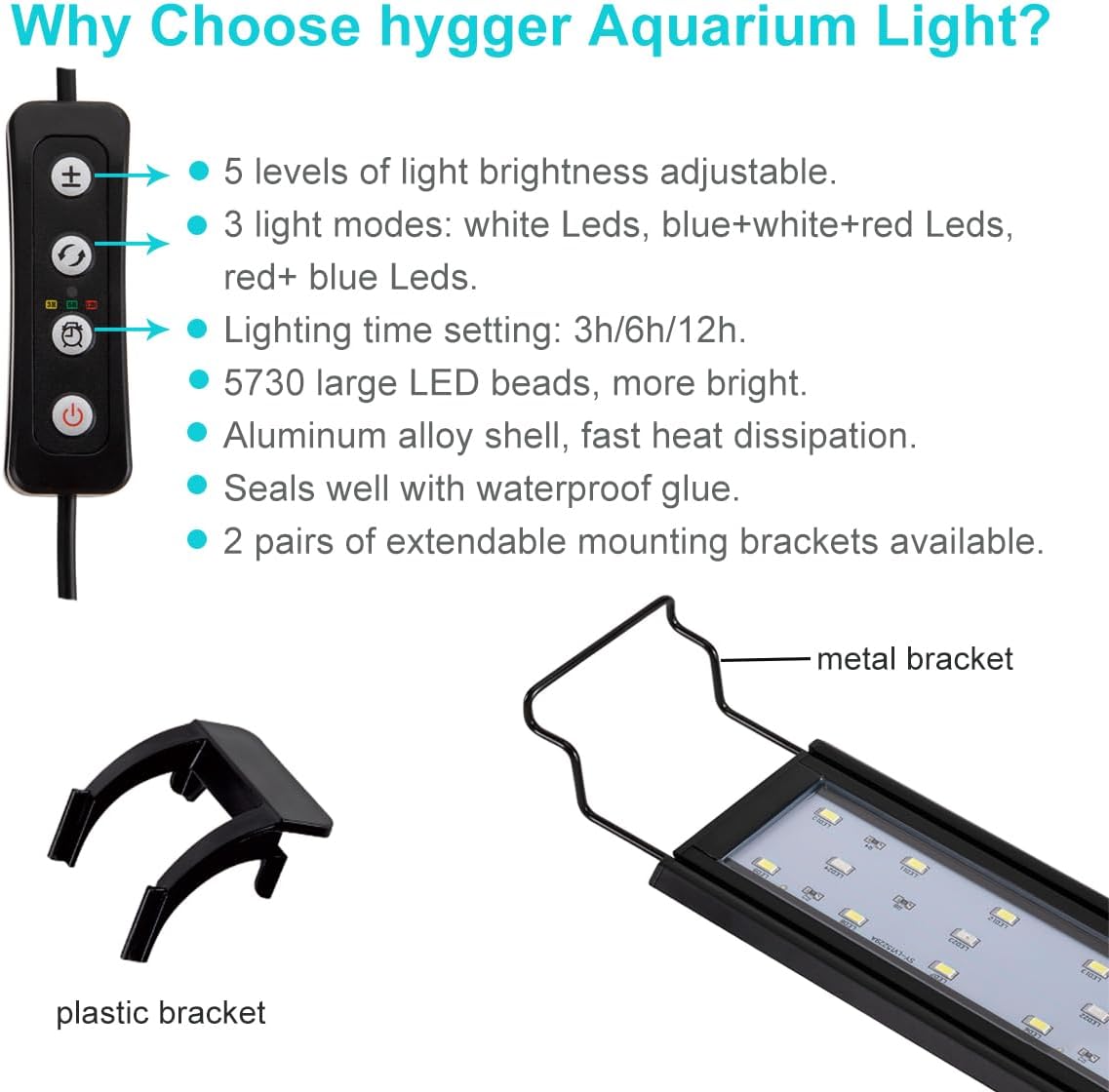
Marketing images show a sleek fixture hovering over a pristine aquascape. What they don’t show is a person crouching at the edge of the tank, squinting at two tiny buttons while trying to remember which long-press sequence sets the “off” time versus the “ramp” time.
Practical Fishkeeping’s LED buyer’s guide notes that timer usability is one of the most underweighted factors in purchasing decisions, even though it’s what most hobbyists interact with every time they make a change to their schedule. The spec sheet tells you “built-in timer” — it doesn’t tell you what happens when the power blinks off during a storm.
The two things that trip buyers up most often:
- Settings retention after a power outage. Some lights save your programmed schedule to onboard memory; others reset to factory defaults every time power is interrupted.
- The difference between a “24/7 auto cycle” and a manual schedule. These are not interchangeable, and picking the wrong mode for your goals creates real problems.
Understanding both before you buy will save you a frustrating first few weeks.
Auto Cycle vs. Manual Schedule: The Core Decision
Think of a 24/7 auto cycle as a pre-written story the light tells every day, without you scripting it. The fixture runs through a full simulated day — gradual brightening in the morning, peak intensity midday, a long color-shift toward red and amber tones in the evening, then a slow fade to darkness — on a loop, every 24 hours, automatically. You don’t set specific on/off times; the light figures out where it is in its cycle based on an internal clock you set once at setup.
A manual schedule, by contrast, is a blank page. You define each time period: “on at 8:00 a.m., ramp to 80% by 9:00 a.m., hold until 7:00 p.m., off at 8:00 p.m.” You get precise control, but you also take on the configuration work.
Per Aquatic Plant Central’s photoperiod guide, most planted tanks do well with 6–10 hours of light per day, with a midday “siesta” period sometimes used to interrupt algae growth cycles. The auto cycle handles the gradual transitions beautifully but gives you less say over total duration. Manual schedules let you dial in exact hours, which matters if you’re fighting algae or running CO₂ injection timed to your light.
The quick tradeoff table:
| Feature | 24/7 Auto Cycle | Manual Schedule |
|---|---|---|
| Setup complexity | Low — set clock once | Medium to high |
| Sunrise/sunset simulation | Built in | Depends on fixture |
| Precise daily hours | Fixed by manufacturer | Owner-defined |
| Algae-management control | Limited | High |
| Best for | Low-tech, community tanks | Planted, CO₂-injected, algae-prone |
What Owners Are Actually Saying: Model by Model
Hygger 978 — The Reliable Workhorse
The Hygger 978 stands out in aggregated owner reviews for one thing above all others: it simply keeps working. Multiple owners report two-plus years of daily operation without issues, which is a long runway by mid-market LED standards. Reviewers consistently praise the 24/7 auto-cycle mode as its standout feature — the light handles the sunrise-to-sunset simulation on its own, and most owners in low-tech planted setups report that they set it up once and haven’t touched it since.
For buyers whose priority is hands-off reliability over granular control, the pattern in reviews is clear: this is the fixture that gets quietly praised rather than loudly complained about.
Hygger 48–55” (Longer Bar Models) — The Power-Outage Problem
Here’s where owner experience diverges sharply from spec-sheet promises. Reviewers of the longer Hygger bar fixtures — particularly those marketed for 48–55” tanks — flag a specific, recurring real-world problem: the light loses all programmed settings after any power interruption.
That means every time your power blinks, trips, or you unplug the fixture during a water change, you’re starting the programming process from scratch. For a tank in a home with reliable power and an owner who rarely moves the light, this might be a minor annoyance. For anyone in an area with frequent outages, or who travels and relies on a caretaker, this is a genuine operational liability.
TFH Magazine’s piece on circadian rhythms in freshwater aquariums notes that inconsistent photoperiods — exactly the kind caused by a light resetting to “always on” after an outage — are a documented driver of stress in fish and algae blooms in planted tanks. The hardware may be solid; the memory architecture is the weak link.
Hygger 16W — The “1972 Sleep Function” Problem
One owner’s review of the Hygger 16W awarded zero stars specifically for the timer functionality, comparing it to “the sleep function on a TV in 1972.” That’s a specific and memorable complaint — and it points to a category-wide issue with entry-level Hygger fixtures: the off-timer behavior is poorly implemented, confusing to program, and in some cases appears to function more like a countdown than a true scheduled off-time.
The Spruce Pets’ guide on aquarium light timers recommends that any timer-controlled fixture be verified over three consecutive days after setup to confirm it’s actually cycling as intended — advice that feels especially relevant for this model tier.
Hygger Advanced Remote-Control Model — Comfort Beats Crouching
The remote-control Hygger model addresses one of the most common complaints in the category: having to physically crouch at tank level, pressing tiny buttons in a specific sequence to program the light. Reviewers note that the remote makes the programming process significantly more comfortable — you can stand back, see the tank at eye level, and make adjustments without contorting yourself.
The tradeoff: at least one reviewer reported receiving a unit with physical damage out of the box, which is a QC note worth flagging if you’re ordering. The programming logic itself is similar to other Hygger fixtures, so the remote doesn’t solve the underlying complexity — it just makes navigating that complexity less physically awkward.
SEAOURA — Serious Scheduling, Serious Learning Curve
The SEAOURA fixture takes a different approach. Its standout hardware feature is a dedicated 660nm red LED channel — that wavelength sits in the “far-red” spectrum that Advanced Aquarist’s spectral quality overview identifies as particularly efficient for plant photosynthesis, driving stronger stem plant growth and carpet plant density than fixtures that skimp on it.
On the programming side, owners describe a multi-period scheduling system: you can define several distinct time blocks across the day, each with its own intensity and color settings. For a planted tank with CO₂ injection, this is genuinely useful — you can schedule a low-intensity “pre-ramp” period before CO₂ comes on, peak intensity during your main photoperiod, and a slow evening wind-down.
The consistent caveat in owner reviews, though, is that “understandably confusing” is the polite way to describe the setup process. Reviewers who invested time in reading the manual and working through the programming sequences report high satisfaction. Reviewers who expected plug-and-play behavior were frustrated. This is a fixture that rewards patience at setup and punishes impatience.
By the Numbers
A realistic snapshot of what the mid-market freshwater LED timer category delivers in 2026:
- 6–10 hours: Recommended daily photoperiod for most planted freshwater tanks (Aquatic Plant Central)
- 3–7 time periods: Typical programmable block range across mid-market fixtures with manual scheduling
- 0: Number of the above fixtures that offer smartphone app control (as of current spec sheets and owner reports — none in this tier are app-connected)
- 24 hours: Full cycle time for auto-cycle modes — the light completes one full simulated day, then repeats
Frequently Asked Questions
Does the Hygger light remember my timer settings if the power goes out? It depends on the specific model. The Hygger 978 in auto-cycle mode retains its clock setting in most owner reports. However, the longer-bar Hygger models (the 48–55” range) are specifically flagged by multiple reviewers for losing all programmed settings after power interruptions — a genuine frustration for anyone with unreliable power or who unplugs the fixture regularly during maintenance.
What is the difference between a 24/7 auto cycle and a manual schedule? A 24/7 auto cycle is a pre-programmed loop: the fixture simulates a full day’s lighting arc on its own, repeating every 24 hours. You set the clock once, and the light handles everything else. A manual schedule requires you to define each on/off period and intensity yourself — more work upfront, but more control over exact hours, which matters for algae management and CO₂-synchronized ramp timing.
How many time periods can I set on the SEAOURA programmable light? Based on owner reports and published product documentation, the SEAOURA supports multiple programmable time periods per day — typically enough to set distinct morning, midday, and evening intensity blocks. Reviewers who work through the manual describe it as genuinely flexible, though the programming interface requires patience to learn initially.
Which of these lights can I control from a smartphone app? None of the fixtures covered in this guide — the Hygger 978, the Hygger 16W, the Hygger 48–55”, the Hygger Advanced remote-control model, or the SEAOURA — offer smartphone app control based on current published specifications and owner reports. App connectivity in freshwater LED fixtures is generally found in higher price tiers (Fluval, Current USA Satellite Pro) or reef-focused systems.
Will any of these lights actually ramp brightness up slowly like a sunrise, or do they just switch on at full power? The Hygger 978’s 24/7 auto-cycle mode does include a genuine gradual ramp — owners consistently describe a soft sunrise-to-sunset simulation. The SEAOURA, with its multi-period scheduling, can be programmed to step up incrementally if you configure each period at progressively higher intensity. The entry-level Hygger models (including the 16W) are more likely to switch on abruptly, which is consistent with the complaints about clunky timer behavior. True continuous-ramp behavior (smooth dimming rather than stepped levels) is the exception, not the norm, at this price tier.
The Decision Rule
Here’s the honest framework based on what owners report:
- If you want set-it-and-forget-it simplicity and long-term reliability: The Hygger 978 in auto-cycle mode is the consistent performer. Accept that you’re trading scheduling precision for ease of use.
- If you’re running CO₂ injection or actively managing algae: The SEAOURA’s multi-period scheduling is worth the learning curve. Budget a genuine evening to read the manual before declaring it too complicated.
- If your power is unreliable or you do frequent water changes: Avoid the 48–55” Hygger bar models until the memory-retention issue is addressed in a hardware revision. The reset behavior will erode your photoperiod consistency in exactly the moments that matter.
- If your main frustration with other lights has been physically programming them: The Hygger Advanced remote-control model removes that specific pain point — but it won’t solve deeper scheduling logic issues, so evaluate whether comfort or capability is your actual gap.
The timer on your fixture isn’t a footnote. It’s the variable your tank lives on, every single day.