Your aquarium light’s timer is, in a word, the invisible caretaker of your tank. A timer in this context is any feature — built into the fixture itself or managed through a smartphone app — that automatically turns your light on and off on a schedule, sometimes mimicking gradual sunrise and sunset. For freshwater planted tanks especially, consistent lighting duration matters: too many hours of light causes algae blooms; too few stunts plant growth. The promise of a $30–$80 LED fixture with a built-in auto-schedule sounds like a solved problem. Plenty of buyers are discovering it is anything but. This article maps the real failure modes buyers have reported across several popular Hygger and competing models, explains why they happen, and gives you a clear decision framework so you can match the right fixture to the reliability level your tank actually demands.
If you already know what a photoperiod is and you’ve cursed at a blinking remote at least once, you’re in the right place. Let’s get specific.
| EDITOR'S PICKhygger Advanced Remote Control… | Mid-tierhygger Auto On Off LED Aquarium… | Budget pickhygger 16W Full Spectrum Aquari… | |
|---|---|---|---|
| Wattage | 58W | — | 16W |
| Tank length | 48–54 in | 48–55 in | 24–30 in |
| Timer | — | ✓ | — |
| Control | Remote | — | External controller |
| Light modes | DIY/Default/Weather | Daylight/Moonlight | White/Blue/Red LEDs |
| Color channels | — | 7 colors | 3 colors |
| Price | $99.99 | $71.24 | $39.99 |
| See on Amazon → | See on Amazon → | See on Amazon → |
The Timer Problem Is Worse Than the Marketing Suggests
Walk into any major online marketplace and the product listings for budget freshwater LEDs read like a checklist of solved problems: “24/7 auto cycle,” “programmable timer,” “sunrise/sunset simulation.” Buyers across multiple Hygger models have discovered that these phrases describe features with sharp, sometimes infuriating limitations — and the limitations aren’t disclosed prominently.
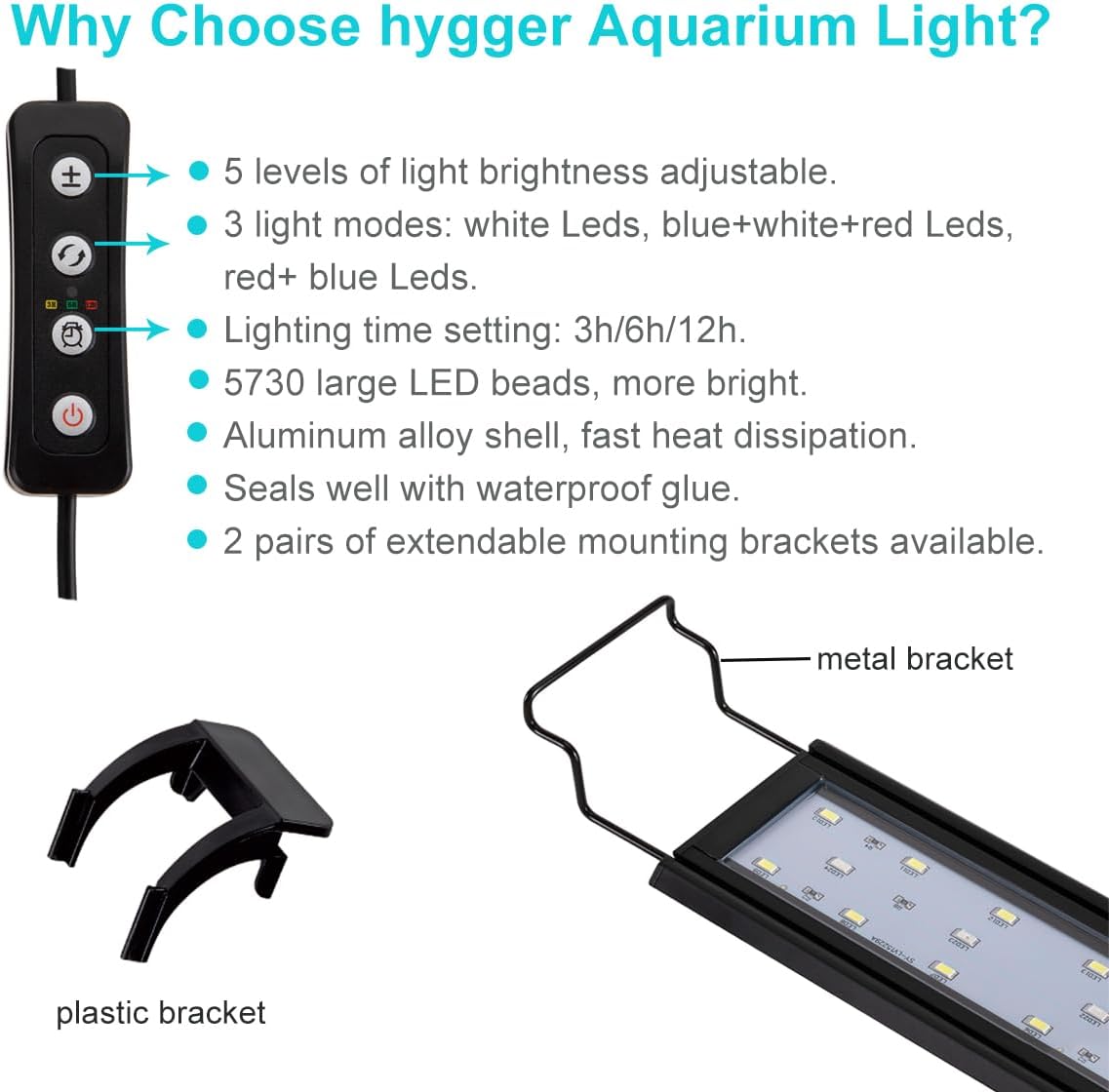
The most widely cited complaint, documented across aggregated reviews of the Hygger 16W fixture, is what one reviewer described as a “1972 TV sleep function.” The timer turns the light off at a scheduled time. That’s it. It does not turn the light back on. To get light the next morning, the owner either has to press a button manually or wire the fixture into a separate mechanical or smart-plug timer — effectively paying for a timer feature and then buying a second timer to make it actually work. Practical Fishkeeping’s beginner lighting guide notes that this single-direction “off-only” timer design is a known category issue across entry-level fixtures, not unique to one brand, but it is particularly frustrating when marketed as a scheduling solution.
The second major failure mode is setting loss after power interruption. Owners of the Hygger 48–55” model report that any power outage — even a brief one — wipes all programmed settings. The light returns to a factory default state. For a planted tank keeper running a precision photoperiod (the daily window of light your plants receive), this is not a minor inconvenience. It means your tank can go from a healthy 8-hour cycle to a 12-hour or continuous-on state until you notice and reprogram. Aquatic Plant Central’s community FAQ on LED lighting highlights setting retention after power loss as one of the top overlooked specs when buyers comparison-shop budget fixtures.
By the Numbers: What Buyers Actually Care About
| Feature | Hygger 16W | Hygger 48–55” | Hygger Advanced 24/7 | SEAOURA | FZONE App Light |
|---|---|---|---|---|---|
| Auto on/off cycle | Off-only | Full cycle | Full 24/7 auto | Multi-period | App-scheduled |
| Retains settings after outage | No data | No | Yes | Yes | Yes (post-update) |
| App required | No | No | No | Optional | Yes |
| Sunrise/sunset ramp | No | Limited | Yes | Yes | Yes |
| 660nm spectrum | No | No | No | Yes | Varies |
Compiled from aggregated owner reviews; manufacturer spec sheets; TFH Magazine planted tank lighting coverage.
The Models That Actually Work — and Why
Not every fixture in this category is a disappointment. The pattern in owner reviews is clear enough to act on.
Hygger Advanced 24/7 — the set-and-forget benchmark
The Hygger Advanced 24/7 model receives consistent multi-year praise from owners who run it without intervention. The core value proposition is a pre-programmed 24/7 cycle that mimics natural light progression — gradual ramp-up in the morning, peak intensity midday, gradual dimming in the evening, and a low moonlight mode overnight. No app. No remote programming required. You plug it in, select the 24/7 mode, and it runs.
Owners who have run this fixture through power interruptions report that it returns to the 24/7 auto-cycle when power is restored, rather than going to a blank or full-on state. This is the critical differentiator. For a planted tank running CO₂ injection (a dissolved carbon dioxide system that boosts plant growth during lit hours), having the light schedule stay consistent after an outage isn’t a nice-to-have — it’s the difference between a stable system and a crash.
The Spruce Pets’ aquarium lighting setup guide recommends auto-cycle fixtures specifically for hobbyists who don’t want to monitor their system daily, calling the hands-off reliability more valuable than extra programmability for most freshwater planted tanks.
SEAOURA — best spectrum flexibility, steeper learning curve
SEAOURA fixtures offer something genuinely different at the mid-budget tier: multi-period programmability and dedicated 660nm red LEDs — a wavelength that research associates with enhanced photosynthesis in aquatic plants. TFH Magazine’s planted tank lighting coverage notes that 660nm is often absent from budget LED arrays, which tend to prioritize visible white output over biological plant response.
The tradeoff is setup complexity. Owners consistently describe an initial configuration process that requires patience. The instruction documentation has earned pointed criticism in reviews for being ambiguous on how to string multiple time periods together. Once configured, owners report the settings hold reliably, but getting to “correctly configured” takes real effort. If you’re detail-oriented and willing to spend 30–45 minutes on setup, the payoff in spectral quality is real. If you want to plug in and forget it, look elsewhere.
FZONE App-Controlled Light — honest improvement, dependency acknowledged
The FZONE app-paired fixture occupies an interesting position: it received early criticism for app instability, and then owners who reviewed it post-software-update describe a meaningfully improved experience. The app now allows granular scheduling, intensity curves across the day, and color channel control.
The honest limitation is structural: app-dependent lights are only as reliable as the app, the phone OS version, and the local WiFi connection. Owners in aggregated reviews note that Bluetooth pairing occasionally requires a re-pair after phone updates. For a hobbyist who enjoys the control and checks their phone setup regularly, this is manageable friction. For a set-and-forget scenario — a hospital waiting room planted display, a vacation situation, or a secondary tank you check weekly — app dependency is a genuine reliability risk.
How to Choose: A Decision Framework
The buyer confusion in this category comes from fixtures being marketed as equivalent when they serve genuinely different use cases. Here’s the decision logic distilled from the owner experience patterns:
If your priority is zero-maintenance reliability after power outages: The Hygger Advanced 24/7 is the clear pick. The auto-cycle mode survives interruptions and requires no ongoing management. You give up spectral precision and manual customization, but you gain a system that runs itself.
If you want spectral quality and multi-period control and you’ll invest in setup: SEAOURA is worth the configuration friction. The 660nm channel is a real differentiator for planted tanks. Budget 45 minutes for initial programming and keep the manual accessible.
If you want app-level granular control and you’re comfortable with the dependency: The FZONE fixture post-update is a capable option. Understand that you’re accepting a maintenance relationship with the app ecosystem, not a fire-and-forget install.
If you’re looking at the Hygger 16W or the Hygger 48–55” specifically for their timer features: Be aware going in that the timer architecture on these models has significant real-world limitations. The 16W’s off-only timer and the 48–55“‘s setting-loss behavior after outages are documented buyer pain points, not edge cases. Pair these with a smart plug or mechanical timer if you need reliable on/off automation.
Aquatic Plant Central’s community discussions consistently surface one piece of meta-advice that holds up: for any fixture below $80 with a built-in timer, test the power-loss behavior in week one by deliberately cutting power and checking what state the light returns to. It’s a five-minute test that reveals the most important reliability characteristic before it becomes a crisis at week twelve.
Frequently Asked Questions
What happens to my light’s timer settings when the power goes out?
It depends entirely on the fixture’s firmware design — and most budget lights don’t document this clearly. The Hygger 48–55” is a confirmed example where all settings are lost after any power interruption, reverting to factory defaults. The Hygger Advanced 24/7, by contrast, returns to its built-in auto-cycle mode. SEAOURA and FZONE owners report settings are retained. Test this yourself during the first week of ownership by cutting power briefly and observing the light’s behavior on restoration.
What is the difference between a 24/7 auto-cycle mode and a programmable timer?
A 24/7 auto-cycle is a fixed, factory-defined lighting curve baked into the fixture’s firmware. The light follows the same gradual ramp-up, peak, ramp-down, and moonlight pattern every day without any user input. A programmable timer lets you define your own on and off times — or in more sophisticated systems, multiple periods and intensity levels throughout the day. Auto-cycle is simpler and more resilient. Programmable timers offer more control but require correct setup and, in many budget models, can lose their settings.
Can I set a gradual sunrise and sunset on budget freshwater lights?
Some budget fixtures include this, but implementation varies widely. The Hygger Advanced 24/7 includes ramped transitions as part of its built-in cycle. SEAOURA includes programmable ramp periods. Most single-mode budget lights — including the basic Hygger 16W — do not. Practical Fishkeeping notes that gradual transitions are genuinely beneficial for fish stress reduction, but they’re not a requirement for plant health; consistent total duration matters more for photosynthesis than transition smoothness.
Why does my Hygger light keep changing settings by itself?
The most common cause is unintended button presses — the control interfaces on several Hygger models cycle through modes with a single button tap, making it easy to accidentally change modes when handling or cleaning the tank. A secondary cause is power interruptions resetting the unit to a default mode that differs from your programmed settings. Review your firmware version if the manufacturer provides updates, and if the issue persists, a smart plug that cuts power on a defined schedule effectively sidesteps the internal timer entirely.
Which freshwater LED lights work without an app or remote?
The Hygger Advanced 24/7 is the strongest example in this tier — once plugged in and set to auto-cycle mode, it operates indefinitely without app, remote, or manual intervention. Basic Hygger models also require no app but have the timer limitations described above. SEAOURA can be configured standalone after initial setup. The FZONE fixture is explicitly app-dependent for scheduling control. If app-free operation is a hard requirement — for a secondary tank, a travel situation, or a commercial display — prioritize fixtures with a self-contained auto-cycle over app-scheduled models.