If you’ve ever stood in front of a freshwater tank that looks flat and dull — plants barely growing, colors washed out — the fix is almost always the light sitting on top of it. LED lighting (Light Emitting Diode, meaning solid-state bulbs that run cool, sip electricity, and last for years) has replaced fluorescent tubes as the default choice for freshwater planted tanks. The four brands covered here — NICREW, Hygger, FZONE, and SEAOURA — all live in the $25–$80 price range and get recommended constantly by hobbyists. But they are not interchangeable. Each one makes a different set of tradeoffs around spectrum (the blend of light colors emitted), PAR output (Photosynthetically Active Radiation — the measure of light energy plants can actually use for growth), programmability, and one surprisingly divisive feature: whether the light remembers your settings after a power outage. This guide breaks all of that down so you can pick the right fixture the first time.
| EDITOR'S PICKFZONE Aquarium Light for Plants | Mid-tierhygger Auto On Off LED Aquarium… | Budget pickNICREW ClassicLED Plus LED Aqua… | |
|---|---|---|---|
| Fits tank length | 47.2–55.1 in | 48–55 in | 30–36 in |
| Wattage | 72W | — | 21W |
| App control | ✓ | — | ✗ |
| Sunrise/sunset | ✓ | — | ✗ |
| Color channels | Full spectrum | 7 colors | Daylight + moonlight |
| Price | $87.99 | $71.24 | $48.99 |
| See on Amazon → | See on Amazon → | See on Amazon → |
The Feature That Actually Divides These Four Lights
Before diving into specs, there is one decision point worth naming right at the top, because it filters out a fixture immediately for some buyers: power-loss memory.
When your power cuts out — a tripped breaker, a brief outage, an unplugged cord — some lights come back exactly where they left off. Others reset to factory defaults and forget every schedule and dimming curve you programmed. Across aggregated owner reviews, this is the single most-cited dealbreaker in this price category.
SEAOURA has explicit power-off memory. Owners who switched to it specifically name this feature as the reason — reviewers on product listings frequently mention they came from a Hygger unit and chose SEAOURA directly because of it.
Hygger’s Auto On/Off model (distinct from the Hygger 978, discussed below) loses all programmed settings on power loss. Multiple owners flag this as a dealbreaker, particularly for planted tanks where a consistent photoperiod — the number of hours of light per day — matters for plant health and algae control.
NICREW ClassicLED Plus uses a physical external timer in many owner setups, which sidesteps the memory issue entirely by removing the scheduling from the fixture’s brain.
FZONE Light 120 relies on its app for scheduling. If power cuts and the app reconnects, it resumes the stored schedule — though owners note the app must be paired properly for this to work smoothly.
The practical decision rule: If you live somewhere with frequent outages, or if you simply don’t want to reprogram your light after every thunderstorm, SEAOURA or FZONE are the safer choices. If your power is stable and you want simplicity, the Hygger 978 or NICREW are excellent.
Quick Fixture Snapshot
| Fixture | Best For | Power-Loss Memory | Multi-Unit App? | Plant Tier |
|---|---|---|---|---|
| NICREW ClassicLED Plus | Dense carpets, demanding plants | Via external timer | No | Medium–High |
| Hygger 978 Advanced 24/7 | Day-night simulation, large displays | Loses settings | No | Low–Medium |
| FZONE Light 120 | Large tanks (100–125 gal), multi-unit | Yes (via app) | Yes | Low–Medium |
| SEAOURA Planted LED | Set-and-forget reliability | Yes (onboard) | No | Low–Medium |
Head-to-Head: Each Fixture in Detail
NICREW ClassicLED Plus — The Quiet Performer for Real Plant Growth
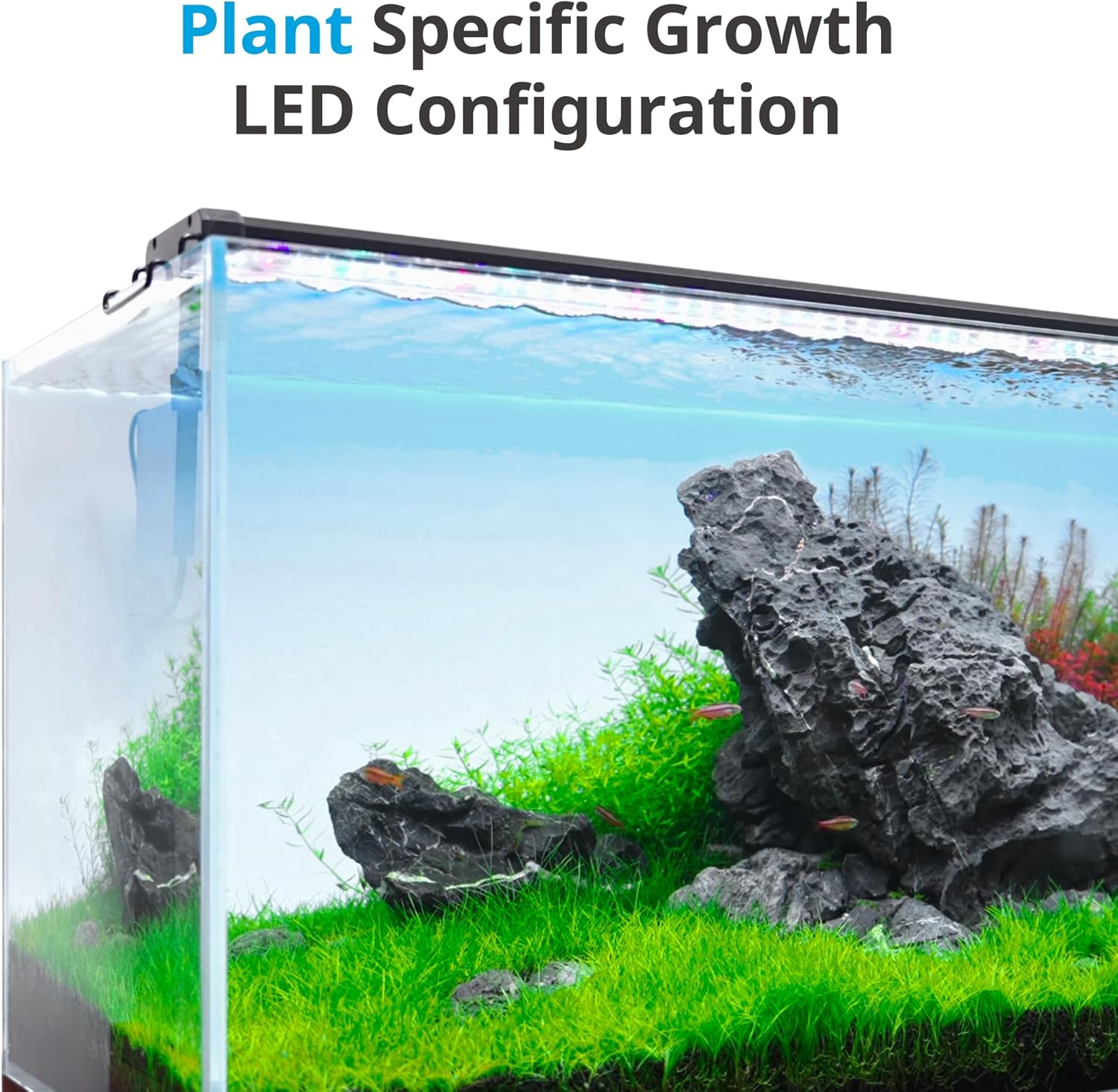
The NICREW ClassicLED Plus doesn’t try to be clever. There is no app, no sunrise simulation, no Bluetooth pairing. What it does offer, based on published specs and a consistent pattern across owner reviews, is genuine PAR output that translates to measurable plant growth.
Reviewers who upgraded directly from cheaper fixtures report that the NICREW ClassicLED Plus grew demanding foreground plants like Dwarf Hairgrass where their previous light had failed. That is a meaningful data point. Dwarf Hairgrass (Eleocharis parvula) is one of the standard benchmarks for a high-demand carpeting plant; it needs dense, even PAR coverage across the substrate to carpet rather than just clump.
Aquatic Plant Central’s Plant Lighting Requirements Overview notes that carpeting plants like Dwarf Hairgrass and HC Cuba generally need higher PAR values — typically in the 50–100+ µmol range at substrate level — than most budget LEDs deliver. The NICREW ClassicLED Plus appears to hit that range in shallower tanks (under 18 inches of water depth) based on what owners report at substrate level.
The tradeoff: you are giving up programmability. Most owners run it on a mechanical outlet timer — the kind that costs a few dollars and clicks on a physical dial. That is simple and reliable, but it means one brightness level all day, no ramp-up, no dawn/dusk simulation. For a low-tech planted tank or a fish-forward community setup, that is entirely fine.
Best fit: Owners running low-tech to medium-tech planted tanks (Java Fern, Anubias, Crypts, Bucephalandra) or anyone attempting a foreground carpet who wants genuine light output without complexity.
NICREW
$48.99
In stock on Amazon
Check price on AmazonHygger 978 Advanced 24/7 — The Day-Night Simulation Specialist
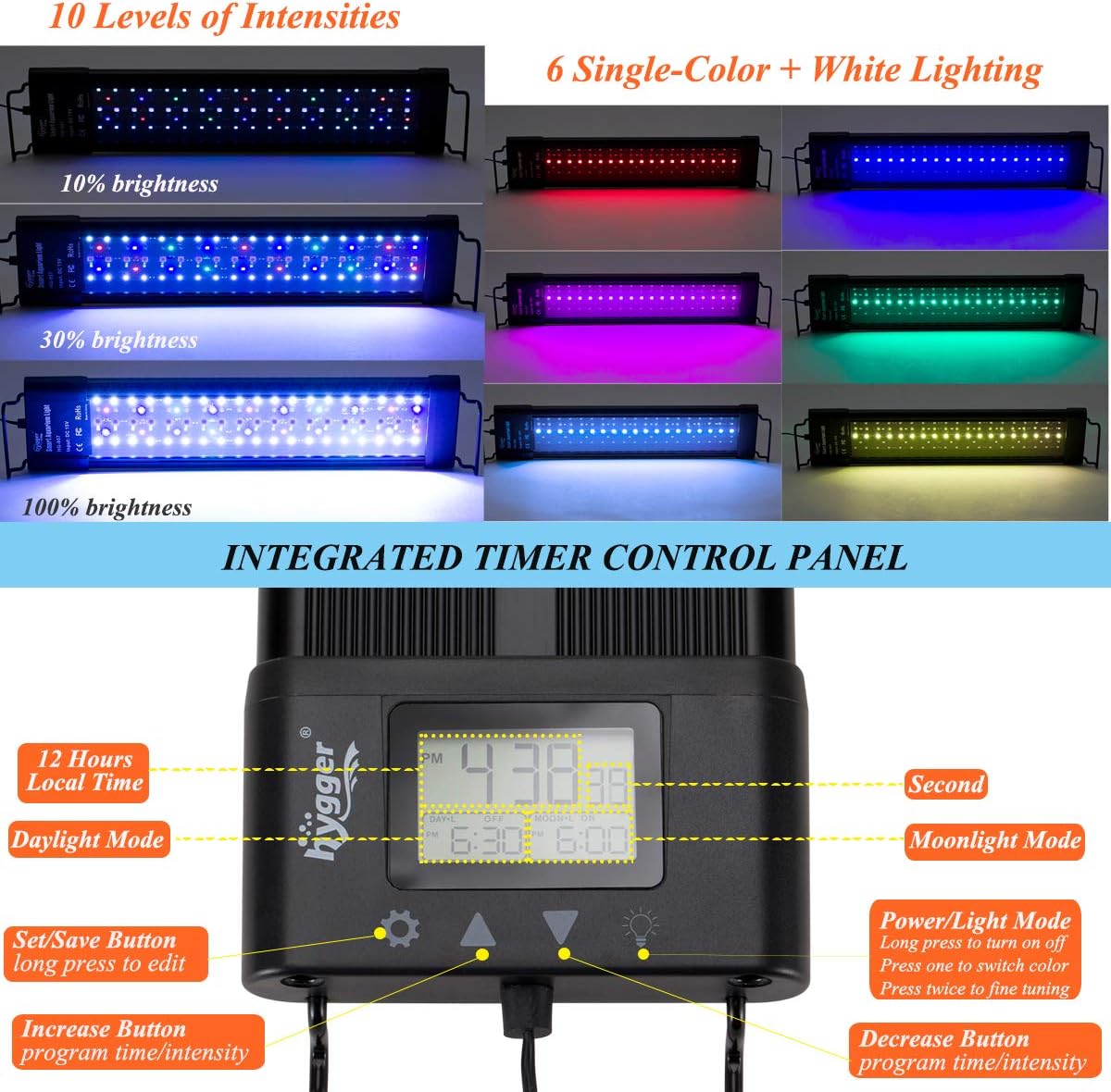
The Hygger 978 is the most popular fixture in this group by volume, and it earns that position. The signature feature is its automatic 24/7 day-night cycle: the light ramps up gently in the morning, peaks mid-day, dims in the afternoon, and shifts into a low-intensity moonlight mode at night. Owners consistently describe the effect as natural and visually compelling — particularly over cichlid displays and community tanks where fish behavior mirrors the light cycle.
One owner documented running a multi-unit array of Hygger 978 fixtures over a 450-gallon cichlid display tank, specifically calling out the brightness and seamless day-night simulation as reasons for choosing multiple units over a single high-end fixture.
The honest limitation: the Hygger 978’s Auto On/Off variant loses all custom programming on power loss. This is not a deal-breaker for every buyer, but it is a documented pattern in owner reviews — not an edge case. If your programming is simple, resetting takes a few minutes. If you have dialed in a complex ramping curve, losing it is genuinely frustrating.
On plant performance: TFH Magazine’s article “LED Lighting for Planted Freshwater Aquariums” notes that mid-range LED fixtures in this category often deliver adequate PAR for easy plants but fall short of the consistent deep-canopy penetration that demanding carpeting plants require. Owner reports with the Hygger 978 align with this — it grows easy to moderate plants reliably, but reviewers attempting Dwarf Hairgrass carpets report mixed results.
Best fit: Fish-forward community tanks, African cichlid displays, and planted setups running easy plants (Anubias, Java Fern, low-light stem plants). Outstanding value-per-dollar for the day-night simulation feature alone.
hygger
$71.24
In stock on Amazon
Check price on AmazonFZONE Light 120 — The Multi-Unit Solution for Large Tanks
The FZONE Light 120 targets a specific problem: what do you do when your tank is 120–125 gallons and a single budget fixture doesn’t cover the footprint? The answer FZONE offers is a fixture designed to be paired across multiple units, with app-based scheduling that syncs across all of them simultaneously.
Owners of large tanks — specifically the 120-gallon standard footprint (48” × 24”) and the 125-gallon — frequently run two or three FZONE units in tandem. The consistent praise across these multi-unit reviews is that app pairing works. Syncing multiple fixtures to the same schedule without independent timers or mismatched ramp curves is a real operational convenience, and reviewers note it as seamless.
Advanced Aquarist’s piece “PAR and Spectrum in Planted Tanks” observes that overlapping coverage from multiple mid-range fixtures can approximate the even PAR distribution of a single high-end fixture — provided the units are positioned to eliminate shadow gaps. The FZONE Light 120’s app allows brightness and scheduling adjustments per unit, which gives owners the flexibility to compensate for coverage asymmetry.
Plant performance is moderate — similar to the Hygger in the low-to-medium demand range. The FZONE’s real value proposition is logistics and scalability, not raw PAR per unit.
Best fit: Owners with 100–125-gallon community or lightly planted tanks who need multi-unit coordination without paying for a commercial-tier fixture array.
hygger
$71.24
In stock on Amazon
Check price on AmazonSEAOURA Planted LED — The Set-It-and-Forget-It Option
SEAOURA occupies a quieter corner of this comparison, but its owner community is notably loyal. The reason comes back to that power-loss memory: it works. Owners explicitly mention switching from other fixtures in this tier because they were tired of reprogramming after outages. SEAOURA delivers a consistent scheduled photoperiod that simply resumes after power interruption, without owner intervention.
Practical Fishkeeping’s Beginner Planted Tank Guide emphasizes consistent photoperiods as one of the most important factors in controlling algae — irregular lighting schedules are a leading cause of nuisance algae blooms in new planted tanks. A light that remembers its schedule after every power hiccup removes one variable from that equation.
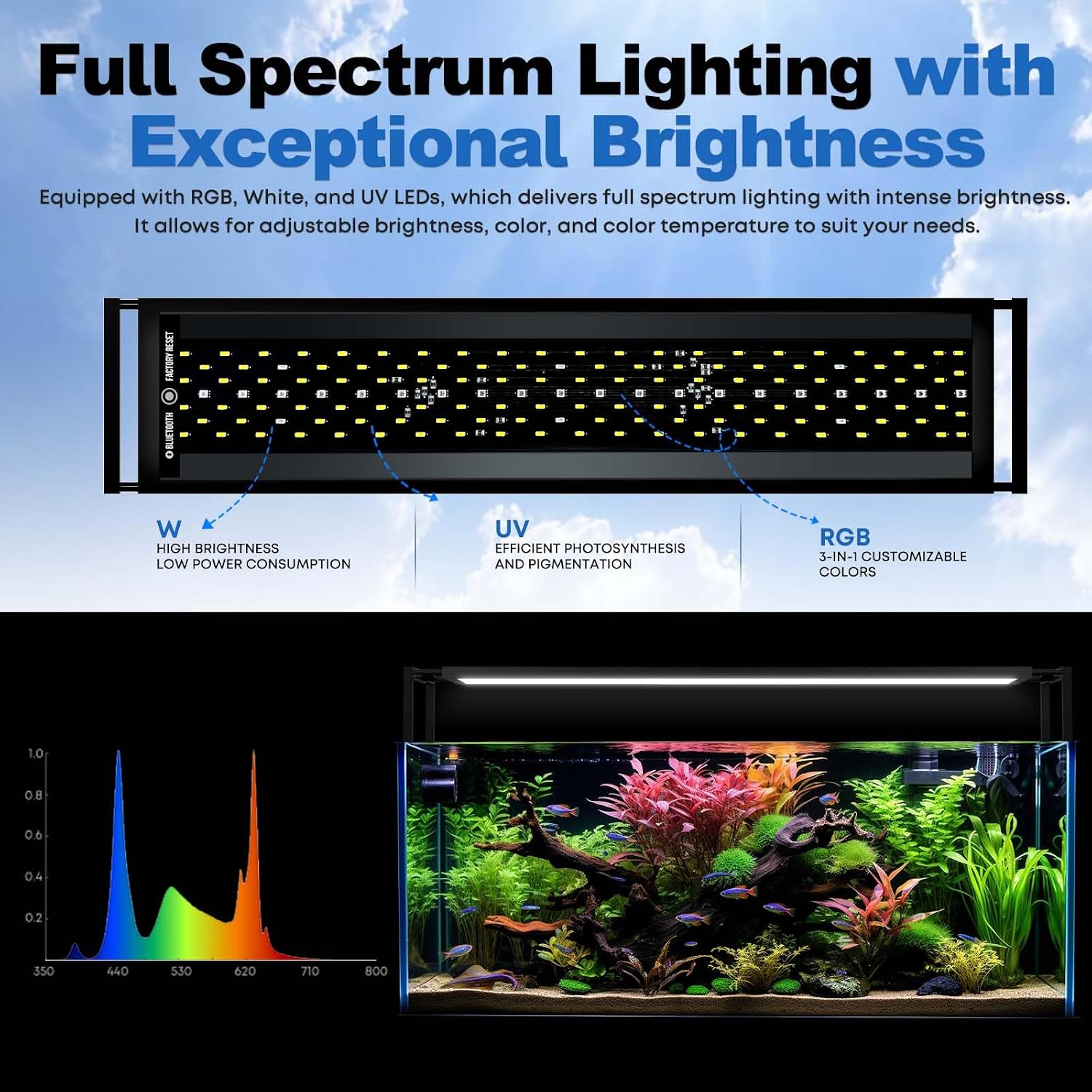
Spectrum-wise, SEAOURA units typically offer a planted-spectrum LED blend with both the red and blue peaks plants use most for photosynthesis. Plant performance sits in the low-to-medium demand range, consistent with others in this price tier. The Spruce Pets’ aquarium lighting roundup consistently positions SEAOURA as a reliable mid-range pick for hobbyists who prioritize reliability over advanced programmability.
Best fit: Owners who want a reliable, schedule-respecting light for low-to-medium planted tanks and don’t want to babysit their fixture after every power event.
FZONE
$87.99
In stock on Amazon
Check price on AmazonThe Manual Problem — and How to Solve It
Across all four fixtures, one pattern in owner reviews is impossible to ignore: buyers who don’t watch the instruction video struggle with programming. The printed manuals that come in the box are universally described as inadequate — confusing button sequences, missing steps, poorly translated instructions.
The fix is simple: before you touch a single button, search the fixture’s model name alongside “setup tutorial.” Manufacturer-uploaded video walkthroughs exist for all four of these lights, and owners who use them report smooth setup. Owners who rely on the paper manual report confusion and frustration. This is a known friction point, not a defect — just budget 15 minutes for the video before unboxing.
Frequently Asked Questions
Which of these lights will regain its settings after a power outage? SEAOURA has explicit onboard power-loss memory and is the clearest choice for this requirement. FZONE’s app-based scheduling also resumes after reconnection in most cases. The Hygger Auto On/Off model and NICREW ClassicLED Plus used without an external timer do not retain custom programming after a power cut.
Can the Hygger 978 grow carpeting plants like Dwarf Hairgrass or Monte Carlo? Owner reports suggest mixed results. The Hygger 978 performs well for easy-to-moderate plants but does not consistently deliver the PAR levels at substrate depth that demanding carpeting plants like Dwarf Hairgrass (Eleocharis parvula) or Monte Carlo (Micranthemum tweediei) require. For a reliable carpet attempt at this price tier, the NICREW ClassicLED Plus has stronger owner-reported success.
How many FZONE Light 120 units do I need for a 120-gallon planted tank? Most owners with a standard 120-gallon footprint (48” × 24”) run two units positioned end-to-end. Some owners of heavily planted setups run three for additional PAR depth and overlap. The app’s multi-unit sync is specifically built for this configuration.
Is the NICREW C10 24/7 bright enough for medium-demand plants or only low-tech setups? The NICREW C10 24/7 is positioned for low-to-moderate plant demands — Anubias, Java Fern, Crypts, and easy stem plants. For medium-demand plants, it can work in shallower tanks under 15 inches. The NICREW ClassicLED Plus is the better choice if medium-demand plant growth is the primary goal.
Does the Hygger Auto On/Off light work with a separate outlet timer, or does it conflict? Owners report that using a mechanical outlet timer with the Hygger Auto On/Off model creates a conflict — the fixture’s internal scheduling and the external timer can produce unexpected behavior. If you want to use an outlet timer, the NICREW ClassicLED Plus is designed with that workflow in mind and works cleanly with external timers.
What does WRGB mean, and do freshwater plants actually benefit from the additional channels? WRGB stands for White, Red, Green, and Blue — a four-channel LED spectrum that blends those wavelengths to produce both a visually appealing color rendering and a light profile that includes the red and blue peaks plants use most efficiently for photosynthesis. Advanced Aquarist’s “PAR and Spectrum in Planted Tanks” notes that plants primarily absorb red (~660–680 nm) and blue (~430–450 nm) wavelengths for photosynthesis. The white and green channels in a WRGB fixture improve visual color rendering — making fish colors pop and plants look vivid — rather than directly boosting plant growth rates. For pure plant growth, total PAR output at substrate level matters more than having a WRGB label. That said, WRGB fixtures typically look better to the human eye over a planted display, which is a legitimate reason to choose one.
The Decision Rule
If you want the clearest possible framework:
- If plant growth is the priority and you’re attempting carpeting species → NICREW ClassicLED Plus, paired with a mechanical outlet timer.
- If you want a dynamic day-night simulation and mostly keep fish or easy plants → Hygger 978 Advanced 24/7, and accept the power-loss caveat.
- If your tank is 100–125 gallons and you need multi-unit coverage → FZONE Light 120, two units minimum.
- If you want set-and-forget reliability and hate reprogramming after outages → SEAOURA, full stop.
None of these fixtures will disappoint at their price point if you match them to the right use case. The ones that generate negative reviews almost always involve a mismatch — someone using a fish-display light to grow a demanding plant carpet, or someone skipping the setup video and blaming the firmware. Get the fit right, watch the tutorial, and any of these four will run a clean planted display.