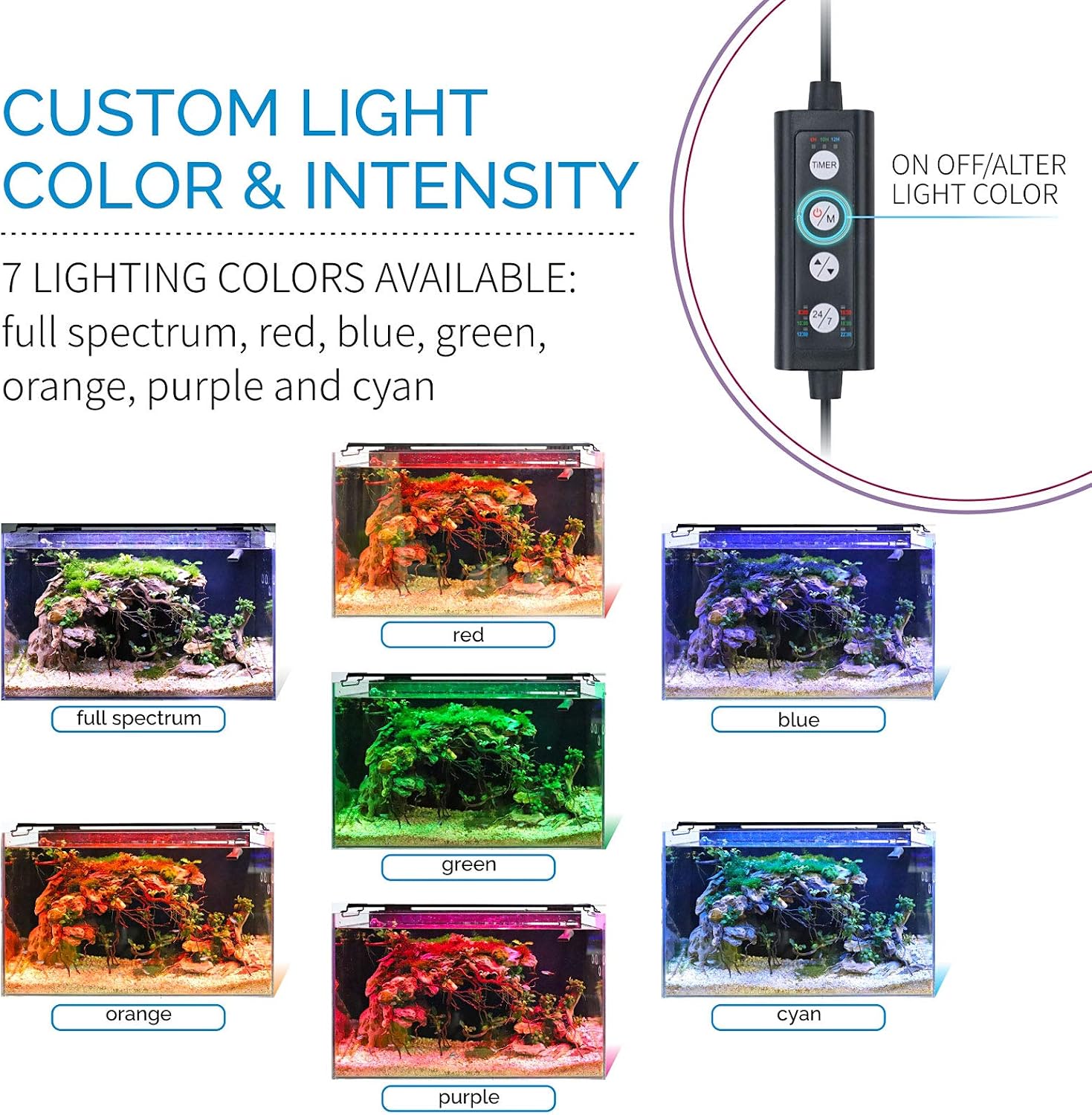
If you’ve ever forgotten to flip your aquarium light on in the morning — or left it blazing at 11 p.m. while your fish tried to sleep — you already understand the appeal of a 24/7 auto-cycle light. These are aquarium LED fixtures (LED stands for light-emitting diode, the energy-efficient bulbs inside modern aquarium lights) that automatically simulate a full day: a soft sunrise ramp-up in the morning, peak brightness through the afternoon, then a gradual sunset dimming into a faint moonlight glow overnight. You set the schedule once, and the light handles the rest — indefinitely. For planted tanks in particular, where consistent light duration is one of the primary drivers of healthy plant growth and algae control, that kind of reliable automation matters more than most beginners expect. This comparison looks at three popular mid-range options — the Hygger 978, the NICREW C10, and the SEAOURA — and tells you plainly which one earns your money based on owner-reported reliability, programming experience, spectrum quality, and a few important edge cases that don’t show up in the product photos.
| EDITOR'S PICKhygger Auto On Off LED Aquarium… | Mid-tierhygger Advanced LED Aquarium Li… | Budget pickSEAOURA Aquarium LED Light with… | |
|---|---|---|---|
| Fits tank | 48-55 in | 30-36 in | 24-30 in |
| DIY mode | — | ✓ | — |
| Dimmable | ✓ | — | ✓ |
| Thermometer | — | — | ✓ |
| Price | $71.24 | $50.34 | $49.99 |
| See on Amazon → | See on Amazon → | See on Amazon → |
What “24/7 Auto-Cycle” Actually Means — and Why It’s Not All the Same
The term “24/7 auto-cycle” sounds uniform, but implementations differ significantly across brands. At the basic level, every light in this comparison can run a continuous loop: sunrise, daylight, afternoon, sunset, moonlight, repeat. Where they diverge is in how many programmable time periods you get, whether individual color channels (white, blue, red, green) can be controlled independently, and — critically — what happens to your settings when the power goes out.
Practical Fishkeeping’s planted-tank lighting coverage notes that consistency in photoperiod (the number of hours your light is on each day) is one of the most underrated variables in algae management. A light that resets to factory defaults after every power blip doesn’t just annoy you — it disrupts the biological rhythm your plants and fish have adapted to.
Here’s where the three lights land on the features that actually move the needle:
| Feature | Hygger 978 | NICREW C10 | SEAOURA |
|---|---|---|---|
| Auto-cycle mode | Yes | Yes | Yes |
| Power-off memory | Yes (reported by owners) | Not confirmed in reviews | Yes (highlighted by reviewers) |
| Programmable time periods | Multiple preset phases | Simplified 24-hr mode | S1 / S2 / S3 three-period structure |
| Independent channel dimming | Yes | Limited | Yes |
| 660nm red LEDs | Not prominently noted | Not confirmed | Yes — specifically called out |
| Housing material | Aluminum alloy | Plastic | Aluminum alloy |
The Three Lights, Head to Head
Hygger 978: The Long-Term Reliability Pick
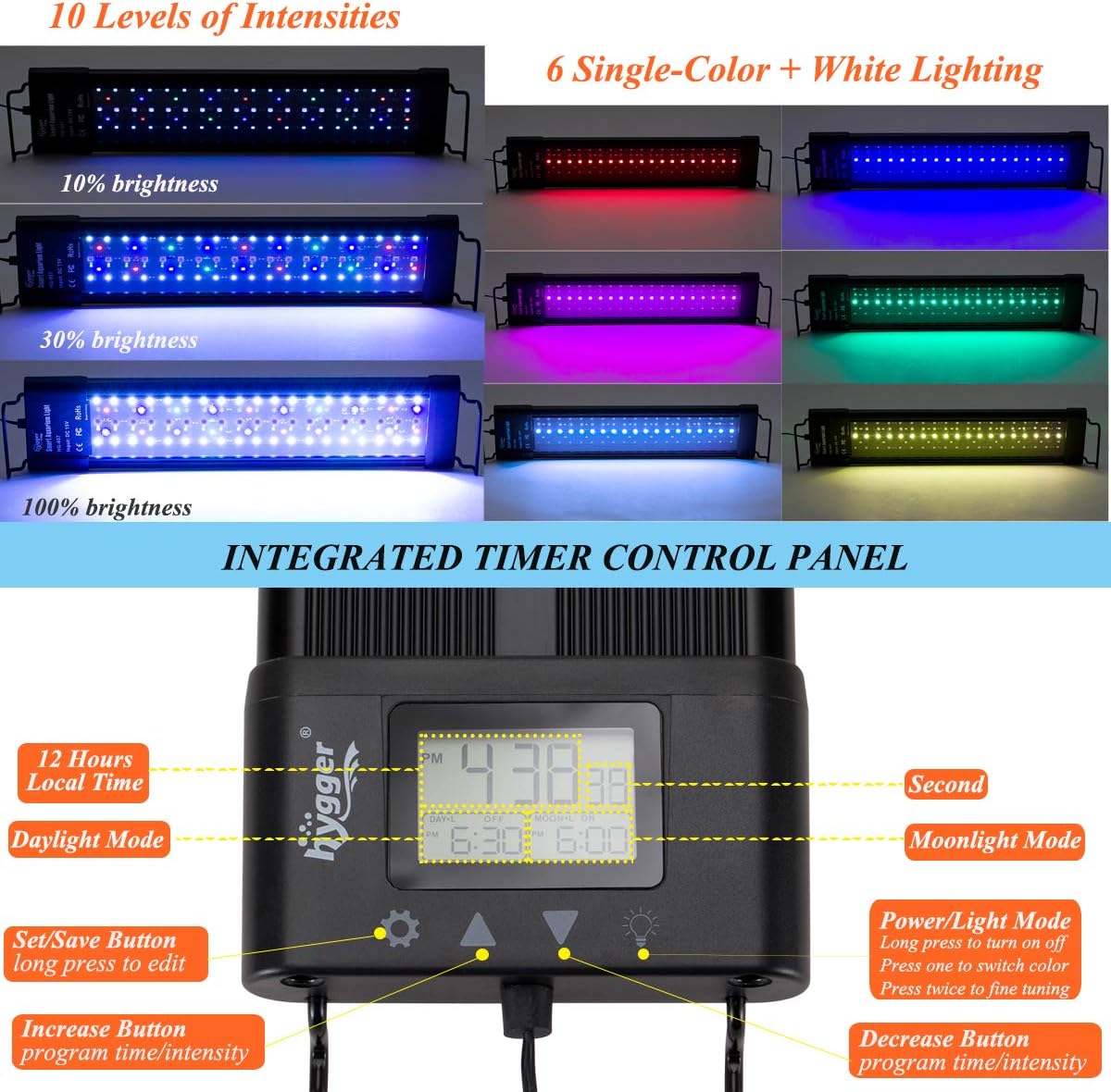
The Hygger 978 has developed a reputation among planted-tank owners that’s fairly unusual in this price bracket: genuine multi-year durability. Owners who left long-run update reviews specifically mention returning to their original posts at the two-year mark to confirm their units are still running strong and growing plants well. In a product category where LED drivers and controller chips often fail within 12–18 months, that kind of owner-reported longevity is worth taking seriously.
The Hygger 978’s auto-cycle implementation is mature. Owners report that programming, while it has a learning curve on first setup, follows a logical pattern once you’ve watched the included instruction video. The aluminum housing — a full metal shell rather than plastic — is consistently mentioned in reviews as running noticeably cooler to the touch than plastic-housed competitors. This matters practically: cooler-running electronics tend to last longer, and heat near the water surface in smaller tanks can incrementally raise water temperature in warm rooms.
As Aquatic Plant Central’s planted-tank lighting documentation notes, a stable, repeatable photoperiod is more important for most plants than peak intensity. The Hygger 978’s long-run reliability record serves this need well.
Where the Hygger line earns a meaningful caveat: the 48–55” version (a different SKU from the 978) draws a recurring complaint that it loses all programming when power is interrupted. Owners report frustration at having to reprogram from scratch after a power outage or if someone accidentally unplugs the unit. If you’re looking at the longer Hygger fixture, confirm the power-off memory behavior before committing. The 978, by contrast, does not carry this complaint in aggregated reviews.
hygger
$50.34
In stock on Amazon
Check price on AmazonNICREW C10: The Simplest Path to “Set and Forget”
The NICREW C10 earns its place in this comparison by solving a narrower problem very cleanly. Owners consistently highlight one specific quality-of-life win: they no longer have to turn the light on or off manually each day. For a keeper running a low-to-medium-light planted tank who wants automation without complexity, that’s exactly the pitch.
The NICREW C10’s 24-hour mode is praised for being bright and genuinely easy to activate. Reviewers who found other auto-cycle lights confusing to set up report that the C10’s simplified interface got them running quickly. The tradeoff is nuance — the C10 offers less granular control over individual color channels compared to the Hygger 978 or SEAOURA. If you want to dial in a specific blue-to-white ratio during the midday phase, or run a deeper red spectrum during a specific window, the C10 isn’t built for that level of adjustment.
Power-off memory behavior for the C10 isn’t definitively confirmed in aggregated owner reviews. If your setup is in a space with frequent power fluctuations, that’s a gap worth noting.
The Spruce Pets’ aquarium lighting roundup positions lights in the NICREW C10’s category as strong value picks for beginner-to-intermediate freshwater setups — tanks running easy stem plants, java fern, anubias, and crypts — rather than high-demand carpeting or demanding stem species like Hemianthus callitrichoides (HC Cuba) or glosso.
SEAOURA
$49.99
In stock on Amazon
Check price on AmazonSEAOURA: The Spectrum Nerd’s Pick at This Price Point
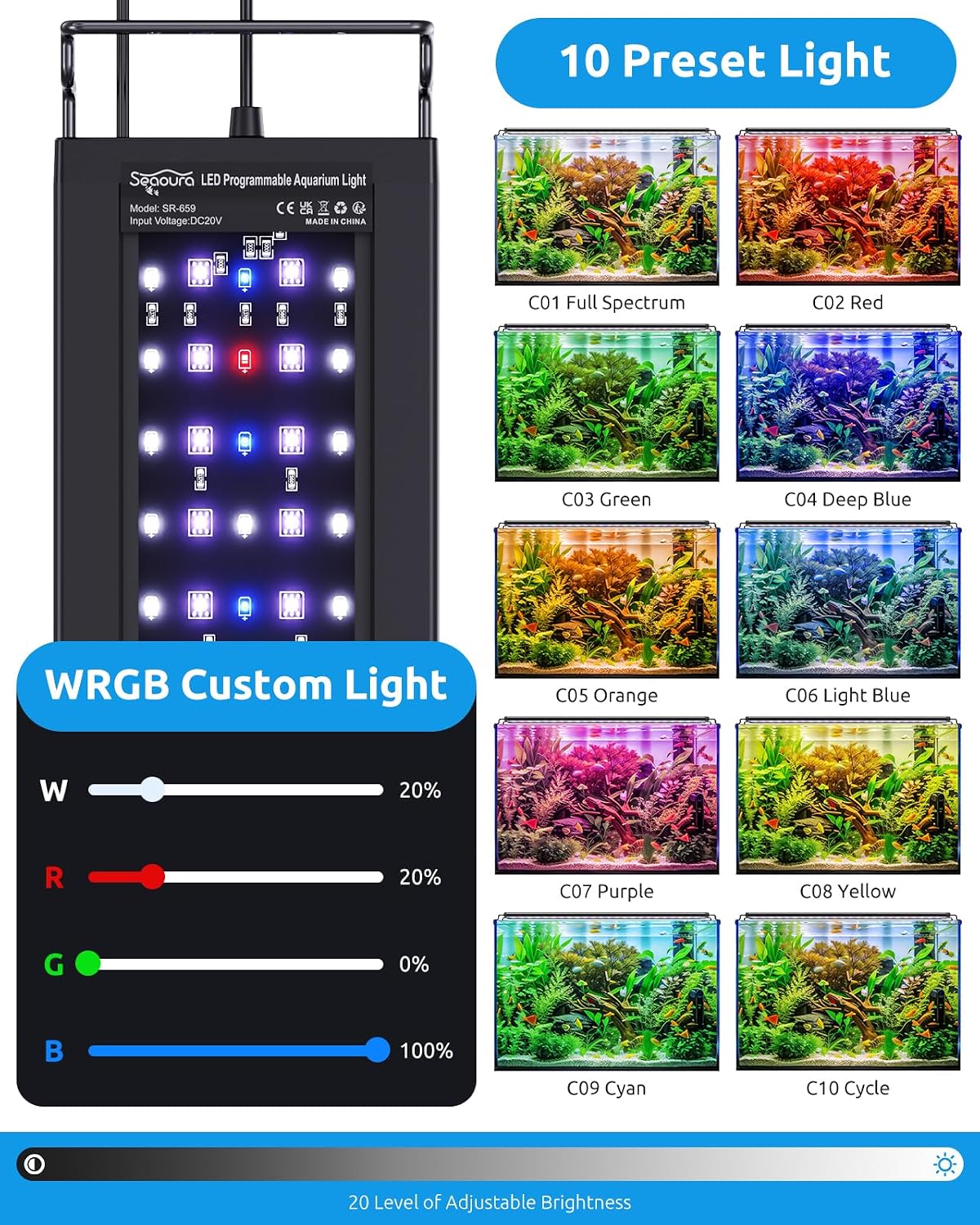
The SEAOURA stands out for one feature that most competitors at this price tier quietly skip: dedicated 660nm red LEDs. That wavelength sits in the deep red range — the part of the spectrum that TFH Magazine’s planted-aquaria coverage and aquatic plant literature consistently identify as most efficiently absorbed by chlorophyll-a, the primary photosynthetic pigment in aquatic plants. Most budget fixtures lean heavily on white and blue LEDs because they’re cheaper to source. Including a true 660nm red channel represents a deliberate engineering choice, and reviewers who noticed it specifically called it out as a meaningful differentiator.
The SEAOURA’s S1/S2/S3 programmable time-period structure is the other feature that earns it dedicated praise. Owners who detailed their setup process report that the three-period framework — where you define start time, intensity, and duration for up to three distinct phases — is logical and gives enough flexibility to build a convincing sunrise-to-moonlight cycle without requiring you to navigate an overly complex menu system. One long-form owner review walked through the entire programming sequence in detail and concluded it was genuinely user-friendly once the logic clicked.
Critically, the SEAOURA’s power-off memory is confirmed by owners as functioning correctly. Settings survive a power interruption and resume where they left off — a feature that the manufacturer appears to have prioritized deliberately, given how often reviewers mention it as a pleasant surprise.
For planted-tank keepers running moderate-to-demanding species — including some carpeting plants and mid-difficulty stem plants — the 660nm red channel gives the SEAOURA a legitimate photosynthetic edge over fixtures relying solely on white and blue diodes. Aquatic Plant Central’s planted-tank lighting documentation notes that red spectrum coverage in the 640–680nm range measurably improves growth rates in red-pigmented stem plants and boosts photosynthetic efficiency broadly. At this price tier, having it is unusual.
hygger
$71.24
In stock on Amazon
Check price on AmazonProgramming These Lights: Honest Expectations
A theme that runs through reviews of all three lights is that first-time setup can feel confusing. This is not specific to one brand — it’s endemic to button-and-remote aquarium light controllers, which pack a lot of functionality into a minimal interface. The pattern in owner reviews is consistent: people who struggle initially, then watch the manufacturer’s instruction video or read the manual carefully, almost universally report satisfaction afterward. People who skip that step and try to intuit the programming logic from scratch tend to leave frustrated reviews.
Practical advice, based on the aggregated owner experience:
- Watch the video first. All three manufacturers have setup instruction content. Spend 10 minutes with it before touching the controller.
- Program during the day. Trying to set sunrise and sunset times at night when the light is in a dim cycle adds confusion.
- Test memory before you rely on it. If power-off memory matters to you, deliberately unplug the unit after programming and confirm your settings survived before you consider setup complete.
Frequently Asked Questions
Does the light remember my programming schedule after a power outage? This varies by model and is one of the most practically important differences in this comparison. The SEAOURA’s power-off memory is confirmed by multiple owners as working reliably. The Hygger 978 carries positive owner reports on memory retention. The NICREW C10’s behavior isn’t definitively confirmed in aggregated reviews — worth verifying before purchase if your setup is in an area with power interruptions.
How difficult is it to actually program the 24/7 sunrise-sunset cycle? Moderately complex on first attempt, straightforward once the logic clicks. Owners across all three lights report a short learning curve that resolves quickly with the instruction video. The SEAOURA’s S1/S2/S3 structure is specifically praised for its clarity. Don’t skip the manual.
Will these lights grow carpeting plants or demanding stem plants, or just easy low-light species? The SEAOURA, with its 660nm red LEDs, gives the best theoretical spectrum for demanding plants and is reported by owners to support moderate-difficulty stem plants effectively. The Hygger 978 performs well for a wide range of freshwater plants based on long-run owner reports. The NICREW C10 is best suited to low-to-medium-light species — anubias, java fern, crypts, and easy stem plants — rather than high-demand carpeting species like HC Cuba or glosso. TFH Magazine’s planted-aquaria coverage notes that carpeting plants specifically require not just the right spectrum but sufficient PAR (photosynthetically active radiation) at the substrate level, which varies by tank depth and light positioning.
Can I dim individual color channels separately? The Hygger 978 and SEAOURA both support independent channel dimming, giving you control over white, blue, and red intensities within a given phase. The NICREW C10 offers more limited channel control — it’s better understood as a brightness-level dimmer than a full spectrum mixer.
What happens to the light cycle if I only want it on for part of the day rather than a full 24 hours? All three lights can be configured to run a condensed photoperiod rather than a full 24-hour cycle. The “24/7” label refers to the continuous auto-loop capability, not a requirement to run the light all day. Most planted-tank keepers run 6–10 hours of peak light, with the auto-cycle handling the ramp-up and ramp-down outside that window. The SEAOURA’s S1/S2/S3 structure makes it easy to define exactly which hours are active.
Is the aluminum shell on Hygger models actually cooler to the touch than plastic-housed alternatives? Based on owner reports, yes — the aluminum housing on the Hygger 978 is consistently described as running cooler than plastic-shelled competitors. Aluminum dissipates heat more efficiently than plastic, and owners notice it in direct comparisons. Whether that translates to longer lifespan is harder to isolate, but the Hygger 978’s two-plus-year reliability record in owner reviews is at least consistent with better thermal management.
The Decision Rule
If long-term reliability and peace of mind are your primary criteria: the Hygger 978 is the track record pick. Two-plus years of owner-confirmed performance in multiple long-run reviews is unusual in this segment.
If you want the simplest possible auto-cycle setup for an easy planted tank: the NICREW C10 delivers a low-friction experience for keepers who prioritize convenience over spectrum precision.
If you’re running moderate-to-demanding plants and want the best spectrum at this price point — plus confirmed power-off memory and a logical programming structure: the SEAOURA is the standout. The 660nm red channel alone sets it apart from what most fixtures in this tier offer, and the S1/S2/S3 system gives you meaningful control without overcomplicating setup.
The one firm avoid: if you’re considering the Hygger 48–55” fixture rather than the 978, confirm the power-off memory behavior before purchasing. The recurring complaint about settings loss after power interruption is a real quality-of-life issue that the shorter 978 does not appear to share.