If you’ve just set up your first aquarium with a sump — the separate reservoir tank below your display that holds your filter equipment and extra water — you’ve probably realized that you need a return pump to push filtered water back up into the main tank. That pump is the heartbeat of the whole system. Get it right and the tank runs quietly, efficiently, and with stable water flow. Get it wrong and you’re dealing with noise, flooding risks, or plumbing that doesn’t fit together. This article compares the Orlushy DC-5000 and DC-4000, the Hygger 660 GPH LCD pump, and a 12V nano option, breaking down what owners actually experience — not just what the spec sheets claim — so you can make a confident call before you buy.
| EDITOR'S PICKFluval SEA Marine Nano LED Aqua… | Mid-tierOrlushy DC-4000 Silent Swirl Co… | Budget pick660GPH Aquarium Return pump wit… | |
|---|---|---|---|
| Max Flow | — | 1050GPH | 660GPH |
| Power | 20 Watts | 25W | 25W |
| Control | Bluetooth | Controller | LCD display |
| Wave Mode | — | ✓ | — |
| Use | Lighting | Pump | Pump |
| Price | $85.15 | $59.99 | $49.99 |
| See on Amazon → | See on Amazon → | See on Amazon → |
Why DC Pumps Won the Budget Return-Pump Argument
For most of the hobby’s history, return pumps were simple AC units: plug in, run at one fixed speed, done. DC (direct current) pumps changed the game by adding a speed controller — usually a dial or LCD panel — that lets you dial flow up or down without changing any plumbing. That matters because head pressure (the resistance created by pushing water upward through tubing) eats into your rated flow rate fast.
Advanced Aquarist published an overview titled “Head pressure and real-world flow loss in DC controllable pumps” that makes the core point clearly: a pump rated at 1,000 GPH at zero head may deliver only 600–700 GPH at 5 feet of vertical lift, and even less once you add elbows and tubing friction. Being able to fine-tune speed means you can match actual delivered flow to your tank’s real turnover needs rather than guessing at plumbing combinations.
Practical Fishkeeping’s return pump sizing guide for sumped reef tanks recommends targeting 5–10x display volume turnover through the sump for reef systems — a benchmark worth keeping in mind as you read through each pump below.
The Orlushy and Hygger pumps covered here are all submersible DC units in the $40–$90 price tier — the sweet spot for freshwater sumps, small reef builds, and budget-conscious reefkeepers who want variable flow without a $200+ investment.
The Comparison: Four Pumps, Four Use Cases
The following H3 sections each cover one pump in depth. Because flow needs, installation style, and outage risk vary widely across tank sizes, the recommendations are framed around the scenario that best fits each pump — not a single ranked list.
Orlushy DC-5000: The Quiet Workhorse With Headroom to Spare
Owners of the Orlushy DC-5000 consistently land on the same word: quiet. Across aggregated reviews, near-silent operation is the standout trait mentioned most often, even at higher speed settings. For a bedroom tank or a living-room display where pump hum is a dealbreaker, that’s not a small thing.
The more compelling story comes from a creative dual-tank build documented by an owner running the DC-5000 to push water 7 feet vertically between a 55-gallon cichlid display and a 40-gallon planted shrimp tank below it. That’s a demanding head-pressure scenario. The fact that the pump handled it with enough remaining flow to keep both systems properly circulated says something real about its headroom.
What the spec sheet says: Manufacturer-rated at 5,000 liters per hour (roughly 1,320 GPH) at zero head, with a variable speed controller and standard submersible installation. Power draw is rated at around 65W at full speed.
If your return run is 4–6 feet with a couple of elbows, expect delivered flow closer to 800–1,000 GPH — still more than adequate for most 75–125 gallon systems running a basic sump. Per Practical Fishkeeping’s sizing guidance, the DC-5000 hits the 5–10x turnover target comfortably for tanks up to about 100 gallons depending on plumbing layout.
The one friction point: The DC-5000 shares a family quirk with its smaller sibling around non-standard thread sizing. Confirm your tubing and union sizes against the pump’s outlet specs before ordering fittings.
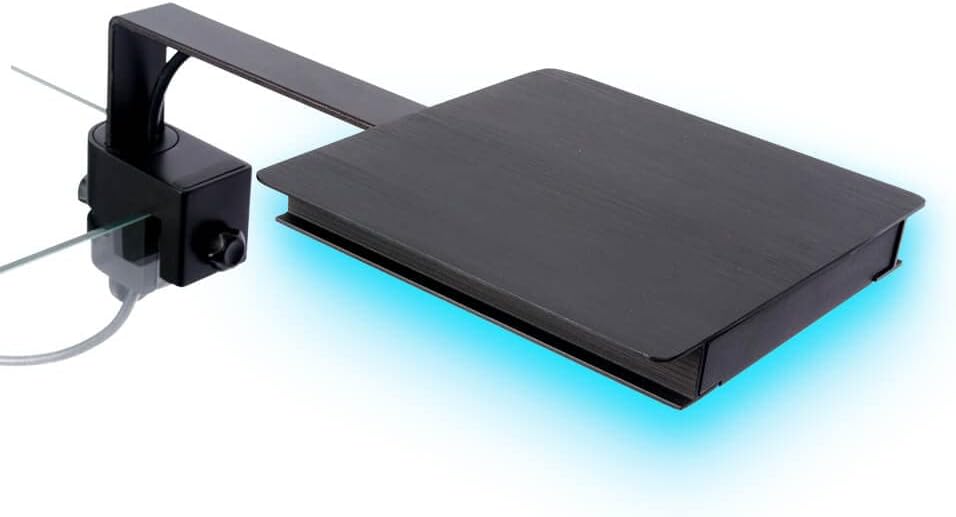
Fluval
$85.15
In stock on Amazon
Check price on AmazonOrlushy DC-4000: Solid Mid-Range Performance With a Fitting Caveat
The DC-4000 is the logical choice when you’re running shorter head heights or a smaller tank — rated at roughly 4,000 LPH (just over 1,000 GPH) at zero head, lower wattage, and a smaller footprint. Owners report the same quiet-running character as the DC-5000, and flow control works as advertised.
The recurring frustration, flagged consistently across owner reviews, is non-standard threading on the outlet. The pump’s outlet doesn’t accept standard PVC fittings from hardware stores, and no off-the-shelf barbed adapters fit reliably without modification. For fishkeepers who want to hardpipe their return line or use standard Schedule 40 PVC unions, this is a genuine problem that adds time, cost, and leaking risk to the build.
Practical workarounds owners have used:
- Coupling the included tubing directly to the pump and using compression-style hose barb connections downstream
- Wrapping the threads with multiple layers of PTFE tape and testing under low flow before sealing permanently
- Sourcing metric-to-NPT adapters from specialty aquarium plumbing suppliers (verify thread pitch before ordering)
If your install is a simple flexible-tubing run without unions, the DC-4000’s thread issue may never bite you. If you’re hardpiping with ball valves or building a tidy sump bay with true unions, plan extra time to solve this before your tank is full of water.
The Reef2Reef community thread “DC pump roundup — noise, flow, and fittings” (posted 2025) documents several owner-tested fitting solutions and is a useful starting point if you’re committed to this pump and need to hardpipe.
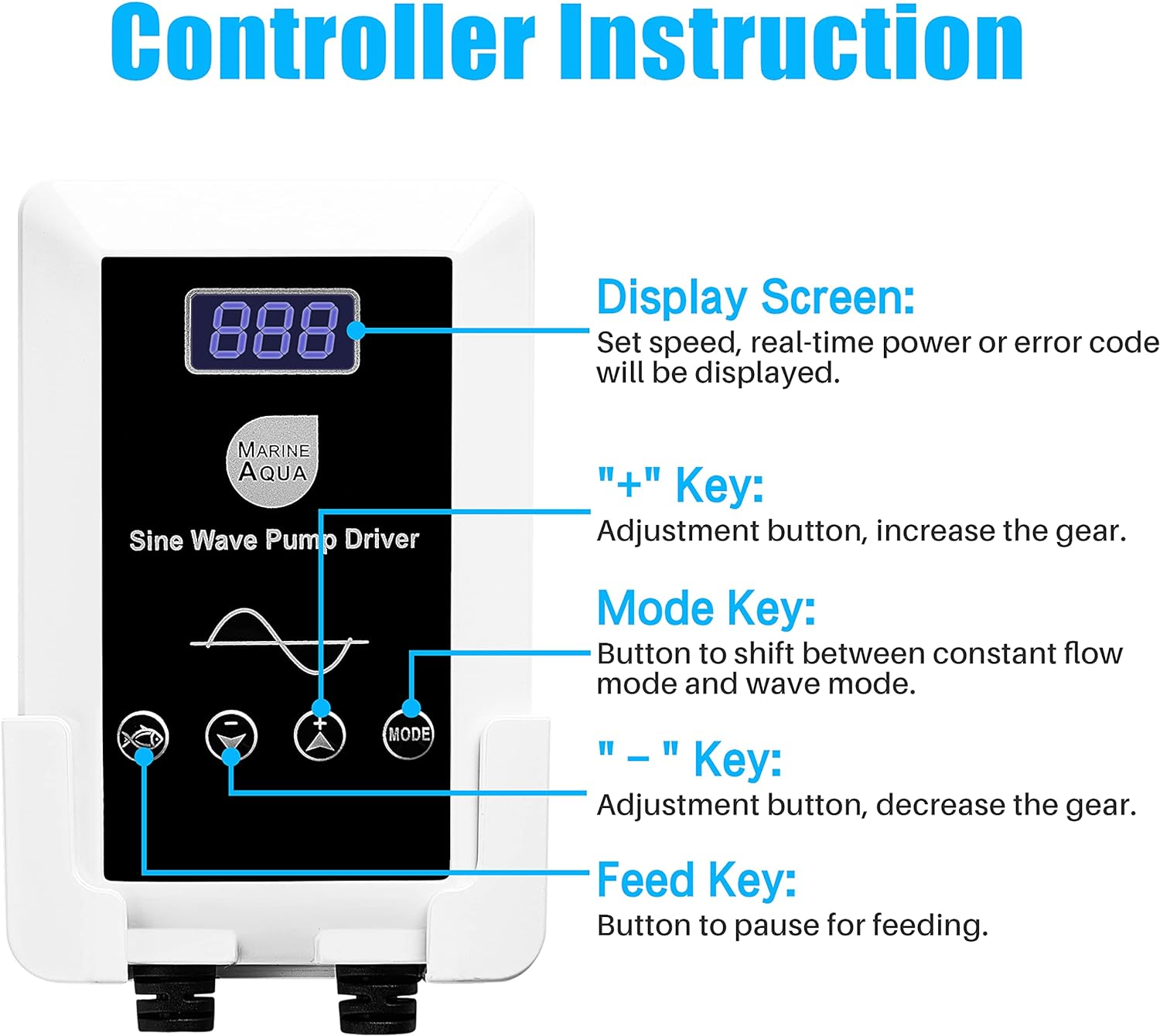
Orlushy
$59.99
In stock on Amazon
Check price on AmazonHygger 660 GPH LCD Pump: A Back-Siphon Warning You Must Read First
The Hygger 660 GPH LCD pump offers a clean LCD display, easy speed control, and flow ratings appropriate for nano and mid-size tank returns. Owners report it as a solid performer for the price point.
However, one documented owner finding needs to be treated as a safety note, not a footnote: this pump back-siphons immediately on shutdown.
Back-siphoning means that when power cuts to the pump — whether you switch it off manually or during a power outage — water continues flowing backward through the return line from the display tank down into the sump. If your sump doesn’t have enough spare volume to absorb that water, it overflows. Reef Builders published a write-up titled “How back-siphoning damages sumps — and how to stop it” that confirms this failure mode is both underappreciated by beginners and entirely preventable.
The fix is a check valve (also called a non-return valve) installed in the return line above the pump. A check valve allows flow in one direction only; when the pump stops, the valve closes and the back-siphon stops. This is a $5–$15 add-on, but it is not optional with this pump.
Build this into your plan: If you purchase the Hygger 660 GPH LCD pump, add a check valve to your order at the same time. Treat it as part of the pump’s total cost.
The Reef2Reef community thread on DC pump roundups (2025) notes that back-siphon susceptibility varies by pump design and that inline check valves are widely considered best practice regardless of brand — the Hygger makes it mandatory rather than advisory.
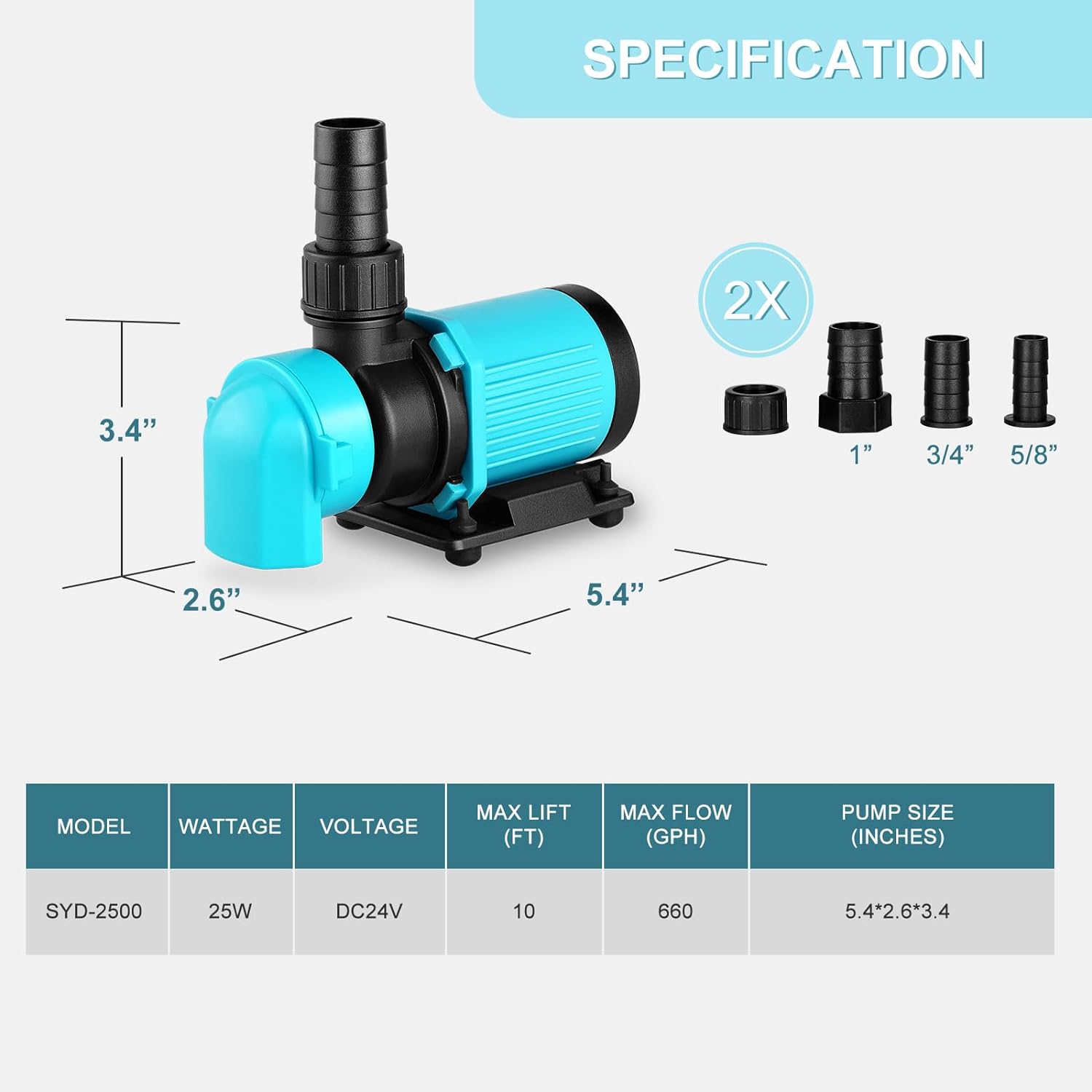
660GPH
$49.99
In stock on Amazon
Check price on Amazon12V Nano Pump: Small Tank Workhorse and Emergency Backup Option
The 12V nano pump in this category is sized for small aquariums — pico reef tanks, nano freshwater setups, desktop displays. Owners use it as a quiet, low-draw option for short return runs of 1–3 feet.
But one owner’s documented use case deserves attention beyond a footnote: hurricane preparedness with a 12V battery backup. Because this pump runs on 12 volts DC, it can be powered directly from a car battery, a portable lithium jump-start pack, or a dedicated aquarium UPS (uninterruptible power supply) with a 12V output. That’s not a capability most AC pumps or larger DC pumps with proprietary power bricks can match.
TFH Magazine’s piece “Pump selection for freshwater systems: flow, noise, and energy use” notes that power-outage planning is increasingly cited by hobbyists as a top-three purchasing criterion — and it should be. A tank with livestock can crash within hours during a heatwave blackout if circulation stops. A 12V nano pump paired with a battery keeps gas exchange and water movement going during a short outage, which may be enough to hold your tank stable until power returns.
If you run a small display and live in a hurricane corridor, a high-risk grid zone, or anywhere that sees extended summer outages, this pump’s 12V compatibility is a genuine system-design feature, not just an emergency spare.
660GPH
$49.99
In stock on Amazon
Check price on AmazonA Cautionary Note on the U-Return Duckbill Fitting
The U-return duckbill fitting gets recommended frequently alongside budget return pumps as an easy way to direct return flow back into your display tank. Owners flag a manufacturing defect worth knowing: a misaligned seam at the hose barb that leaks even under low-flow conditions.
The leak isn’t catastrophic — it’s typically a slow drip at the barb connection rather than a full failure — but a slow drip into a sump cabinet or onto a stand floor is still water damage waiting to accumulate. If you use this fitting, inspect the seam alignment before installation and test with the pump at low speed for 24 hours before walking away.
Note on product codes: Per site editorial policy, product identifier strings are not reproduced in article body copy. Use the pump names and descriptions above to locate these items through your preferred retailer.
By the Numbers: Head Pressure Flow Estimates
| Pump | Rated GPH (0 ft head) | Est. GPH @ 5 ft head | Best Fit | Tier |
|---|---|---|---|---|
| Orlushy DC-5000 | ~1,320 GPH | ~850–1,000 GPH | 75–125 gal systems | Fluval — $85.15 |
| Orlushy DC-4000 | ~1,056 GPH | ~650–800 GPH | 40–75 gal systems | Orlushy — $59.99 |
| Hygger 660 GPH LCD | ~660 GPH | ~400–500 GPH | 20–55 gal systems | 660GPH — $49.99 |
| 12V Nano | ~200 GPH | ~120–160 GPH | Pico/nano + battery backup | 660GPH — $49.99 |
Estimates based on manufacturer specs and head-loss guidance from Advanced Aquarist, “Head pressure and real-world flow loss in DC controllable pumps.” Actual delivered flow varies with tubing diameter, number of elbows, and valve restriction.
Frequently Asked Questions
How much flow will I actually get from an Orlushy DC-4000 after running it 5 feet vertically?
Based on manufacturer specs and published head-loss guidance from Advanced Aquarist’s overview of DC controllable pump performance, expect roughly 650–800 GPH at 5 feet of head — not the 1,000+ GPH the box rating implies. Add elbows and narrow tubing and you can lose another 10–15%. Size your expectations around the 650–700 GPH floor and you won’t be surprised.
Why does my return pump back-siphon into the sump when I turn it off?
Back-siphoning happens when the return line acts like a siphon tube: once the pump stops, water flows downhill from your display tank back through the same pipe. The solution is a check valve (non-return valve) installed in the return line above the pump. Reef Builders’ article “How back-siphoning damages sumps — and how to stop it” recommends a check valve as standard practice for any return pump without a built-in anti-siphon feature.
Can I run an Orlushy pump externally, or does it have to be submerged?
Both Orlushy DC models are rated for submersible use only. Running them dry or semi-submerged risks overheating the motor and voiding any warranty. If you want an external (inline) return pump, look at pumps specifically rated for inline operation — a different product category.
What size return pump do I need for a nano all-in-one reef like the Fluval Evo 13.5?
The Fluval Evo 13.5 uses an internal filter chamber rather than a true external sump, so a dedicated return pump isn’t part of the stock setup. If you’re modifying an AIO nano for an external mini-sump or refugium, Practical Fishkeeping’s sizing guide suggests targeting 10x display volume turnover for reef systems — roughly 135 GPH minimum, with 200–300 GPH being a comfortable target that leaves room for head loss. The 12V nano pump or the lower speed settings on the Hygger 660 are appropriate in this range.
Are there any standard PVC fittings that fit the Orlushy DC-4000 outlet?
Based on owner-documented experience, no off-the-shelf Schedule 40 PVC fittings fit the Orlushy DC-4000 outlet reliably. Some owners have found metric BSP fittings that come close, but thread pitch matching isn’t guaranteed without physical testing. PTFE tape and flexible tubing connections are the most reliable workaround for most installations.
The Decision Frame
-
If you need quiet operation above all else and have a 5–7 foot return run: The Orlushy DC-5000 is the pick. Owner reports on noise are unusually consistent, and documented real-world performance at elevation backs the spec sheet. Fluval — $85.15
-
If you’re on a tighter budget and running a 40–75 gallon system with flexible tubing (not hardpipe): The Orlushy DC-4000 works well — but confirm your plumbing approach before buying given the thread-size issue. Orlushy — $59.99
-
If you buy the Hygger 660 GPH LCD pump: Order a check valve in the same cart. This is not optional. 660GPH — $49.99
-
If you live in an outage-prone area or keep a nano tank: The 12V nano pump’s battery-compatibility is a genuine system-design advantage worth building around, not just an emergency spare. 660GPH — $49.99
-
If someone recommends the U-return duckbill fitting as an add-on: It can work, but inspect the hose-barb seam on arrival and run a 24-hour low-flow leak test before trusting it.
The budget DC return pump market has matured enough that real-world performance data is available across all four of these options. Installation fit, noise tolerance, and outage planning are more likely to determine the right choice for your build than raw GPH ratings alone — and on those criteria, each pump above has a scenario where it earns its place.