If you’ve just set up your first reef tank — a saltwater aquarium where you keep coral alongside fish — you’ve already figured out that lighting is everything. Coral is an animal that contains algae living inside its tissue; those algae need specific wavelengths of light to photosynthesize and keep the coral alive and colorful. That’s why reef hobbyists obsess over PAR (Photosynthetically Active Radiation, a measure of usable light intensity), spectrum (the mix of wavelengths, especially blue and violet), and coverage (whether the light reaches every corner of the tank evenly). Premium fixtures from brands like Ecotech Marine and AI cost $400–$800 each and earn their price. But there’s a serious middle tier — lights in the $80–$180 range — that has gotten genuinely good, and that’s exactly what this comparison is about.
This article is for the keeper who’s 6–18 months in, running a mixed reef or aggressive LPS (large-polyp stony coral) system, and staring at a light that’s either underpowered or borrowed from a freshwater setup. You know what a skimmer does. You’ve checked your alkalinity this week. Now you want to know whether the NICREW HyperReef Gen 2, the VIPARSPECTRA 165W, or the Wills Black Box can carry your tank through another year — or whether you’re just delaying the inevitable upgrade to an AI Prime 16 HD.
| EDITOR'S PICKNICREW HyperReef 150 Gen 2 Reef… | Mid-tierVIPARSPECTRA 165W LED Aquarium… | Budget pickWills Aquarium Light | |
|---|---|---|---|
| Wattage | 150W | 165W | 100W |
| Control | 5 channels | Remote/timer | Dual dimmable |
| Spectrum | Violet + blue | Full spectrum | Full spectrum |
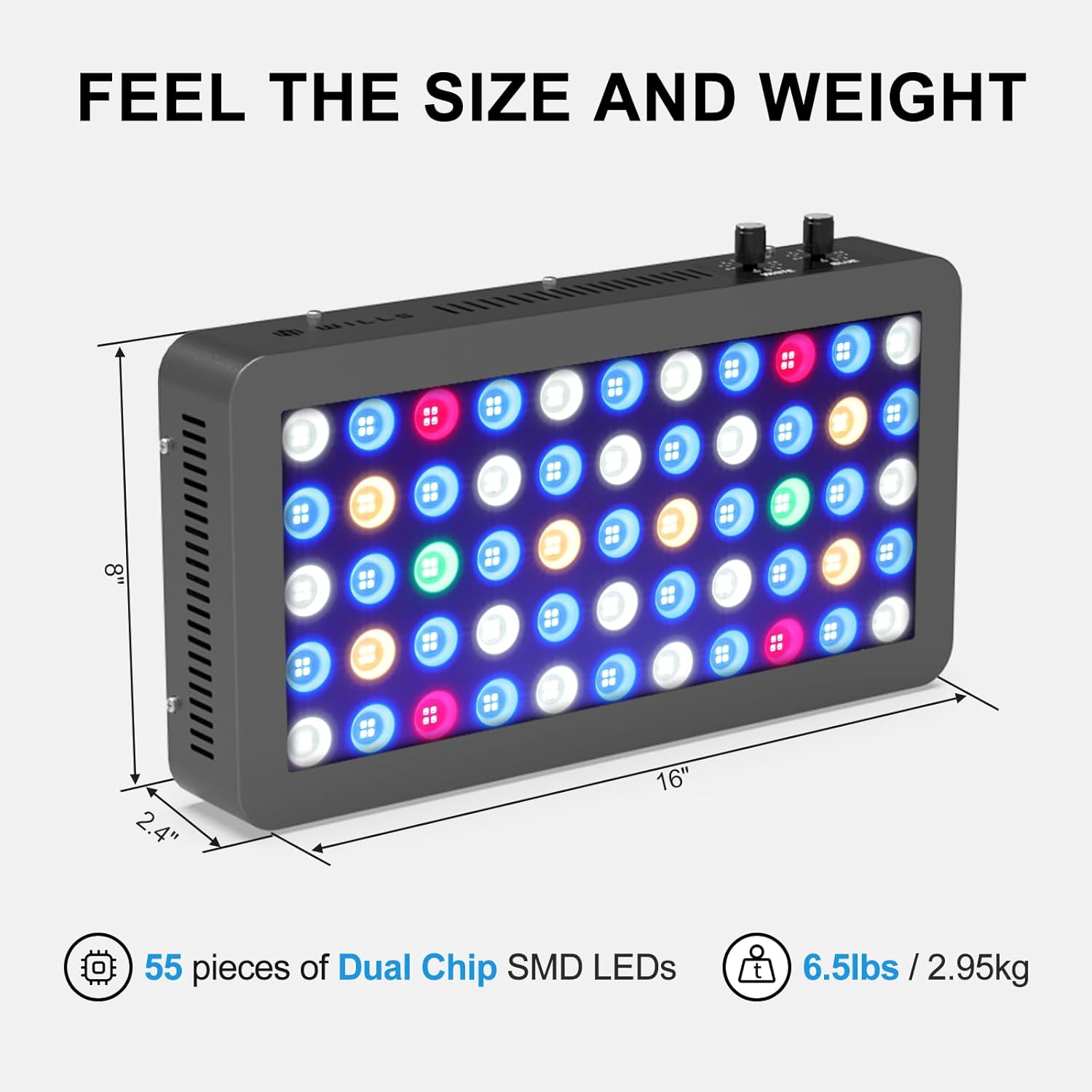
| LED count | — | — | 55 |
| Mount type | — | — | Hanging kit |
| Daisy chain | — | — | ✓ |
| Price | $249.99 | $139.99 | $89.99 |
| See on Amazon → | See on Amazon → | See on Amazon → |
What You’re Actually Comparing (And What You’re Not)
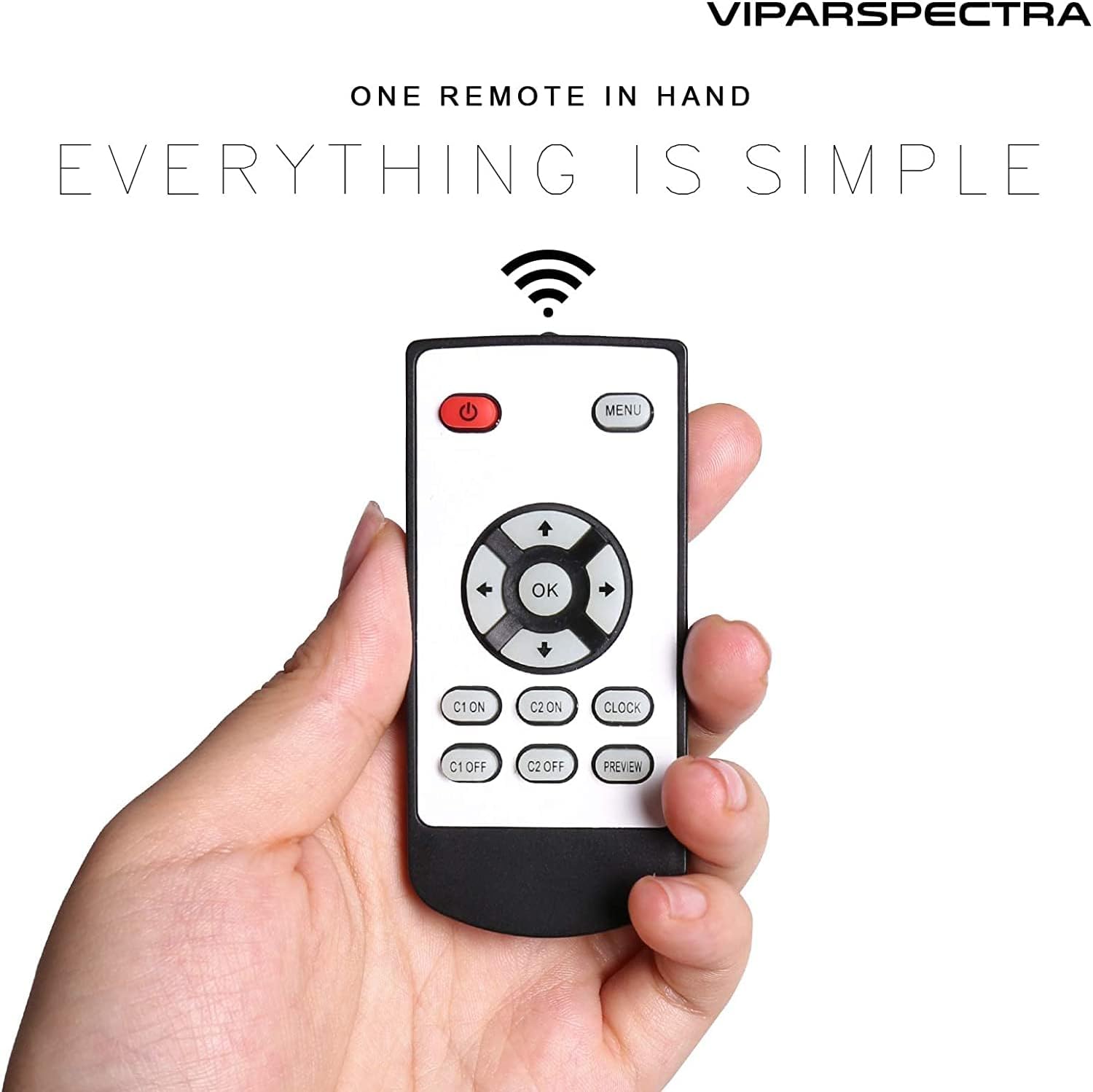
Let’s set expectations cleanly. All three of these fixtures are manufactured in China, sold under private-label or semi-private-label arrangements, and priced to compete on value rather than ecosystem integration. None of them offers Wi-Fi, Bluetooth, or app control. None of them communicates with an Apex or GHL controller via 0–10V or proprietary protocol. You set a schedule on a built-in timer or a simple manual controller, and that’s your programmability ceiling.
That’s not a dealbreaker — it’s the deal. The price point reflects the compromise. What you’re evaluating is whether the spectrum, intensity, and build quality are good enough to grow coral while you build the rest of your system, or whether the limitations will frustrate you inside 12 months.
One honest caveat before the deep dive: most of the positive owner reviews on these units are six months old or less at the time of writing. Long-run reliability data — motor failures, diode degradation, controller board burnout — is genuinely thin across all three products. Reef2Reef community threads on budget LED longevity consistently flag this gap. Buy with that uncertainty priced in.
Head-to-Head: Three Budget Reef LEDs Compared
NICREW HyperReef Gen 2 — The Spectrum Story
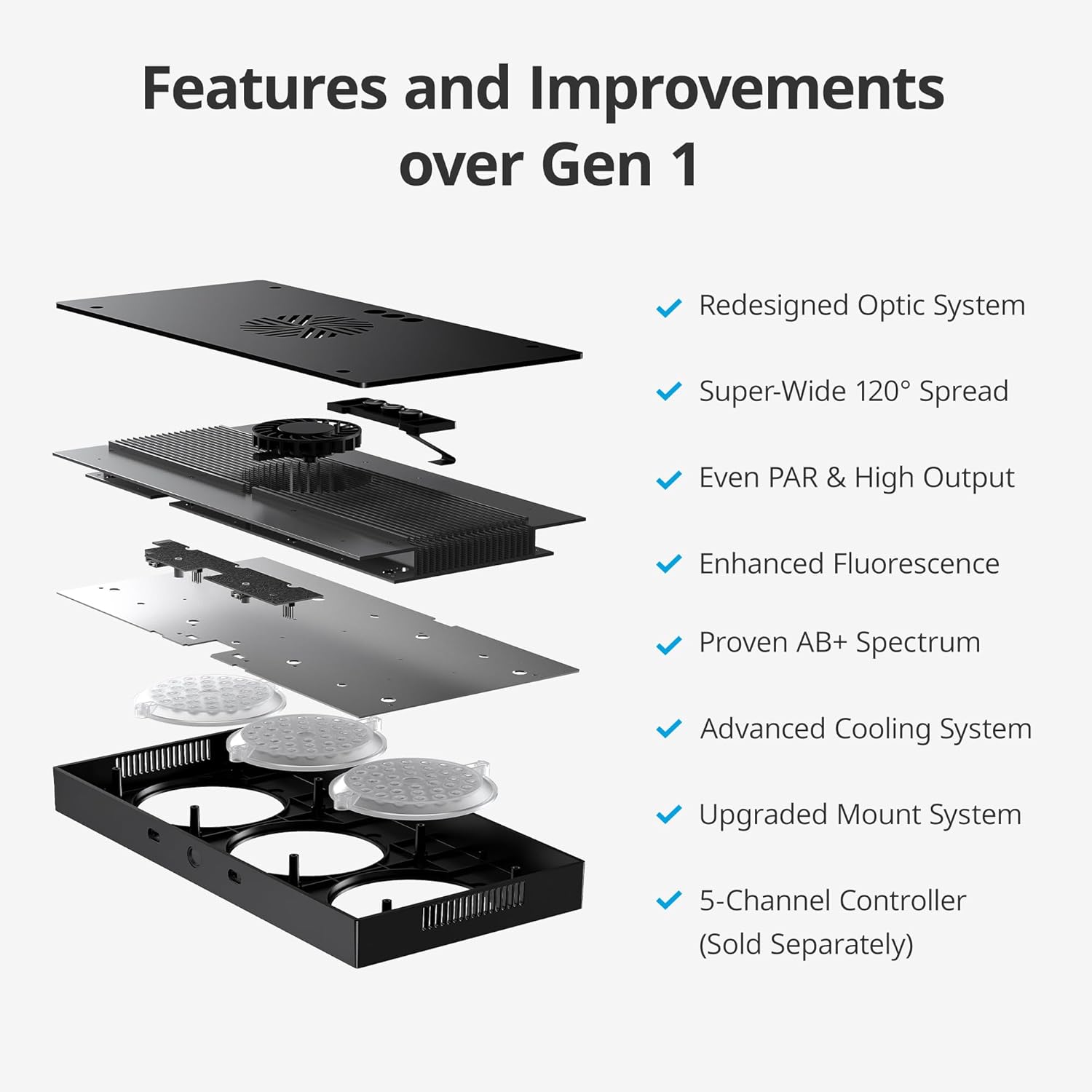
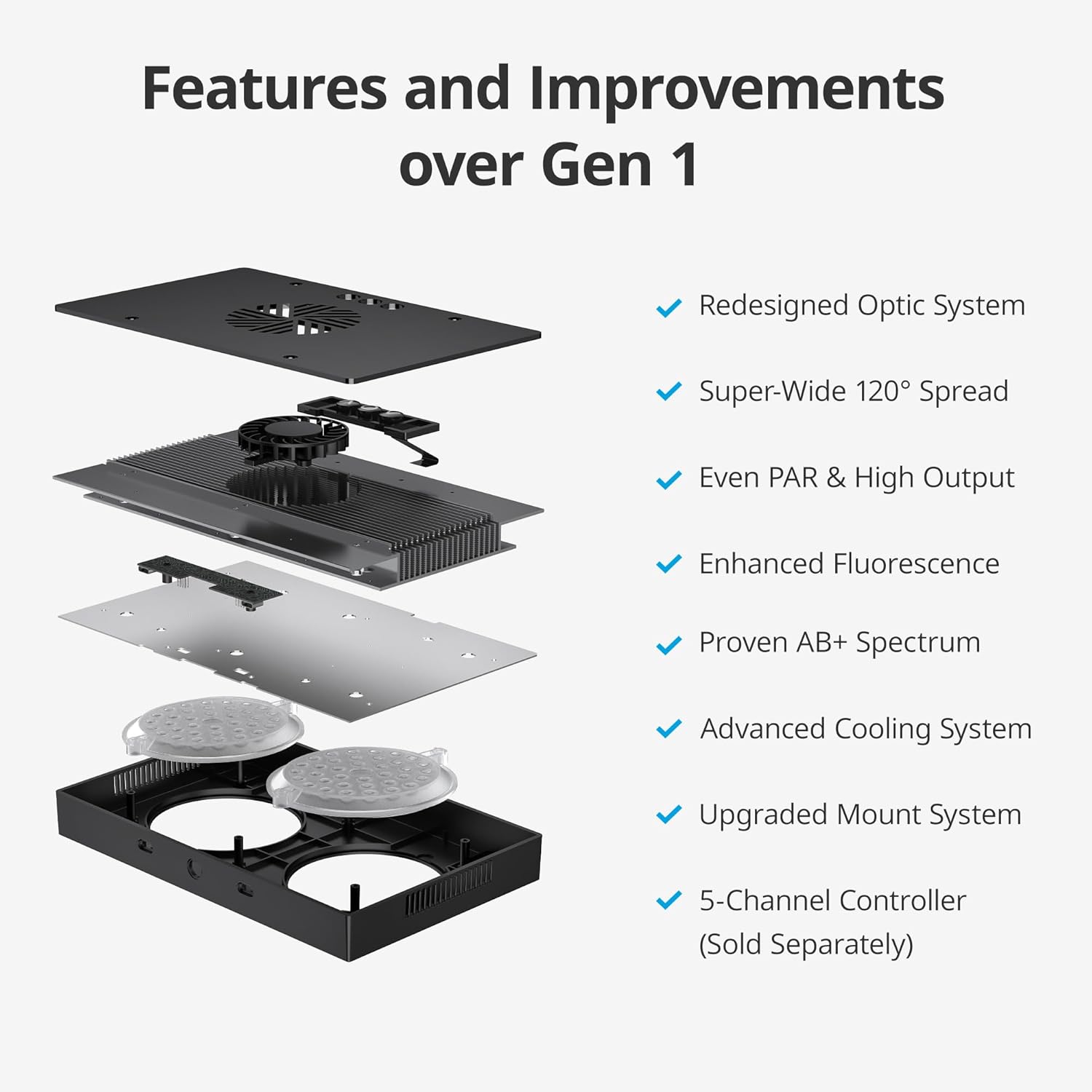
The NICREW HyperReef Gen 2 has built a reputation specifically around its violet and blue channel ratio. Where older budget reef LEDs leaned heavily on white diodes and threw in token blue channels to call themselves “reef-grade,” the HyperReef Gen 2 owners consistently report a genuinely blue-dominant mix that reads as reef-appropriate to the eye and, based on shared PAR readings discussed in Reef2Reef community threads, delivers meaningful light energy at sand-bed level under real-world conditions.
One owner running four HyperReef Gen 2 units over a 180-gallon system reported sand-bed PAR readings at just 70% blue channel intensity and 3% white — a configuration that keeps the aesthetic blue while preserving PAR headroom for fragile SPS (small-polyp stony corals, the most demanding coral type). That’s a promising data point, though four units over 180 gallons is a generous fixture-to-volume ratio that not every build can replicate.
Can it grow SPS? At reduced intensity, with careful placement, advanced aquarists report mixed but cautiously positive results with lower-demand SPS like Montipora and Stylophora. High-demand Acropora in the upper third of the water column is a harder ask. The consensus from Reef2Reef community discussion suggests the HyperReef Gen 2 functions best as a dedicated LPS and soft coral light, with SPS success depending heavily on proximity to the light and PAR spot-checking. Advanced Aquarist, in their article “PAR and the Reef Aquarium” (advancedaquarist.com), notes that SPS in high-light zones typically requires sustained PAR above 200–250 µmol/m²/s; whether the HyperReef delivers that across a full footprint rather than a hot center spot is something individual owners should verify with a PAR meter before committing to a full SPS system.
The programmability ceiling is real: the controller is manual dial-based. Sunrise and sunset ramping is limited. If you’re eventually migrating to a Neptune Apex, you’ll be using a separate smart power strip and fixed intensity rather than native controller integration.
Wills
$89.99
In stock on Amazon
Check price on AmazonVIPARSPECTRA 165W — The DIY Reef Light With a Cult Following
The VIPARSPECTRA 165W has a different kind of reputation. It’s not primarily known for its spectrum or its build — it’s known for what the community does to it after purchase. A substantial DIY subculture has grown up around removing the unit’s internal secondary lenses (small acrylic or plastic optics mounted over the diodes) to improve light spread and reduce the punchy hot-spot effect that concentrated optics create.
Owners who’ve performed the lens removal describe the result as meaningfully better light distribution — more even PAR across the footprint, less center-weighted intensity. Reef2Reef community documentation on this modification is detailed and widely shared. The question is whether you want to void a warranty and do surgery on a $100 light you just received.
Is lens removal necessary or just optional? Strictly speaking, optional — mushroom corals and tolerant LPS (Hammer, Frogspawn, Duncan) grow under unmodified units without issue, particularly if positioned deliberately to avoid the hot center. But if you want even coverage, especially for a mixed reef where you’re placing corals across the full footprint, owners treating the lens removal as “almost mandatory” aren’t wrong. It’s a 15-minute job with a heat gun and flat tool, extensively documented across Reef2Reef forum threads.
How many units for a 65-gallon? A standard 65-gallon reef tank with a footprint around 36” × 18” is comfortably covered by two VIPARSPECTRA 165W units with lenses removed and fixtures positioned at the recommended hanging height. Coral Magazine’s LED spectrum guidance for reef tanks (coralmagazine.com) notes that overlapping coverage from paired fixtures reduces the variance between hot-spot and shadow zones — exactly what the VIPARSPECTRA benefits from. One unit is workable for a low-demand soft coral or mushroom system, but two is the right call if you’re planning any LPS or want future flexibility.
The “Corolla vs. Sequoia” framing that owners use to describe the VIPARSPECTRA relative to Radion-class fixtures is honest and instructive. It works, it gets the job done, it won’t embarrass you on a casual reef — but the gap in sophistication is real.
Wills
$89.99
In stock on Amazon
Check price on AmazonWills Black Box — Build Improvements, Consistency Questions
The Wills Black Box name covers a family of fixtures that have iterated through several internal revisions. Owners of current-generation units report improved construction relative to earlier versions — better heat management, tighter diode binning, more professional driver circuitry. ReefBuilders’ budget lighting editorial coverage (reefbuilders.com) has noted the category-wide improvement in Chinese LED manufacturing at this tier over the past several years, and the Wills units reflect that trend.
The recurring flag in owner reviews is wire length inconsistency. Multiple buyers report that two units from the same order — or the same product listing — arrive with noticeably different cable lengths. This isn’t a performance issue, but it matters for installation: if you’re hanging two units over a peninsula or rimless display tank where cable management is visible, mismatched lengths create an aesthetic problem and occasionally a practical rigging problem. There’s no apparent quality-control standard being enforced here, and Wills has not publicly addressed it.
Why the inconsistency? Based on aggregated owner feedback discussed on Reef2Reef, the most plausible explanation is component sourcing variability at the factory level — different cable batches used across production runs without standardization. It’s a solvable problem at the manufacturer level; until it’s solved, buy with awareness that you may need aftermarket cable extensions or strain-relief management.
Spectrum-wise, Wills Black Box units occupy similar territory to the NICREW — adequate blue and violet presence for LPS and soft coral, less convincing for demanding SPS. Practical Fishkeeping’s overview “Understanding aquarium LED lighting” (practicalfishkeeping.co.uk) emphasizes that blue-channel dominance in roughly the 420–480nm wavelength range is the key driver of coral health in budget fixtures, and the Wills delivers there adequately for the LPS and soft coral keeper.
VIPARSPECTRA
$139.99
In stock on Amazon
Check price on AmazonBy the Numbers
| Fixture | Rated Wattage | App / BT Control | SPS Capability | DIY Community | Consistency Flag |
|---|---|---|---|---|---|
| NICREW HyperReef Gen 2 | ~165W | None | Marginal (low-demand SPS only) | Moderate | Low |
| VIPARSPECTRA 165W | 165W | None | LPS/Mushroom focus | High (lens mod) | Low |
| Wills Black Box | ~165W | None | LPS/Mushroom focus | Low-moderate | Wire length |
How These Stack Up Against the AI Prime 16 HD
The AI Prime 16 HD — roughly twice the price of any fixture in this comparison — represents a different category. It isn’t just brighter; it’s a different philosophy. Wi-Fi control, native Apex integration, a proven track record in SPS and mixed reef systems, and a user community with years of PAR maps and intensity-profile sharing behind it. Reef2Reef discussions on budget-versus-premium LED fixtures consistently return to the same threshold: if SPS is your goal, or if you want automation, the Prime 16 HD closes the cost gap quickly when you factor in time spent managing the limitations of manual-dial controllers.
That said, the AI Prime 16 HD covers a smaller footprint per unit — it’s designed for nano and mid-size tanks, not to blanket a 65-gallon with a single fixture. For a 65-gallon reef, you’d typically run two Prime 16 HDs, which doubles the cost differential immediately.
ReefBuilders editorial coverage (reefbuilders.com) has consistently positioned the AI Prime 16 HD as the entry point for serious mixed-reef and SPS systems where spectrum precision and scheduling flexibility matter. The budget fixtures in this comparison are best understood as a 12–18 month bridge to that tier, not a permanent alternative for the keeper who wants to push demanding coral.
NICREW
$249.99
In stock on Amazon
Check price on AmazonIf X, Then Y — Your Decision Rule
-
If you want the best out-of-box spectrum for the money and you’re keeping LPS or softies: Start with the NICREW HyperReef Gen 2. The violet and blue channel ratios are the most reef-tuned of the three without any modification required.
-
If you’re comfortable doing a minor DIY modification and want the broadest community support for troubleshooting: The VIPARSPECTRA 165W with lens removal is well-documented and widely discussed in Reef2Reef community threads. The mod is reversible and the community resources are extensive.
-
If you’re buying two units and wire management is a concern: Factor the Wills cable inconsistency into your planning. It’s not disqualifying, but it’s the kind of friction that bothers people on a display tank where cable runs are visible.
-
If you’re planning SPS, want app control, or expect to run this tank for more than two years: None of these three fixtures is your endpoint. Budget toward the AI Prime 16 HD tier now and skip the middle step.
-
If your budget is fixed at budget-tier for the next 12 months: Any of these three fixtures will grow a healthy LPS and soft coral system. Buy the one that fits your tank footprint, accept the programmability limitations, and revisit the decision when the tank is dialed in.
Frequently Asked Questions
Can the NICREW HyperReef Gen 2 grow SPS at reduced intensity? With selective placement and a PAR meter to verify actual delivery, owners report success with lower-demand SPS like Montipora at reduced settings. High-demand Acropora is a harder target. Advanced Aquarist’s article “PAR and the Reef Aquarium” (advancedaquarist.com) suggests the fixture is more reliably an LPS and soft coral light than a true SPS workhorse at this price point.
How many VIPARSPECTRA 165W units do I need over a 65-gallon reef? Two units, ideally with lenses removed, covers a standard 36” × 18” footprint well for LPS and mixed reef systems. One unit can work for a low-demand soft coral tank, but two is the right number for even coverage and PAR overlap.
Is removing the VIPARSPECTRA lenses necessary or just optional? Optional in a strict sense — the light works without the mod. But owners pursuing even PAR distribution across a mixed reef footprint consistently treat it as a meaningful improvement. The modification is well-documented in Reef2Reef community threads and is widely considered reversible.
Why do my two Wills Black Box units have different wire lengths? Component sourcing variability at the factory level is the most consistent explanation from owner reports shared on Reef2Reef. It’s a quality-control gap that hasn’t been publicly addressed by the manufacturer. Plan for aftermarket cable management before installation.
Do any of these lights have app or Bluetooth control? No. All three use manual dial controllers. Anyone wanting app-based scheduling, sunrise and sunset ramping, or Neptune Apex integration will need to step up to fixtures like the AI Prime 16 HD or Ecotech Radion series.
How do these compare to the AI Prime 16 HD at twice the price? The AI Prime 16 HD offers Wi-Fi and Apex integration, a deeper track record in SPS systems, and a more refined spectrum — but at roughly double the per-unit cost and a narrower per-unit footprint. For a 65-gallon tank, two Prime 16 HDs represent a significant price jump. The budget fixtures reviewed here are best understood as a capable interim step, not a permanent alternative to the Prime 16 HD for serious reef-building.