If you’ve just set up your first saltwater tank — or you’re a year or two in and wondering whether you really need to spend $500 on a light fixture — this article is for you. LED (light-emitting diode) reef lights are the fixtures mounted above your aquarium that supply the specific wavelengths of light your corals use to photosynthesize and thrive. PAR (photosynthetically active radiation) is the standard unit for measuring how much usable light actually reaches the coral — think of it like a speedometer for your light’s output. Soft corals (leathery, flexible species like mushrooms, zoanthids, and leathers) and LPS (large polyp stony corals — think hammer corals and bubble corals) are far more forgiving of lower PAR than the demanding SPS (small polyp stony) corals that dominate high-end builds. That gap in requirements is exactly what makes the budget LED category worth taking seriously. This shootout covers the fixtures that reef owners are genuinely running day-to-day, the trade-offs you’ll hit, and the decision rules that should drive your choice.
| EDITOR'S PICKNICREW HyperReef 150 Gen 2 Reef… | Mid-tierVIPARSPECTRA 165W LED Aquarium… | Budget pickWills Aquarium Light | |
|---|---|---|---|
| Power (W) | 150W | 165W | 100W |
| Control | 5 Channels | Dual Channel | Dual Channel |
| Dimmable | — | ✓ | ✓ |
| Timer | — | ✓ | — |
| Mounting | — | — | Hanging Kit |
| Price | $249.99 | $139.99 | $89.99 |
| See on Amazon → | See on Amazon → | See on Amazon → |
What “Budget” Actually Means in Reef Lighting
In 2026, the reef LED market has a clean three-tier structure. Premium fixtures — Radion XR30, AI Hydra, Mitras LX 7206 HV — sit at $400–$800 per unit and come with polished app control, factory-calibrated spectrum, and proven SPS performance. Mid-tier sits around $150–$300 and includes lights like the Maxspect Ethereal and some of the more established Chinese-manufactured units that have earned community trust over years of collected owner data. Then there’s the budget tier: $50–$150, dominated by “black box” style panels and single-brand mid-tier crossovers. That’s the zone this article covers.
The honest framing here: budget lights are not premium lights with a cheaper shell. They are a different tool. As Advanced Aquarist’s practical overview of LED reef lighting explains in plain terms, budget fixtures routinely trade controllability, spectral precision, and thermal management for raw watt-per-dollar output. That trade works well for soft corals and LPS. It is a rougher deal for SPS, which we address directly in the FAQ section below.
The Fixtures Under the Microscope
Wills Black Box — The Honest Workhorse
The Wills black box (sold under various names as a fixture class; “black box” refers to the flat-panel, multi-LED-array format common to Chinese-manufactured reef panels) has gone through multiple generations. Owners participating in the Reef2Reef Budget LED Mega Thread 2025 consistently call out measurable improvements over older versions: the cooling fans are notably quieter in current-generation units, and the internal wiring and driver organization is cleaner — a detail that matters for long-term reliability. The community consensus that has emerged is blunt and memorable: it is a “Corolla, not a Sequoia.” That framing is not a knock. A Corolla gets you to work every day for years without drama. If your livestock is mushrooms, zoas, and a hammer coral or two, the Wills delivers PAR in the 50–150 µmol range at depth, which is the documented target window for most LPS, without the premium fixture price tag.
The caution that comes with it: do not expect silky app control or granular scheduling. These are manual or basic timer-driven units. Run them as a simple tool and they perform. Expect a Hydra-level control experience and you will be frustrated.
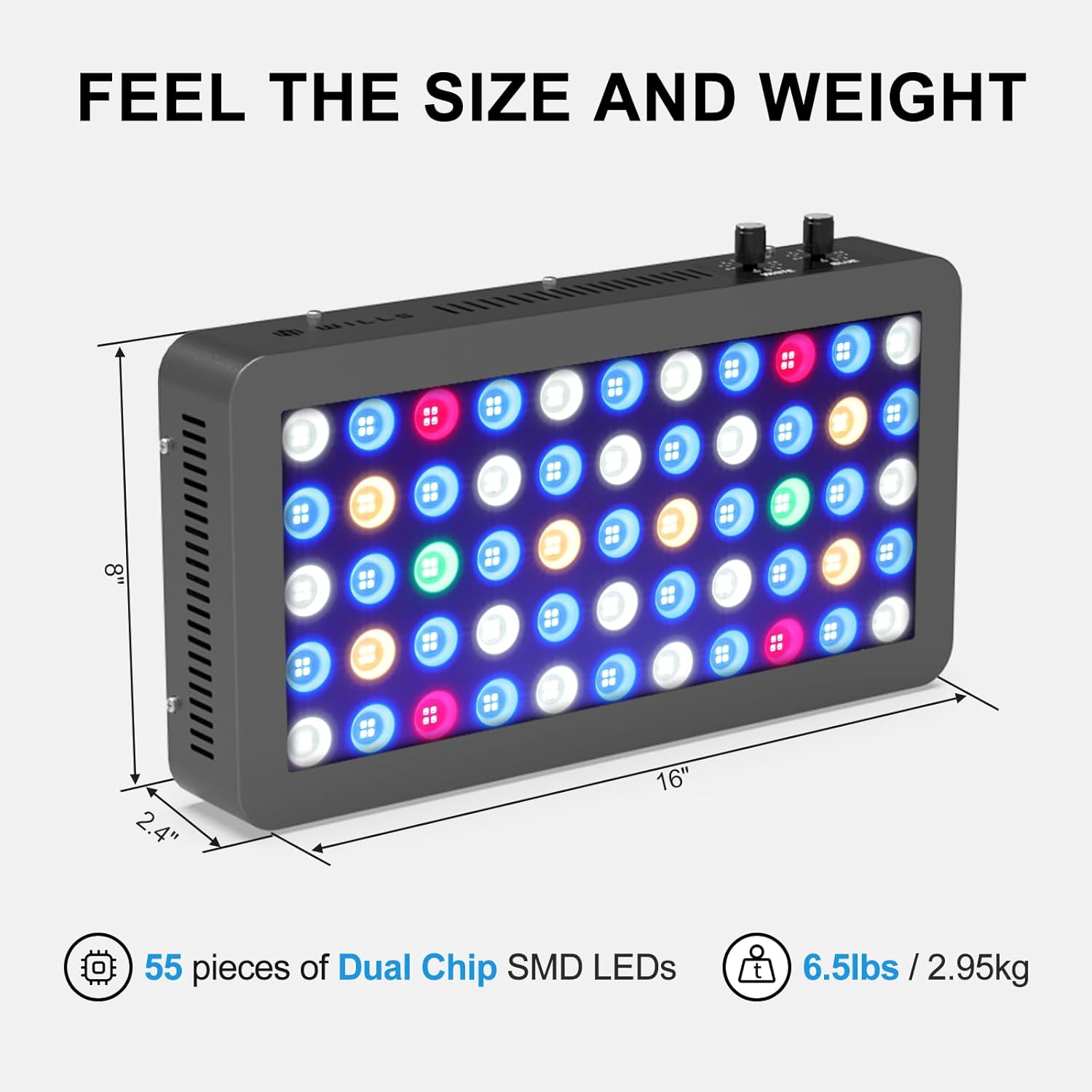
Wills
$89.99
In stock on Amazon
Check price on AmazonViparspectra 165W — The Lens Mod Situation
The Viparspectra 165W is probably the most discussed budget reef fixture in hobbyist circles right now, partly because of a community modification that reveals something real about its design. Multiple owners on Reef2Reef and in coral-focused communities report physically removing the inner lens arrays from the fixture to improve light spread across the tank footprint. Here is why that mod exists: the 165W ships with secondary lenses that focus LED output into tighter beams — effective for maximizing PAR at a single point, but creating hot spots and shadowed zones across a wider tank. Removing the lenses diffuses the output, spreading light more evenly at a modest PAR cost per point.
Is the mod necessary? Not universally. On tanks 24 inches wide or less, the stock lens coverage is often adequate. On a standard 48-inch, four-foot-wide display, owners running the 165W over the full footprint almost uniformly report better coral response after removing the lenses. Coral Magazine’s coverage of low-cost LED panels notes that secondary lens design is one of the most common differentiators between budget fixtures — and it is worth understanding before you purchase rather than after.
Wills
$89.99
In stock on Amazon
Check price on AmazonNICREW HyperReef Gen 2 — The Multi-Unit Large Tank Solution
The NICREW HyperReef Gen 2 has earned a specific niche: large-tank coverage achieved through multiple units running in coordination. Owners reviewed across the Reef2Reef Budget LED Mega Thread 2025 report running three to four HyperReef Gen 2 units over a 180-gallon system — a common show-tank footprint of 72 inches long by 24 inches wide by 24 inches deep — at a consistent real-world setting of approximately 70% blue/violet channel and only 3% white. That settings data point is meaningful. The heavy lean toward blue spectrum is intentional: it drives coral fluorescence and photosynthesis while keeping the display visually striking without the washed-out look that high white output produces. The low white percentage also reduces nuisance algae pressure, a real benefit in a high-bioload system.
At these settings, owners report stable growth and coloration across LPS and soft coral systems. The HyperReef Gen 2 is not a single-fixture solution for large tanks — it is a multi-unit strategy, and it functions well as one. ReefBuilders’ reporting on budget LED spectrum performance notes that blue-dominant channel weighting is the most effective tuning approach available to hobbyists using fixtures with limited programmability.
Wills
$89.99
In stock on Amazon
Check price on AmazonNavaReef 65 vs. HyperReef 100 — A Direct Community Comparison
One of the cleaner head-to-head data points in this category came from a single owner who ran both the NavaReef 65 and the NICREW HyperReef 100 over comparable systems and measured PAR directly. Per that owner’s published comparison in the Reef2Reef Budget LED Mega Thread 2025, the NavaReef 65 produced approximately double the PAR output of the HyperReef 100 at equivalent depth and positioning. That is a significant real-world gap — large enough to push the NavaReef 65 into credible LPS territory and edge it toward lower-demand SPS in shallow tanks, while positioning the HyperReef 100 more squarely as a soft coral and mushroom light.
The trade-off: the NavaReef 65 is typically priced higher within the budget tier. Whether doubling PAR is worth the price delta depends entirely on what you are keeping. For zoas and leathers, the HyperReef 100 is more than capable. For a mixed LPS display with Acanthastrea or Lobophyllia, the NavaReef 65’s output headroom provides meaningful margin for coral placement and growth.

VIPARSPECTRA
$139.99
In stock on Amazon
Check price on AmazonThe 95W 6-Channel Wi-Fi Unit — Group Control for Multi-Fixture Builds
The 95W 6-channel sunrise/sunset fixture — sold under several OEM-adjacent brand names but identifiable by its six independently controllable LED channels and Wi-Fi connectivity — has attracted real attention for one specific feature: master/slave group control. For hobbyists running two lights over a 75- or 90-gallon system, the ability to sync both fixtures to a single schedule via Wi-Fi is genuinely useful. It eliminates the manual matching problem that plagues multi-fixture budget builds.
Owners consistently praise the concept. The execution has a documented friction point: the schedule-saving process frequently requires multiple attempts before settings persist. ReefBuilders’ coverage of budget LED controllability identifies Wi-Fi reliability and firmware stability as the most common weak points in this price tier, and the 95W unit illustrates that pattern exactly. The workaround the owner community has settled on is to run the schedule-save process while the phone remains on the same network as the fixture, with the app kept in the foreground until confirmation registers. It is clunky, but it is a one-time setup problem rather than a daily operational issue.
VIPARSPECTRA
$139.99
In stock on Amazon
Check price on AmazonComparison at a Glance
| Fixture | Approx. Wattage | Best-Fit Tank Size | PAR Tier | Key Trade-off | Tier |
|---|---|---|---|---|---|
| Wills Black Box | 165W | Up to 36” × 18” | Moderate (soft coral/LPS) | Basic control, reliable output | Wills — $89.99 |
| Viparspectra 165W | 165W | Up to 48” (post lens mod) | Moderate–High | Lens mod needed for even spread | Wills — $89.99 |
| NICREW HyperReef Gen 2 | Varies | 180 gal+ (3–4 units) | Moderate | Multi-unit strategy required | Wills — $89.99 |
| NavaReef 65 | 65W | Nano–30 gal | High for class (~2× HyperReef 100) | Narrower footprint | VIPARSPECTRA — $139.99 |
| 95W 6-Channel Wi-Fi Unit | 95W | 40–75 gal | Moderate | Schedule-save process unreliable | VIPARSPECTRA — $139.99 |
Making the Call: Decision Rules for This Tier
If you are keeping soft corals and LPS exclusively and your tank is under 40 gallons, the Wills black box or Viparspectra 165W covers you without complication. Budget for the lens mod on the Viparspectra if your tank is wider than 24 inches.
If you are running a large display — 75 gallons and up — and want a proven multi-unit strategy with real settings data behind it, the NICREW HyperReef Gen 2 running at 70% blue and 3% white is a documented setup with community validation. The Reef2Reef Budget LED Mega Thread 2025 confirms that settings profile has been replicated successfully across multiple large-tank builds.
If you are deciding between the NavaReef 65 and HyperReef 100 for a nano or small display, PAR output should drive the choice: if you are growing LPS or want future flexibility toward easier SPS species, the NavaReef 65’s doubled output is a meaningful advantage. If you are building a soft coral showcase, the HyperReef 100 is sufficient and saves money.
If you need two fixtures running in sync, the 95W Wi-Fi unit’s group control feature is the only budget option with that capability. Go in knowing that the schedule-save process requires patience at initial setup.
For hobbyists who anticipate eventually upgrading to SPS-dominant systems, neither the budget nor mid-tier fixtures reviewed here are a long-term solution. Advanced Aquarist’s LED reef lighting overview is explicit on this point: sustained PAR above 200 µmol and long-term spectral consistency, both of which SPS requires, are not reliably achievable at this price tier. Plan your upgrade path accordingly rather than trying to push budget hardware past its design limits.
Frequently Asked Questions
Can I grow SPS under budget LED fixtures, or are they only suitable for softies and LPS? Most budget fixtures can support low-demand SPS species — montipora capricornis, a flat encrusting coral, is the most commonly cited example — when placed high in the water column where PAR is highest. But the PAR ceiling, spectral precision, and control limitations of budget lights make them a poor fit for demanding Acropora-dominated SPS reefs. As Advanced Aquarist’s practical LED overview documents, SPS generally require sustained PAR above 200 µmol and consistent spectral output that most budget fixtures cannot guarantee over the long term. Soft corals and LPS are genuinely the right target for this tier.
What settings do experienced reef owners actually run day-to-day? The most consistently reported real-world profile, drawn from owner threads in the Reef2Reef Budget LED Mega Thread 2025, is heavy blue emphasis: 60–80% blue/violet channels, 5–15% white, with UV at whatever the fixture allows — typically 10–20%. The 70% blue/3% white profile reported by NICREW HyperReef Gen 2 multi-unit owners sits at the more extreme blue end, but it reflects a genuine preference among experienced keepers for spectral quality over raw white brightness.
Why do some owners remove the lenses from the Viparspectra, and is this necessary? The secondary lenses focus LED output into tighter beams that increase PAR at a single point but create uneven coverage across a wider tank footprint. Removing them spreads light more evenly at a modest PAR reduction per measured point. The mod is most necessary on tanks wider than 24 inches. On narrower tanks, the stock lenses are often adequate. Owners report the modification is reversible and does not affect any other fixture function.
Does the Wi-Fi group control on the 95W unit work reliably for running two lights in sync? The master/slave sync function works, but the setup process is unreliable enough that owners commonly require several attempts to save schedules successfully. Once established, the sync itself is stable. The practical advice from the owner community: complete setup with your phone on the same Wi-Fi network as the fixture, keep the app in the foreground throughout, and expect to retry the save step at least once. This is a firmware limitation, not a hardware failure.
What is the real-world PAR difference between the NavaReef 65 and HyperReef 100? Based on the direct owner comparison published in the Reef2Reef Budget LED Mega Thread 2025, the NavaReef 65 produced approximately double the PAR output of the HyperReef 100 at equivalent depth and fixture position. That gap is large enough to matter meaningfully for coral selection: the NavaReef 65 opens the door to LPS and entry-level SPS, while the HyperReef 100 is better scoped to soft corals and low-light LPS.
Will these lights lose their programmed schedule during a power outage? This is a legitimate concern with budget fixtures. Across owner reviews in the Reef2Reef Budget LED Mega Thread 2025, the pattern is inconsistent: some units retain schedules via onboard memory, others reset to default after power loss. The 95W Wi-Fi unit is specifically noted as requiring the schedule re-save process after outages in some firmware versions. The safe practice for any budget fixture is to document your schedule settings externally so you can re-enter them quickly after an outage, rather than relying on onboard memory retention.