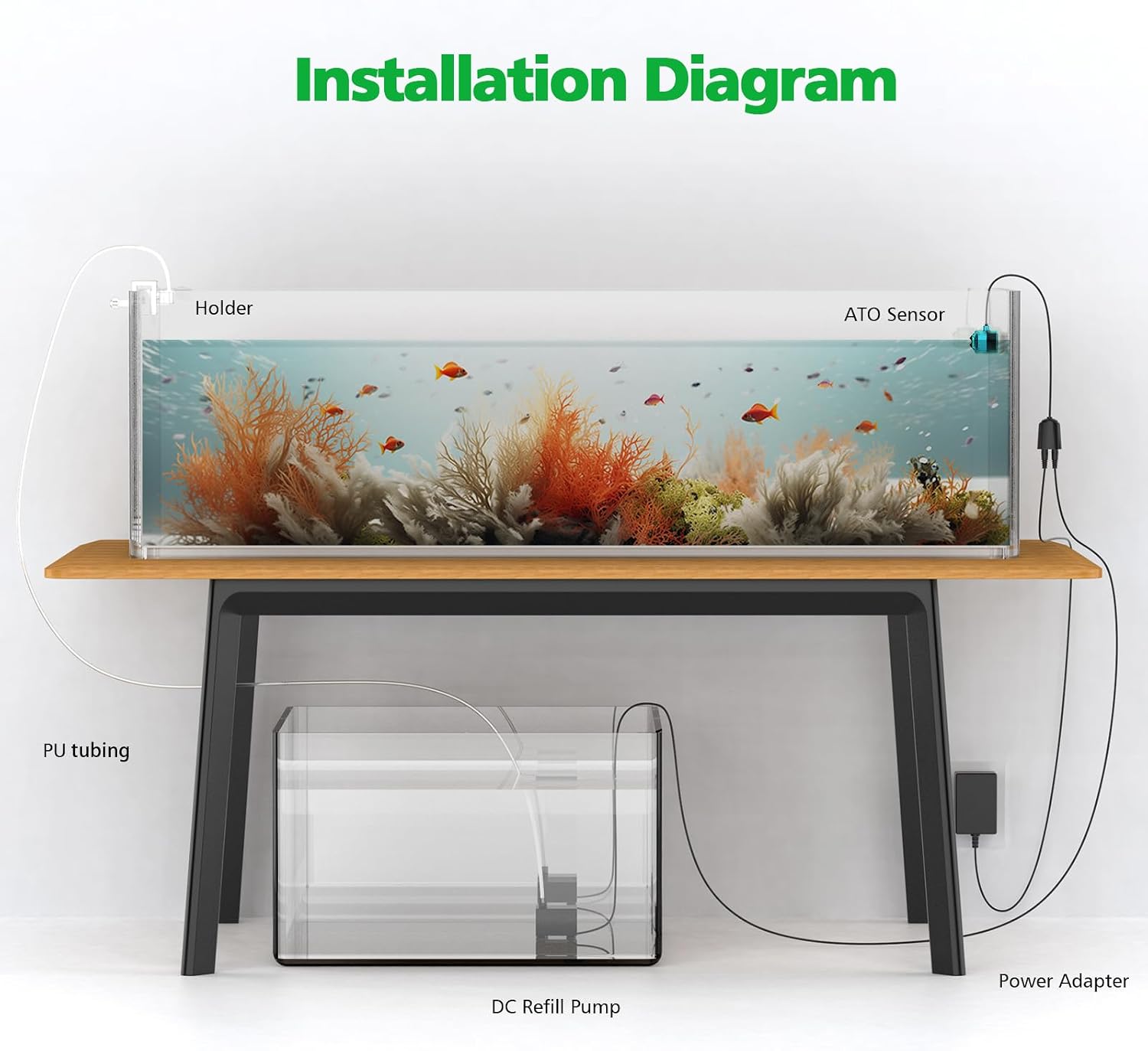
If you keep a saltwater reef tank, one thing is working against you every single day: evaporation. As water evaporates from your aquarium, the salt stays behind — which means your salinity (the concentration of dissolved salt) creeps upward. In a reef tank housing corals, even a small salinity swing over a few days can stress your animals, slow coral growth, and destabilize alkalinity — the chemical parameter that reef-builders obsess over for good reason. An ATO system — automatic top-off system — solves this by sensing the water level in your tank and automatically pumping in fresh, unsalted water to replace what evaporated. In concept, it’s simple. In practice, the reliability of that small pump and sensor sitting quietly behind your tank is one of the most consequential variables in your reef’s long-term health. This guide is about what actually fails, what holds up, and how to build a setup you can trust.
The Two Failure Modes That Matter — And Why They’re Not Equal
Every ATO system has two critical components: a sensor that detects water level and a pump that delivers fresh water. When an ATO fails, it’s almost always one of these two things. Understanding which failure mode matters more will sharpen your purchasing decisions immediately.
Pump failure is the more common of the two, and it’s the one that hobbyist reviewers flag most consistently. Reef Builders’ coverage of budget ATO units notes that small diaphragm and peristaltic pumps in the $30–$50 price range carry a high variance in motor quality — and that variance shows up in lifespan. One reviewer pattern that appears repeatedly in aggregated owner feedback: buyers who purchased multiple units of the same budget model and experienced failure across all of them within one to six months, specifically naming pump degradation as the culprit. The telling detail flagged by one owner who went through three separate units: positive reviews for budget ATOs rarely, if ever, mention “years of use” — they mention days or weeks of trouble-free operation. That’s a longevity signal worth reading carefully.
Sensor failure is the second failure mode and, in some ways, the more dangerous one. A pump that dies simply stops topping off — your salinity drifts upward, which is bad, but you’ll notice it at your next specific gravity check. A sensor that malfunctions and gets stuck in the “low water” position can trigger your pump to run continuously, flooding your sump with fresh water and crashing your salinity downward. Rapid salinity drops are acutely toxic to coral and invertebrates. Advanced Aquarist’s coverage of ATO system design notes this asymmetry explicitly: overfill events tend to be more immediately harmful than underfill events, which is why redundant float valves or secondary high-water shutoffs are considered essential rather than optional on reef systems.
Sensor failure modes also vary by sensor type. Optical sensors — which detect water using infrared light refraction — can be fooled by salt creep, algae buildup, or air bubbles, causing false readings. Float switches are mechanically simpler but can stick in the open or closed position over time, especially in sumps with high turbulence. Owners who moved from units relying on basic float switches (like earlier Duetto-style ATOs, which users report typically lasted around a year before sensor-related leaks and failures became an issue) to optical sensor-based designs generally report improved sensor consistency — though optical units introduce their own maintenance requirements around keeping the sensor lens clean.
Budget vs. Mid-Tier: Does the Price Gap Actually Buy Reliability?
The honest numbers
| Price tier | Typical pump type | Owner-reported lifespan | Sensor redundancy |
|---|---|---|---|
| $25–$40 (budget) | Small diaphragm pump | 1–12 months (high variance) | Single optical or float |
| $60–$90 (mid-tier) | Stronger pump, often with flow control | 12–36 months (more consistent) | Dual-sensor or backup float |
| $150–$300 (premium) | Dedicated ATO controller + separate pump | 3+ years (controller outlasts pumps) | Independent high/low sensors |
The pattern in owner reviews is reasonably consistent: the $30 gap between a budget and a mid-tier unit is not cosmetic. Reef Builders’ comparative coverage of ATO units at various price points notes that mid-tier models tend to use more robust pump mechanisms and, critically, often include a secondary float switch as a failsafe against overfill — the exact protection that makes sensor failure survivable rather than catastrophic.
The DIGITEN ATO sits at this mid-tier threshold and draws favorable comparisons from owners who previously used simpler designs. The consistent positive is improved sensor performance and build robustness relative to budget competitors. The consistent criticism from the same owner base: mounting options are limited — the sensor’s design assumes a rimless tank with clean glass or acrylic edges, and owners with rimmed aquariums report real difficulty achieving secure, reliable sensor placement. This is a practical shortcoming worth understanding before purchasing, not a dealbreaker in isolation.
For reef systems in the $1,500–$5,000+ build range, Coral Magazine’s alkalinity stability guides make a strong case for treating the ATO as a critical system rather than an accessory. At that investment level, a $150 premium ATO with independent pump and controller — where you can replace a failed pump without swapping the whole unit — makes financial and practical sense.
Mounting, Rimmed Tanks, and the Details That Get Skipped in Product Listings
One of the most underreported friction points in ATO purchasing is the rimmed vs. rimless tank compatibility gap. Most consumer ATO sensors are designed with rimless tanks in mind — the sensor hangs cleanly over the edge of flat glass or acrylic. On rimmed aquariums (which remain common on standard-size tanks, particularly in the 29–75 gallon range sold by most mass-market brands), that clean hang-point doesn’t exist. The plastic frame gets in the way.
Practical Fishkeeping’s overview of ATO installation covers this directly: owners with rimmed tanks frequently resort to custom-fabricated sensor mounts, suction cup extensions, or positioning the sensor in the sump rather than the display tank. Sump placement is often the cleaner solution — sump water level is a more stable measurement point, less affected by surface agitation — but it assumes you have a sump, which entry-level all-in-one tanks often don’t.
If you have a rimmed tank, verify sensor mounting compatibility before purchasing. Product listings frequently omit this detail. The workaround exists, but it shouldn’t be a surprise on day one.
What to Do When Your ATO Pump Fails While You’re Away
This is the scenario that causes the most anxiety, and it deserves a direct answer rather than a generic “check your tank regularly” response.
If the pump fails silently (stops working): Your tank will lose water to evaporation at roughly 0.5–2% of volume per day depending on temperature, surface agitation, and airflow. For a 50-gallon system, that’s roughly one gallon per day. Over a three-day trip, you’re looking at a measurable but typically non-emergency salinity increase — serious for sensitive SPS coral, manageable for hardier LPS and fish-only systems. The ask from Reef2Reef community consensus is to top off manually before any trip and to keep a marked water level on the sump so a tank-sitter has a clear visual reference point.
If the sensor malfunctions and causes continuous pumping (overfill): This is the acute risk. The mitigation is a secondary high-water float switch positioned above the normal operating level in your sump. When the water hits that float, it cuts power to the ATO regardless of what the primary sensor says. This single redundancy converts a potentially tank-destroying failure into a nuisance. Premium ATO controllers like the Neptune Systems DOS + FMM combination or the Tunze Osmolator 3155 include this redundancy natively. On budget units without it, adding an external float switch on a relay is a weekend project worth doing before you leave for any trip longer than 24 hours.
Smart home integration — specifically ATO units that connect to Neptune Apex or GHL controller ecosystems — adds email and SMS alerts for ATO run-time anomalies. If your ATO runs for 20 consecutive minutes on a 50-gallon tank, something is wrong; an Apex alert catches it before a neighbor needs to intervene.
How Long Should You Realistically Expect Your ATO to Last?
There’s no site-verified longevity data to cite here, and the article won’t fabricate it. What aggregated owner reports consistently show:
- Budget ATOs ($25–$45): High failure variance. Some owners report months of reliable service; others, like the documented case of a buyer cycling through three failed units in under six months, experience early pump death. Plan for 12 months or less as a conservative baseline.
- Mid-tier ATOs ($60–$90): Owner reports skew toward 18–36 months before pump replacement is needed. Sensor longevity tends to be better in this bracket.
- Premium ATO systems ($150+): The controller hardware often outlives multiple pump replacements. You’re buying an architecture you can maintain, not a disposable unit.
The practical implication: if you’re running a serious reef system and you’re buying a $35 ATO, budget for replacement parts or a full-unit swap within a year. If that feels inefficient — it is. The math on a mid-tier or premium unit frequently works out in year two.
Frequently Asked Questions
How long should a budget ATO system realistically last before it needs replacing? Owner-reported patterns suggest 1–12 months for pump-related failure in the $25–$45 tier, with high variance. As one reviewer who purchased three units from the same budget line noted, none survived past six months. Budget for replacement or upgrade accordingly.
What is the most common failure mode — the pump or the optical sensor? Pump failure is more frequently cited in owner reviews. Sensor failure is less common but more dangerous because a stuck-open sensor can trigger continuous fresh water pumping and crash your salinity rapidly.
Is a slow-flow ATO pump actually dangerous, or just annoying? Mostly annoying — a pump that trickles instead of flows will still top off the tank, just slowly. The risk is that in high-evaporation periods (summer, high-flow systems), a weak pump may not keep pace, allowing salinity to drift. Monitor more frequently if you notice reduced flow.
Can I use an ATO in a rimmed aquarium, or are most sensors designed for rimless tanks? Most consumer ATO sensors are designed with rimless tanks as the default. Owners with rimmed tanks regularly report mounting difficulty. Sump-based sensor placement is often the cleanest workaround, but verify compatibility with the specific unit before purchasing.
What should I do if my ATO pump fails while I am away from home for several days? Top off manually before leaving. Leave a water-level reference mark for any tank-sitter. If your system doesn’t have a secondary high-water float switch, install one before travel — it prevents the opposite failure (overfill) from becoming catastrophic. Smart-controller integration with run-time alerts adds a remote monitoring layer.
Is there a meaningful reliability difference between a $30 ATO and a $70 ATO for reef use? Based on aggregated owner reports, yes — meaningfully so. The mid-tier price bracket tends to deliver better pump durability, secondary sensor redundancy, and more robust build quality. For a reef system where alkalinity stability depends on consistent top-off performance, the $40 gap is generally worth it.
The Decision Frame
If your build is under $500 and you’re still learning the system, a mid-tier ATO gives you reliable performance without overcomplicating the setup — budget units are a false economy given their failure rates in owner reports.
If you’re running an established reef in the $1,500–$5,000 range with SPS coral or automated dosing, an ATO with secondary failsafe protection and smart-controller integration is the correct specification. The alkalinity stability that Coral Magazine and Advanced Aquarist both treat as a primary reef health variable depends directly on evaporation management holding steady across days and weeks, not just hours.
If you travel regularly or manage a commercial display installation, pair your ATO with a Neptune Apex or GHL integration for run-time anomaly alerts. A pump that fails silently while you’re away is the risk you’re buying down — treat it as infrastructure, not an accessory.