Power Outage and Backup Planning for Reef and Freshwater Tanks
A home aquarium is a life-support system. Every pump, heater, and filter running in your tank is doing the same job a hospital ventilator does — keeping living things alive through continuous, uninterrupted mechanical work. When the power goes out, that system stops. For a freshwater community tank, you probably have a few hours before things get serious. For a reef tank — where stony corals (the kind that build elaborate calcium skeletons and are highly sensitive to water quality) and delicate invertebrates live — the clock starts ticking the moment the return pump goes quiet. This guide walks you through how to think about backup power, what to prioritize first, and the specific decisions you’ll need to make before the next hurricane season, storm, or utility failure catches you unprepared.
If you already know what a protein skimmer and a sump are, the sections below will reward that knowledge. If you’re newer: a protein skimmer is a device that removes dissolved organic waste from water using bubbles, and a sump is a secondary tank (usually hidden below the main display) where filtration equipment lives. Both matter a lot when the power goes out.
What Actually Kills Fish and Corals During an Outage
Understanding the threat hierarchy helps you spend money and mental energy in the right order.
Oxygen depletion comes first. Water holds dissolved oxygen (O₂) that fish and corals breathe. Your return pump, powerheads (circulation pumps), and protein skimmer are all constantly agitating the water surface, which is how O₂ enters. Stop all of them and that gas exchange slows dramatically. Advanced Aquarist’s research on oxygen depletion and coral mortality during power failures notes that densely stocked reef systems can see dissolved oxygen drop to dangerous levels within two to four hours under still, warm conditions.
Temperature swings come second. Without a heater, tanks in air-conditioned homes can drop several degrees overnight. Without fans or a chiller, tanks in warm rooms can climb. Both stress livestock and suppress immune function.
Ammonia and toxin buildup comes third. Your biological filter — the beneficial bacteria living in your rock and filter media — needs oxygenated water flowing through it to stay active. Extended stagnation can cause a partial bacterial die-off, and when flow returns, a pulse of ammonia can follow.
Salinity spikes from evaporation are a slower but real risk in reef tanks. An automated top-off unit (ATO) — a device that replaces evaporated fresh water to keep salinity stable — stops working with the power. Over 12–24 hours in a warm room, evaporation can meaningfully concentrate salt in a small system.
By the Numbers
| System type | Safe window (no flow, no O₂ supplement) | Critical concern |
|---|---|---|
| Lightly stocked freshwater | 6–12 hours | Temperature |
| Heavily stocked freshwater | 2–4 hours | Oxygen + ammonia |
| FOWLR reef (fish + live rock, no corals) | 3–6 hours | Oxygen |
| SPS/LPS coral reef | 1–3 hours | Oxygen + pH swing |
Windows assume ambient room temperature 72–78°F and no manual intervention. Source: Practical Fishkeeping emergency care guidance and Advanced Aquarist coral mortality research.
Your First Hour Checklist (Before You Even Think About Gear)
When the power cuts, do these things manually before buying anything or waiting for the generator to kick on:
- Agitate the water surface by hand — a cupped hand or a clean cup splashed repeatedly adds meaningful O₂ in the first critical minutes.
- Unplug your ATO sensor. More on this below, but an ATO that comes back online confused can flood your sump.
- Check your skimmer’s collection cup position — when power restores, skimmers frequently overflow. Pull the cup or lower the water line adjustment now.
- Close any cabinet doors around your sump — keeps ambient temperature more stable.
- Text or call whoever maintains your tank if this is a commercial installation.
None of this requires purchasing anything. It buys you the time to execute the next steps.
The Backup Pump Decision: DC vs. AC, and Why 12V Changes Everything
This is the core gear decision for most hobbyists building a backup plan.
Standard aquarium pumps run on 120V AC power — the same current your wall outlets provide. They are completely useless the moment grid power fails unless you have a generator or a whole-home UPS (uninterruptible power supply, essentially a large battery that converts stored DC power back into AC). Those solutions work, but they’re expensive and require planning.
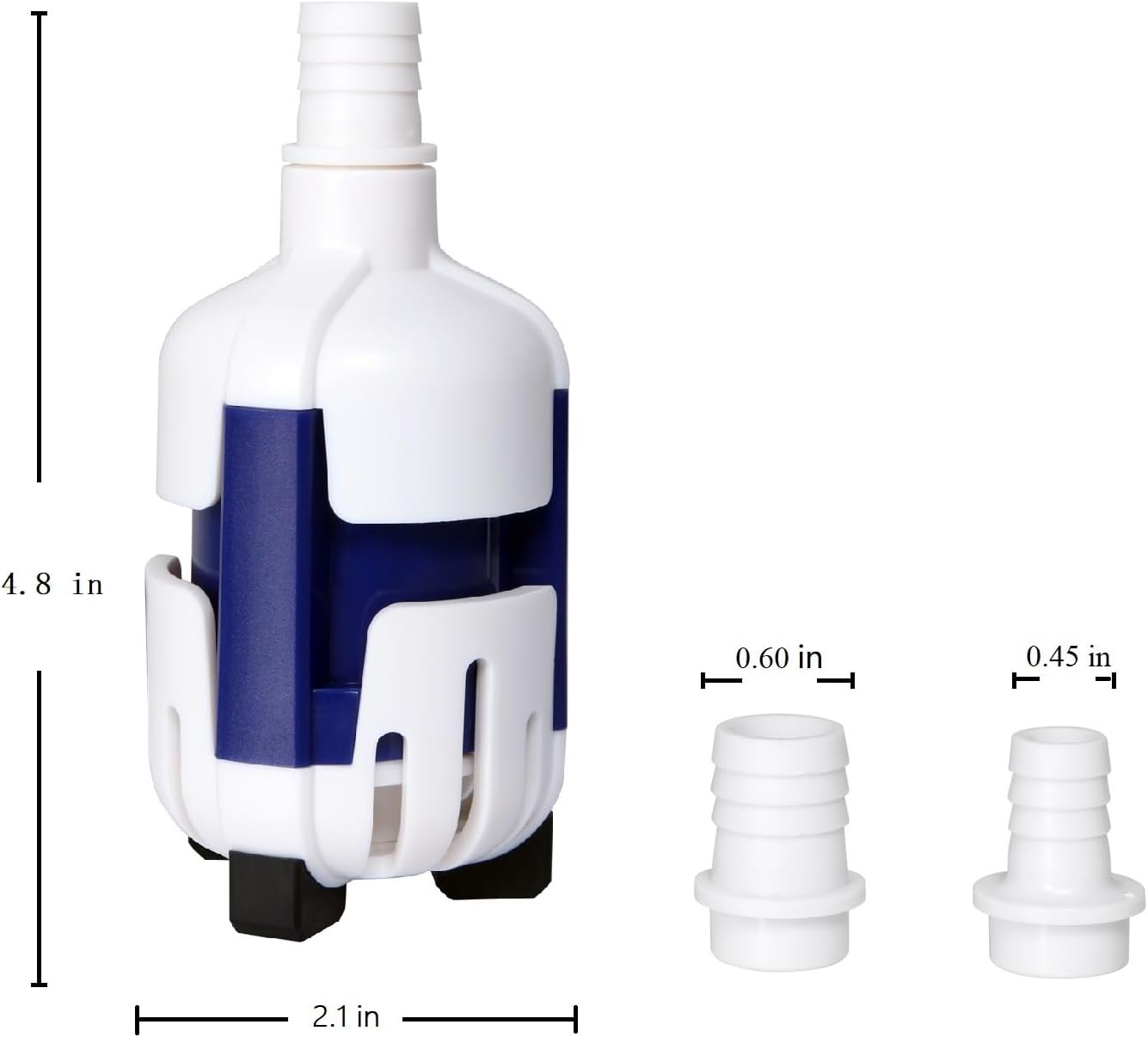
The smarter first layer for most reef keepers is a 12V DC pump — a small circulation pump that runs on 12-volt direct current, the same voltage as a car battery or a standard USB battery bank (via a 12V output).
One buyer documented on a major retail platform that they purchased the Hygger 185GPH 12V nano pump specifically for hurricane backup power, noting it runs off a portable battery bank and fits neatly in a Fluval Evo 13.5-gallon sump. That’s exactly the use case these pumps were built for: not primary circulation, but emergency oxygenation and flow when nothing else is running. Per Reef Builders’ coverage of DC pump strategies, a modest flow rate — even 100–200 GPH in a 50-gallon reef — is enough to prevent the oxygen crash that kills corals in the first two to four hours.
Owners of the Orlushy DC variable-speed pump consistently report two qualities that matter specifically in outage scenarios: near-silent operation and the ability to dial flow down to a trickle. When you’re running on a portable battery bank that holds a finite charge, lower flow = longer runtime. Quiet also matters if you’re running a generator in a garage or utility space and want to actually sleep. Across aggregated reviews, the pattern is that variable-speed DC pumps outlast fixed-speed models on battery power by a significant margin simply because operators turn them down.
The math that guides your battery bank selection:
A 12V pump drawing 10W at full speed pulls roughly 0.83 amps per hour. A 20,000mAh (72Wh) USB battery bank, running the pump at half speed (~5W), could theoretically sustain flow for 12–14 hours before needing a recharge. Real-world runtime is shorter due to conversion losses, but the point holds: a mid-sized battery bank plus a 12V DC pump is a meaningful 8–12 hour bridge.
ATO Sensors: The Hidden Outage Risk Nobody Talks About
Your automatic top-off unit is a convenience device during normal operation. During an outage, it becomes a liability — specifically when power returns.
Several ATO owners report sensor reliability issues on extended review timelines, with units failing within three to four months of purchase. Under normal conditions that’s an inconvenience. During a multi-day hurricane outage, an ATO sensor that was dry during the power failure may re-read incorrectly when flow resumes — triggering a freshwater flood into your sump before your salinity has stabilized, or worse, failing to read at all and letting salinity spike.
The guidance from Reef2Reef’s hurricane prep threads is consistent: unplug your ATO completely when an outage begins. Top off manually with a calibrated refractometer (a tool that measures salinity by bending light through a water sample) before and after the outage. When power returns, let the tank run normally for 30 minutes before reconnecting the ATO sensor — giving your water level time to normalize with all pumps running.
Protein Skimmer Overflow: The Invisible Return-Power Hazard
When your skimmer shuts off during an outage, water inside the skimmer body settles and the organic load that was being processed sits stagnant. When power returns and the skimmer re-pressurizes, it frequently generates a massive foam surge — overflowing the collection cup and potentially draining several cups of skimmate onto your equipment rack.
The fix is simple and free: before power returns (or the moment it does), lower your skimmer’s water level adjustment to its minimum setting and remove or empty the collection cup. Let the skimmer run at minimum for 20–30 minutes before gradually returning it to operating depth. Reef Builders has documented this behavior across multiple skimmer brands as a predictable post-outage effect, not a malfunction.
Budget Reef Lights and the Generator Heat Problem
If you’re running a generator and have a budget LED fixture — the kind with an integrated fan for cooling — be aware that fans under intermittent generator load can introduce voltage irregularities that cause the fan to run erratically or not at all. Budget reef light owners in extended reviews frequently flag fan noise and heat as practical concerns even under normal conditions. On generator power, which often runs at slightly lower or fluctuating voltage, the heat issue compounds.
During an outage, lighting is your lowest priority — corals can survive 24–48 hours of darkness more easily than two hours without oxygen. If your generator has limited capacity, run the return pump and backup circulation pump first. Run the heater second. Run lights last, or not at all for short outages.
Frequently Asked Questions
How long can a reef tank survive without a return pump running?
Based on Advanced Aquarist’s oxygen depletion research, a densely stocked SPS reef can reach dangerous oxygen levels within one to three hours at room temperature. A lightly stocked FOWLR system may have three to six hours. Surface agitation — even manual — meaningfully extends that window. A 12V backup pump running at low flow can push survivability past 12 hours for most systems.
Can a 12V DC pump run off a USB battery bank?
Yes, with the right cable. Most USB battery banks output 5V via USB-A, but many also have a 12V barrel-jack output or can power a 12V pump via a USB-C Power Delivery cable and a compatible adapter. Verify your battery bank’s 12V output rating before the outage, not during it. Reef Builders’ DC pump coverage recommends testing the full circuit at least once before hurricane season.
Should I unplug my ATO during a power outage?
Yes. Unplug both the pump and the sensor. Given documented sensor reliability issues in the ATO category — including units failing within four months under normal conditions — the risk of a malfunction on return power isn’t worth it. Top off manually using a refractometer.
How do I keep my protein skimmer from overflowing when power is restored?
Set the water level adjustment to its minimum before power returns. Empty the collection cup. Let the skimmer run at minimum depth for 20–30 minutes, then slowly return it to operating position. This is consistent with standard guidance from Reef Builders and matches what experienced operators on Reef2Reef recommend after storms.
What is the minimum flow rate to keep corals alive short-term?
There’s no universal number, but the principle from Advanced Aquarist’s research is that any meaningful surface agitation and water movement is better than none. For a 50-gallon reef, even 100–150 GPH of gentle circulation — enough to move the water column and break the surface — can prevent the oxygen stratification that kills corals fastest. The goal isn’t coral health, it’s coral survival until full flow is restored.
The Decision Rule: If X, Then Y
If you have a nano or mid-size reef (under 75 gallons): your single best investment is a 12V DC pump plus a 20,000mAh+ battery bank, tested together before you need them. Add a UPS for your return pump if budget allows.
If you have a large mixed reef or SPS system (75+ gallons): a generator plus a UPS bridge (to cover the 30–60 seconds before the generator stabilizes) is the correct tier. DC pumps become supplemental redundancy, not your primary plan.
If you run a commercial installation — hotel lobby reef, medical office display — redundant return pumps on separate circuits plus an automated generator transfer switch should be written into the maintenance contract. A single crop failure in a $10,000 coral display is far more expensive than the hardware to prevent it.
The outage you plan for is never the one that actually happens. Build the system that survives the one you didn’t expect.