Your aquarium light is not supposed to be a disposable item — but for a lot of hobbyists, it behaves like one. An LED aquarium light (LED stands for light-emitting diode, a semiconductor that converts electricity directly into light) sits in one of the most punishing environments any consumer electronics device ever encounters: constant humidity, salt spray if you’re running a reef, splash events during feeding and water changes, and the thermal stress of cycling on and off day after day. When a light dies early, it’s almost never random bad luck. There’s a physics reason, and once you understand it, you can buy smarter and extend the life of what you already own. This guide walks through the three main failure modes — heat, moisture, and power — with enough detail to inform a real purchasing decision, whether you’re replacing a dead fixture or speccing out a new build.
| EDITOR'S PICKhygger Advanced Remote Control… | Mid-tierNICREW ClassicLED Plus LED Aqua… | Budget pickhygger 16W Full Spectrum Aquari… | |
|---|---|---|---|
| Power | 58W | 21W | 16W |
| Control | Remote | Timer | External controller |
| Light modes | ✓ | Daylight & moonlight | Full spectrum |
| Mounting | — | — | Extendable brackets |
| Housing material | — | — | Aluminum alloy |
| Price | $99.99 | $48.99 | $39.99 |
| See on Amazon → | See on Amazon → | See on Amazon → |
Heat Is the Primary Killer, and Housing Material Is the Lever
Every LED chip generates heat as a byproduct of producing light. That heat has to go somewhere, and where it goes determines how long the electronics survive. The component most sensitive to sustained heat isn’t the LED chip itself — it’s the driver, the small circuit board that regulates the electrical current feeding the LEDs. Driver manufacturers publish operating temperature ranges, and sustained exposure above those ranges degrades capacitors and solder joints over months, not years.
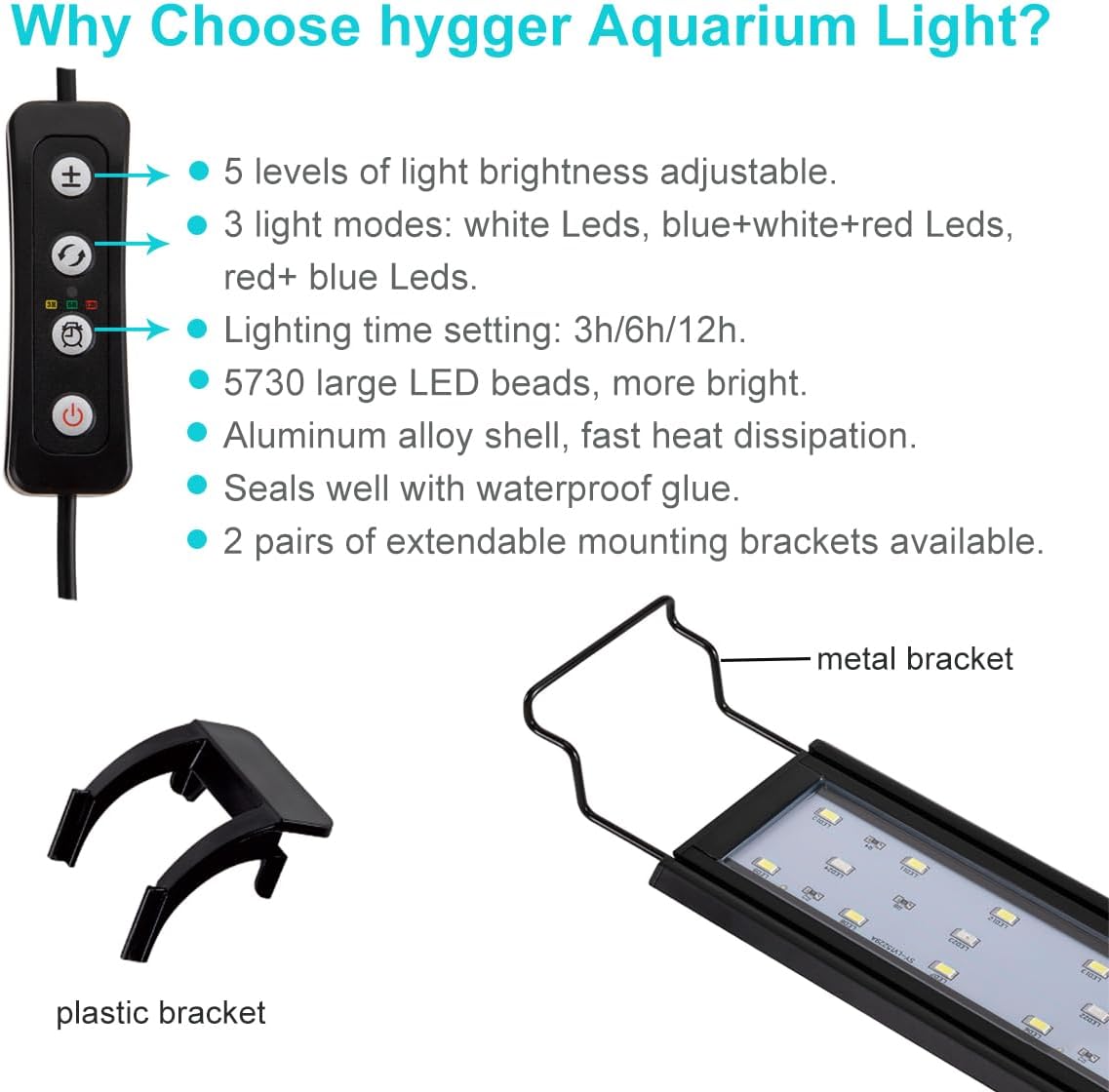
This is why housing material is not a cosmetic choice. Reviewers of the Hygger 16W consistently highlight the aluminum alloy shell as the light’s most meaningful engineering decision. The argument is straightforward and technically sound: aluminum conducts heat roughly four to five times more efficiently than typical ABS plastic (a figure consistent with published thermal conductivity tables from materials science references). A plastic shell traps heat around the driver; an aluminum shell pulls that heat away and radiates it into the surrounding air. Faster heat dissipation means the driver runs cooler at the same wattage output, and a cooler driver lasts longer — potentially years longer. This isn’t marketing language. It’s basic thermodynamics, and it’s the strongest argument for paying a modest premium for metal-housed fixtures in a category where price differences are often small.
Advanced Aquarist’s overview of LED technology for reef aquaria makes a similar point about thermal management, noting that the “L70 rating” — the industry standard for LED lifespan, defined as the point at which light output drops to 70% of its original value — assumes adequate heat dissipation. Push junction temperatures (the temperature at the LED chip itself) above spec consistently, and L70 arrives years earlier than the manufacturer’s quoted lifespan.
The practical takeaway: If two fixtures are similar in output and price, the one with an aluminum or metal housing will almost always outlast the plastic-housed alternative in continuous aquarium use.
Signs Heat Is Shortening Your Light’s Life Right Now
You don’t need a thermal camera to check. Practical Fishkeeping’s guide to aquarium lighting recommends a simple hand-check: after an hour of operation, the housing should feel warm but not hot enough to be uncomfortable to hold. If the fixture is genuinely painful to touch, heat is not dissipating properly. Additional warning signs include:
- LEDs visibly dimming over months without a deliberate setting change
- The driver area (usually the thickest part of the fixture body) noticeably hotter than the lens end
- Flickering at full brightness, which can indicate a driver struggling under thermal stress
- A fixture mounted inside a canopy with no airflow — a common installation mistake
Improving airflow around the fixture is the lowest-cost intervention available. Even a small USB fan exhausting hot air from an enclosed canopy can drop ambient temperature around the driver meaningfully.
Waterproofing: The Awkward Truth About “Aquarium” Lights
Here is the tension that a candid NICREW ClassicLED Plus owner put into words more clearly than most spec sheets do: an aquarium light, by definition, lives directly above water, yet many fixtures in this category carry no formal water resistance rating at all. That owner lost one of three units to water damage and acknowledged the instructions warned against contact — but the underlying frustration is legitimate. A product marketed for aquariums that cannot survive a splash event is a genuine design gap.
The industry standard for water resistance is the IP rating system (IP stands for Ingress Protection, defined by IEC standard 60529). The two digits after “IP” describe resistance to solid particles and liquids respectively. For aquarium context:
| IP Rating | What It Means | Practical Aquarium Use |
|---|---|---|
| IPX4 | Splash-resistant from any direction | Adequate for open-top freshwater |
| IPX5 | Low-pressure water jets | Useful buffer for reef splash |
| IPX6 | High-pressure water jets | Strong protection, rare at budget tier |
| IP67 / IP68 | Dust-tight + submersible | Overkill for most fixtures; common in pond lights |
Most budget LED bars — including many popular freshwater strips — carry no IP rating at all, or an unpublished internal rating the manufacturer declines to specify. TFH Magazine’s coverage of aquarium lighting technology notes that the absence of a published IP rating should be treated as a signal, not an oversight. Manufacturers who achieve a meaningful rating tend to advertise it prominently.
For open-top reef tanks, where salt creep and evaporation spray are daily realities, an explicitly rated fixture or one mounted with meaningful clearance above the waterline is worth the extra scrutiny. For covered freshwater setups with a glass lid, the risk profile is lower — but splash during feeding and water changes is never zero.
Power Supply Failures and the Programming Problem
Heat and moisture get most of the attention, but power-related failures are the third failure mode owners encounter — and they arrive in two distinct forms.
The first is outright power supply failure. Owners of the Hygger 48-55” fixture have documented external power supply (the separate brick-style adapter that converts wall current to the voltage the fixture needs) failure just after the one-year mark. This is a meaningful data point for anyone buying a fixture that uses an external power supply rather than a built-in driver: the supply itself becomes a maintenance item. External supplies are often sourced from third-party manufacturers and may not be engineered to the same standard as the fixture. The good news is that a compatible replacement supply is usually inexpensive and straightforward to source by voltage and amperage specification — but owners who don’t know to check the supply as a suspect when their light dies sometimes replace the entire fixture unnecessarily.
The second form is programming loss on power interruption. Reviewers of the Hygger 48-55” have flagged a specific frustration: when power is interrupted — a tripped breaker, a power outage, an unplugged cord — the fixture’s programmed schedule resets to factory defaults rather than retaining the user’s settings. This is a firmware and hardware design choice related to whether the controller uses non-volatile memory (memory that retains data without power) or relies on a capacitor-buffered circuit that doesn’t survive extended outages. Some fixtures write settings to non-volatile storage every time a change is made; others hold settings in temporary memory. The spec sheet rarely tells you which approach a given fixture uses — you have to look at owner reviews.
Reef Builders’ coverage of LED controller architecture has noted that this distinction matters most for hobbyists running complex sunrise/sunset ramps or species-specific photoperiod schedules, where rebuilding the program after every outage becomes a genuine maintenance burden.
A UPS (uninterruptible power supply) — a battery backup device — is the practical solution for both problems. A UPS buffers your lighting circuit against short outages, preventing the voltage dropout that triggers a programming reset. It won’t protect against a multi-hour power failure, but it handles the brief interruptions (sub-60-second utility blips) that are statistically the most common cause of programming loss.
The Two-Year Mark: What Good Longevity Actually Looks Like
Amid the failure reports, there’s a useful positive benchmark. Long-run owners of the Hygger 978 have published two-year durability updates that are notably positive — consistent output, no driver failures, no programming instability. Two years of daily operation in an aquarium environment is a meaningful threshold. It represents roughly 700 photoperiod cycles, sustained humidity exposure, and thermal cycling through hundreds of on/off sequences.
What distinguishes fixtures that reach this mark? Across aggregated owner reviews and the technical framing from Advanced Aquarist and Reef Builders’ coverage of LED longevity:
By the numbers — the factors that separate early failures from two-year survivors:
- Thermal design: Metal housing vs. plastic correlates strongly with driver longevity
- Driver quality: Constant-current drivers (which regulate output regardless of voltage fluctuation) outperform constant-voltage designs in long-term stability
- IP rating presence: Fixtures with published ratings fail to water intrusion at lower rates than unrated competitors
- Memory architecture: Non-volatile setting storage prevents the programming-loss frustration that compounds owner dissatisfaction
No single fixture hits every mark at the entry-level price tier. The decision frame is about which tradeoff matters most for your specific tank: a planted freshwater setup in a stable indoor environment can tolerate a lower IP rating; a reef nano with salt spray needs waterproofing prioritized; a hobbyist running a complex photoperiod schedule should weight memory architecture heavily.
Frequently Asked Questions
Do budget aquarium LED lights have any water resistance rating, and does it matter? Many do not publish an IP rating. For covered freshwater tanks, this is a manageable risk. For open-top reef setups or tanks prone to splash, prioritize fixtures with a stated IP rating (IPX4 minimum) and mount with adequate clearance above the waterline.
Why did my aquarium light stop working after less than a year? The most common culprits are driver failure from heat (especially in plastic-housed fixtures mounted in enclosed canopies) and external power supply failure. Before replacing the whole fixture, test with a known-good compatible power supply at the correct voltage and amperage. If the fixture powers up normally, the supply was the issue.
Is aluminum housing actually better than plastic for aquarium lights, or is it just marketing? It’s real physics. Aluminum conducts heat significantly more efficiently than ABS plastic, which keeps the driver cooler during operation. A cooler driver degrades more slowly. Reviewers of the Hygger 16W make this case directly from owner experience, and it’s consistent with published thermal conductivity data. It is not marketing.
Will my programmed light schedule be lost if the power goes out? It depends on the fixture’s memory design. Some lights write settings to non-volatile memory and retain them through outages; others lose settings on any power interruption. Reviewers of the Hygger 48-55” specifically flag this behavior. Check owner reviews for your specific fixture before assuming retention.
Can I use a battery backup to protect my light programming and prevent power-loss resets? Yes, and it’s the most practical solution. A UPS on your lighting circuit will buffer short outages — which are responsible for most programming resets — without any modification to the fixture itself. Size the UPS to cover at least 15–30 minutes of your fixture’s wattage draw.
How can I tell if heat is shortening the life of my aquarium light? After an hour of normal operation, the housing should be warm but not painful to touch. Visible dimming over months, flickering at high output, or a driver section noticeably hotter than the rest of the body are all indicators. Improving airflow around an enclosed canopy is the lowest-cost intervention and can meaningfully extend driver life.